
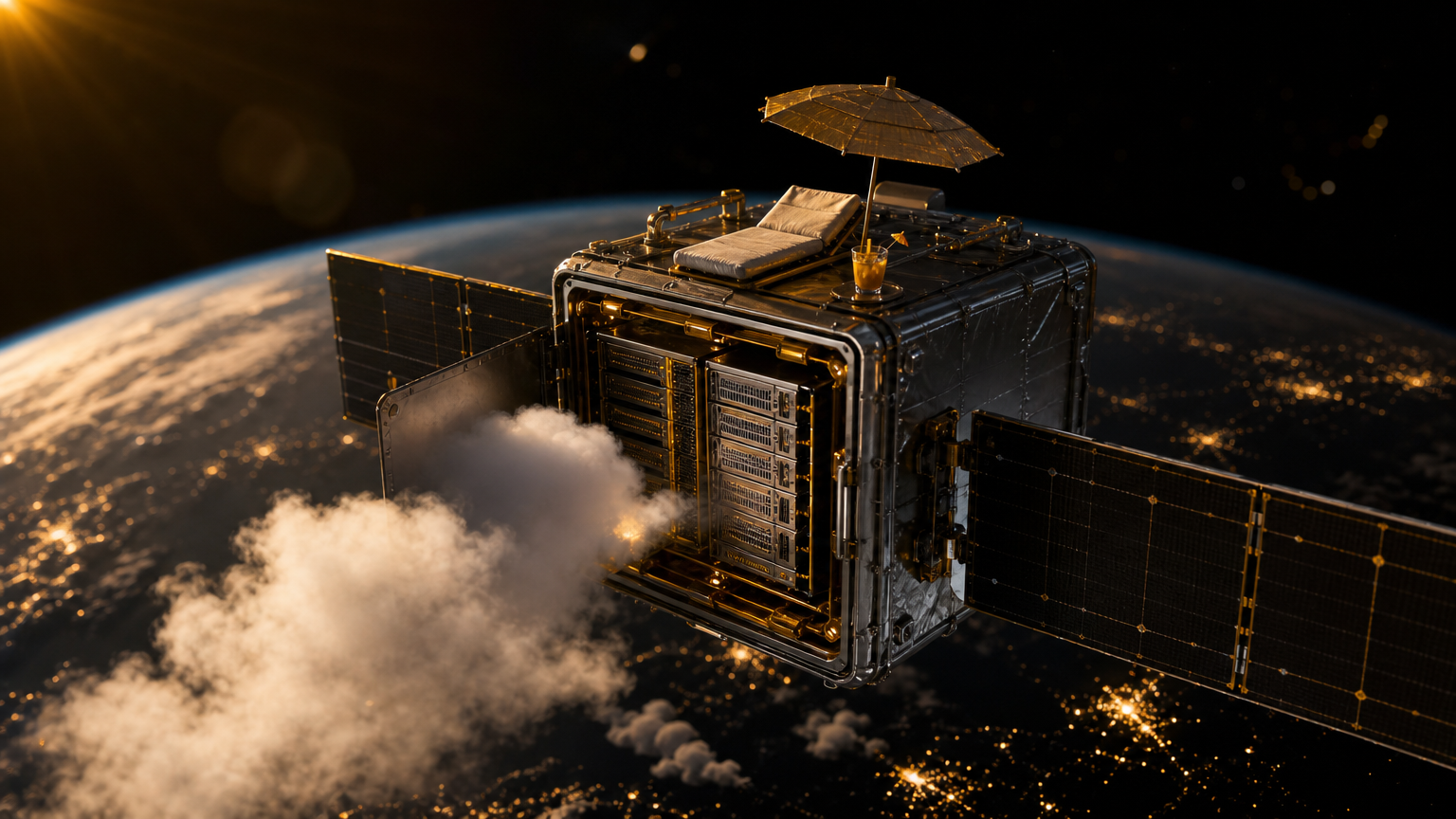
The milestone: a TPU answered from orbit
Google says Project Suncatcher has reached its “Hello World” moment: the company received what it describes as the first AI response from a data-center-class Tensor Processing Unit operating in orbit . The prototype satellite, built with Planet and launched on SpaceX’s Transporter-18 rideshare mission on October 1, had spent the intervening weeks in commissioning, including powering up host systems and TPU trays and running early machine-learning tests .
The first public output was deliberately modest. During a ground-station pass, Google uplinked a prompt to an onboard Gemma 4 open model and asked it to write a haiku about being in space; as the satellite passed Svalbard, Norway, the downlinked answer confirmed that the model had run and returned a complete response . TechCrunch reported that the spacecraft is online and communicating with the ground, carrying four Google TPUs and generating up to 1 kilowatt of electrical power, though only one TPU can be operated at a time for about 20 minutes because of the payload’s power demands .
This is not a commercial space data center. It is a technology pathfinder. But it changes the status of Suncatcher from a concept about orbital AI infrastructure to an in-orbit hardware test in which Google has actually run inference beyond Earth and retrieved the result.
Why a poem matters less than the payload status
The haiku made the milestone legible, but the more important part is what came next. Google says it followed the first output with space-themed limericks and telemetry prompts reporting the technical status of payload systems . That second category matters: in a serious orbital compute architecture, a model that can summarize or report payload health is more than a publicity flourish.
The next phase is where the engineering test becomes harder. Google says it will evaluate how its TPUs perform under thermal stress and radiation exposure in orbit, and that proving reliable execution in space is the gateway to its next milestone: twin interconnected satellites in 2027 . Stocktwits, summarizing the same announcement, framed the current satellite as a test bed for whether TPU hardware can continue running machine-learning workloads while exposed to the harsh conditions that future orbital infrastructure would have to endure .
That distinction is crucial. Running one inference prompt proves that the chip, host electronics, software stack, power path and communications chain can work together at least once. It does not yet prove that they can work reliably for months, across thermal cycles, radiation events, orbital day-night transitions and limited ground-station windows.
The hard problems: heat, radiation, latency and economics
Suncatcher is attractive because space offers a seductive answer to two terrestrial data-center constraints: energy and land. Google’s longer-term idea is that satellites can use abundant solar power and avoid some of the siting, grid and cooling pressures that now shape data-center expansion on Earth . Unite.AI’s recap of Google’s technical framing notes that future Suncatcher designs would use clusters of satellites, each potentially carrying many TPU chips, communicating through high-bandwidth laser links over short inter-satellite distances .
But the same environment that provides solar access also creates the project’s central risks. Radiation can flip bits, corrupt memory or degrade electronics in ways that are hard to reproduce perfectly on the ground. TechCrunch reported that Google’s upcoming test campaign will compare real orbital radiation effects against the company’s particle-accelerator testing, with inference expected to be less vulnerable than training but still requiring in-space validation .
Thermal management is equally unforgiving. On Earth, data centers rely on airflow, liquid cooling, chillers, heat exchangers and a vast service ecosystem. In orbit, there is no air to carry heat away; waste heat must be conducted and radiated. That makes every watt and every duty cycle matter. TechCrunch’s report that the prototype can run only one TPU at a time for around 20 minutes underscores how far this is from an always-on orbital cloud region .
Then there is latency and network design. A useful orbital AI cluster would have to move data between satellites and Earth with predictable timing, high bandwidth and resilience. Google’s 2027 twin-satellite milestone is therefore not a decorative follow-up; it is a test of whether Suncatcher can begin to behave like a distributed compute system rather than a single experimental box in the sky .
Finally, launch economics remain the biggest business variable. PPC Land noted that Google’s own research ties the economics of orbital compute to launch prices that may only become favorable around the mid-2030s, while the current terrestrial AI buildout is still absorbing enormous capital expenditure on Earth . In other words, Suncatcher is not a replacement for today’s data centers; it is a long-dated option on a different infrastructure stack.
Why hyperscale infrastructure is looking upward
The timing is not accidental. AI workloads have made compute capacity, electrical power and cooling into strategic constraints for every hyperscaler. Suncatcher fits into a broader search for infrastructure that can expand without being blocked by grid interconnection queues, local opposition, water constraints or real-estate bottlenecks.
The orbital version of that answer is bold but not magic. Launching hardware is expensive. Servicing failed hardware is difficult or impossible. Hardware refresh cycles are slower than in terrestrial facilities. Space debris and collision avoidance add operational risk. Regulatory and spectrum issues would intensify if constellations grew from prototypes to industrial infrastructure.
Still, the demonstration matters because the center of gravity for cloud architecture may be widening. Data centers have already moved from single buildings to campus-scale regional grids, tied to power-purchase agreements and dedicated energy projects. Suncatcher asks whether the next layer of hyperscale architecture could include orbital assets as part of the compute fabric.
What to watch next
The near-term checklist is clear. First, Google needs to show that the TPU can keep producing correct results under real orbital radiation and thermal conditions, not just during a carefully timed first prompt . Second, it needs to disclose more performance data: chip generation, workload size, error rates, duty cycle, thermal limits and communication constraints. PPC Land emphasized that Google’s October 30 announcement did not provide detailed performance data, mission cost or the exact date of the first response beyond “this week” .
Third, the 2027 twin-satellite test must show whether optical inter-satellite links can support the kind of low-latency, high-throughput communication needed for distributed AI workloads . A single satellite can prove survival. A pair begins to test architecture.
For now, Project Suncatcher has done something simple and symbolically powerful: it put a data-center-class TPU in orbit, ran an AI prompt, and brought the response home. The cloud has, at last, taken its branding literally.
Comments
Be the first to comment.