
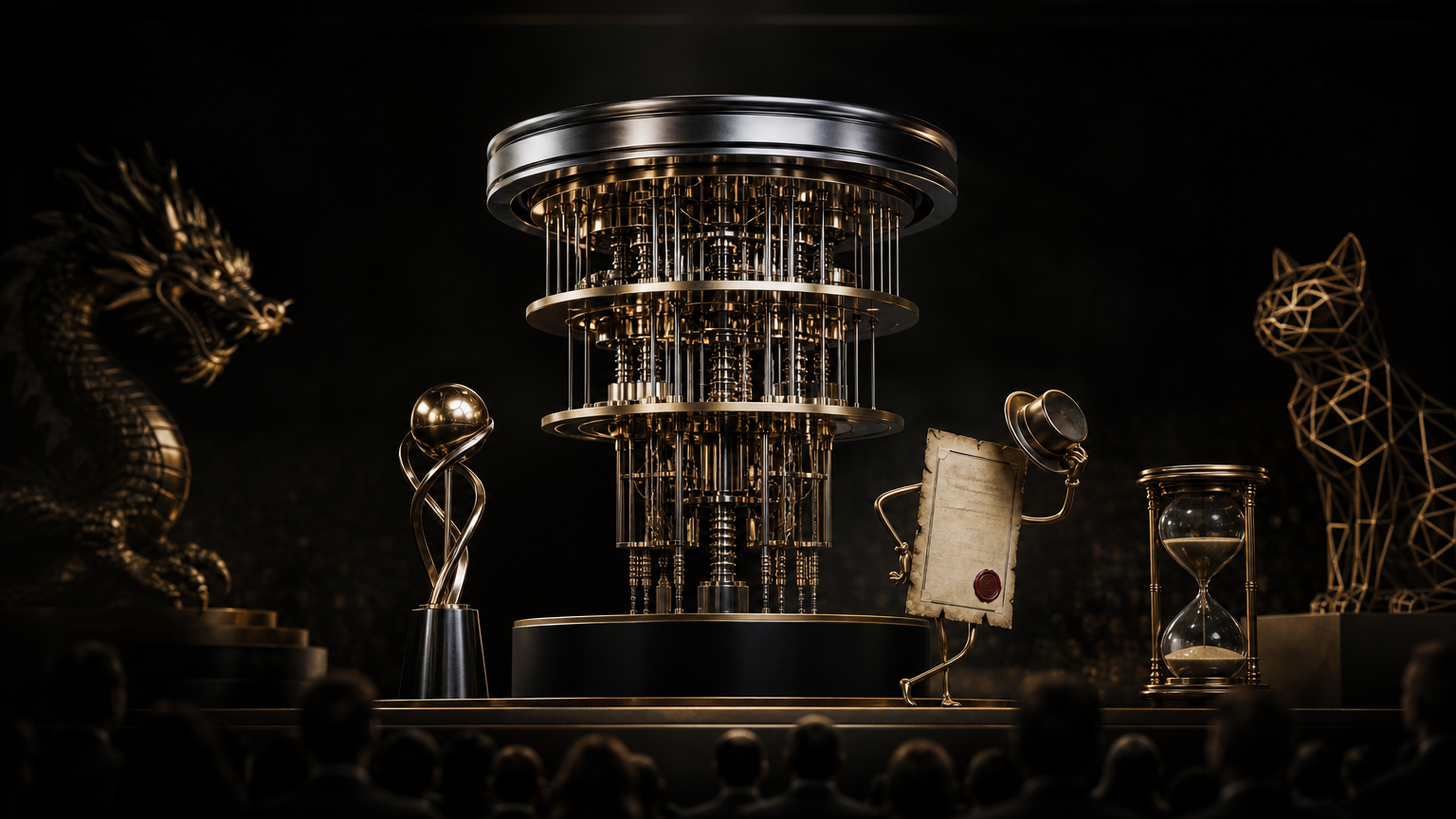
Two signals, one sharper quantum message
The working headline is simple: Jiuzhang 4.0 raises quantum stakes. On November 2, China’s Jiuzhang 4.0 photonic quantum computer was reported as receiving a leading science and technology award at the 2026 World Innovation Conference, a public recognition of a system already associated with extreme-scale optical quantum sampling . In the same 72-hour news window, Alice & Bob’s announcement on quantum resources for Shor’s algorithm put a hard-edged cybersecurity frame around the broader excitement: quantum progress is not only about scientific prestige, but also about the future viability of today’s public-key encryption .
The pairing matters because the two developments sit on opposite sides of the same quantum narrative. Jiuzhang 4.0 represents visible national progress in photonic quantum computing, where photons are manipulated and detected to perform specialized calculations far beyond direct classical simulation. Alice & Bob’s work, by contrast, is not a demonstration of a machine cracking the internet; it is a resource estimate for a future fault-tolerant architecture. But the contrast is precisely the point. One story says quantum machines are advancing fast enough to win public awards; the other says the number of qubits and time projected for cryptanalytic workloads keeps falling .
What Jiuzhang 4.0’s recognition signals
Jiuzhang 4.0’s award at the 2026 WIC gives symbolic weight to a photonic route that China has promoted for years as part of its quantum technology portfolio . The broader WIC setting also matters: the 2026 “Light of the Internet” Expo opened in Wuzhen with more than 1,000 technologies and products from 671 companies and institutions across 54 countries and regions, placing quantum advances within a much larger display of digital infrastructure, AI, 6G, satellite internet and robotics . That context makes Jiuzhang 4.0 less an isolated laboratory artifact and more a national showcase object in a crowded strategic-technology arena.
Photonic quantum computing is not the same engineering path as superconducting quantum processors, trapped ions or neutral atoms. Its promise lies in using light, with potential advantages in networking, room-temperature components and scaling certain optical circuits. Jiuzhang’s public reputation rests on Gaussian boson sampling, a benchmark task designed to stress classical simulation rather than run everyday business software. That distinction is important: a quantum advantage benchmark is not a general-purpose enterprise computer. Still, benchmarks shape funding, talent and geopolitical confidence. They show that a hardware platform can occupy computational territory where classical machines struggle.
The WIC award also turns a technical milestone into a communications milestone. Public recognition creates a feedback loop: governments cite achievements, companies align roadmaps, universities recruit around them and adversaries reassess timelines. For chief information security officers, the conclusion is not that Jiuzhang 4.0 can break RSA tomorrow. The practical conclusion is that quantum progress is now too visible, too competitive and too politically salient to treat as a distant research curiosity.
Alice & Bob moves the cryptographic conversation
Alice & Bob’s announcement is more directly connected to enterprise risk. The company said its cat-qubit architecture sets a record low for total quantum resources, measured as qubits multiplied by runtime, needed to run Shor’s algorithm against today’s encryption . The reported figures are striking: 22,593 physical qubits for RSA-2048 in 3.14 days, and 29,588 physical qubits for an ECDLP-256 problem in 61.8 minutes on the assumed fault-tolerant superconducting cat-qubit hardware . AiThority’s November 2 report also states that the architecture would need 40 times fewer physical qubits than a 2025 Google Quantum AI estimate associated with Craig Gidney for breaking RSA-2048 .
Those numbers should be read carefully. Alice & Bob is not saying that such a cryptanalytic machine exists today. The announcement is a compilation and scheduling estimate for a specific architecture, with assumptions about error behavior, cat qubits, LDPC-cat codes and a redesigned adder . The company’s own framing emphasizes that substantial engineering challenges remain, while also arguing that hardware progress and falling resource estimates could converge in the early 2030s . In other words, the risk is not an immediate apocalypse; it is a planning deadline moving from “someday” toward “within the lifecycle of systems being deployed now.”
The most important part may be the direction of travel. Quantum cryptanalysis has long been understood in theory: Shor’s algorithm threatens RSA and elliptic-curve cryptography once a sufficiently large, error-corrected quantum computer exists. What changes enterprise behavior is not the theorem; it is the shrinking resource estimate. Every reduction in required qubits, runtime or error-correction overhead narrows the gap between “mathematical concern” and “operational threat.”
The enterprise lesson: migrate before the machine arrives
The immediate security message is not to panic, but to inventory. Organizations should assume that cryptographic migration will be slow, uneven and full of hidden dependencies. Public-key cryptography is embedded in TLS, VPNs, code signing, identity systems, hardware security modules, payment infrastructure, messaging systems, software update channels and long-lived archives. Replacing it is not a patch Tuesday exercise.
Alice & Bob’s report explicitly points to the post-quantum transition and notes that U.S. and U.K. guidance calls for organizations to complete migration to post-quantum cryptography by 2035 . That date can sound comfortably far away until a company maps certificate lifetimes, product support periods, operational technology assets, medical devices, vehicles, satellites or archived secrets with decade-long confidentiality requirements. The “harvest now, decrypt later” problem makes the timeline even tighter: adversaries can store encrypted traffic today and wait for future quantum capability to decrypt it.
The prudent response has three layers. First, build a cryptographic bill of materials: know where RSA, Diffie-Hellman and elliptic-curve systems are used. Second, deploy crypto-agility so algorithms can be swapped without redesigning entire platforms. Third, prioritize systems where confidentiality must survive into the 2030s and beyond. That is where quantum risk is already present, even if cryptographically relevant quantum computers are not.
A tale of two quantum clocks
The Jiuzhang 4.0 award and Alice & Bob estimate operate on different clocks. Jiuzhang is on the clock of scientific recognition, national competition and benchmark performance . Alice & Bob is on the clock of error correction, architecture and cryptographic migration . Enterprises are on a third clock: procurement, compliance, asset management and operational resilience.
The mistake would be to collapse those clocks into one simplistic claim. Jiuzhang 4.0’s photonic achievement does not mean the internet is broken. Alice & Bob’s RSA estimate does not mean attackers have 23,000 usable cat qubits. But together they show that quantum computing is advancing on both the prestige front and the threat-model front. That is why the story feels consequential: the trophy case and the risk register are beginning to reflect the same technology curve.
In that sense, Schrödinger’s certificate is both valid and expired. Today’s RSA and elliptic-curve certificates still work in production. They authenticate sessions, protect transactions and support the web’s trust fabric. Yet for data that must remain secret for a decade, and for infrastructure that will still be running in the 2030s, their expiration has already begun as a planning fact. Jiuzhang 4.0 raises the quantum stakes because it reminds the world that quantum milestones are no longer rare; Alice & Bob raises them because it suggests the cost of waiting may be falling faster than institutional migration plans can move .
Comments
Be the first to comment.