
The day’s infrastructure signal
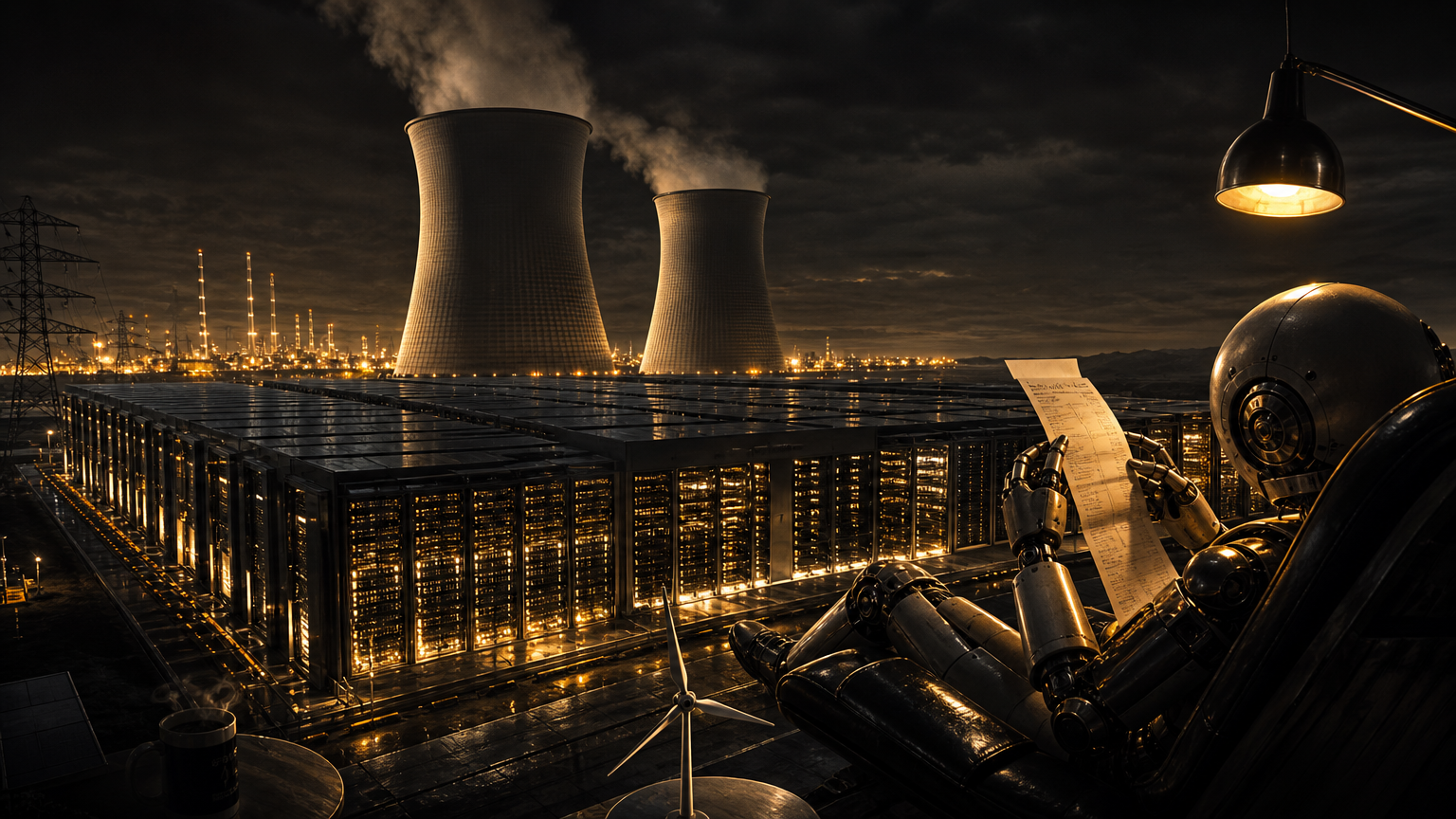
Drax and Brookfield have turned one of Britain’s best-known power sites into the centre of a much larger argument about AI: who controls the compute, who supplies the electricity, and who gets priority when the grid is already under strain. The companies, together with Brookfield-backed Radiant and Qatar-linked Qai, announced a strategic partnership to develop, deliver and operate AI data-centre capacity at Drax Power Station in North Yorkshire, with the long-term target exceeding 1 GW .
The headline figure is large even by the overheated standards of AI infrastructure. Brookfield estimates the full development could exceed £20 billion in total potential investment, including semiconductor chips, with an initial £2.5 billion contemplated for the first phase . Reuters framed the deal at roughly $26.8 billion and reported that Drax shares jumped 9% in early Tuesday trading after the announcement . In practical terms, the project is not a single building suddenly arriving on the Yorkshire landscape; it is a phased attempt to pair land, grid access, energy infrastructure, long-duration capital and AI customers.
That distinction matters. The first phase targets up to 100 MW of compute capacity and commercial operation from the first quarter of 2028, while a second phase aims to add up to 500 MW between 2028 and 2031, followed by further capacity after 2031 . The companies say the first phase remains subject to planning approvals, regulatory and network approvals, an acceptable tenant, commercial agreements and final investment decisions . In other words, this is a major commitment of intent, not a finished campus.
Why Drax is attractive
Drax Power Station is not being pitched as just another brownfield redevelopment. The site brings more than 1,000 acres, around 4 GW of grid access, 2.6 GW of active dispatchable generation and existing cooling systems, as well as proximity to the UK fibre network . Those details explain why an AI data-centre operator would look at a power station rather than a conventional business park. AI compute requires electricity at a density and reliability that quickly turns “location” into an energy question.
The proposed division of labour is also clear. Drax would lead on land, power integration and planning, while Radiant would handle design, customer engagement and commercialisation . Brookfield and Qai would bring capital and operating capacity through the Brookfield-Qai AI infrastructure joint venture . MarketScreener reported a similar structure, noting Jefferies’ view that Drax would provide the land and power connection, Radiant would lead design and commercialisation, and Brookfield-Qai would provide capital and operating capabilities .
This model reflects a wider shift in data-centre development. The scarce asset is no longer just real estate near a fibre route. It is powered land: sites where planning, grid connection, generation, cooling and capital can be assembled quickly enough to meet AI demand. The Tech Capital described the Drax plan as a gigawatt-scale AI data-centre campus at the North Yorkshire power station, while noting that the first 100 MW phase is scheduled for 2028 and still depends on approvals and an anchor tenant .
Sovereign AI meets the electricity bill
The political framing is deliberate. Drax says the project aligns with the UK government’s ambitions for AI sovereignty and reindustrialisation, while the companies welcomed the government’s Data Centre Covenant as a route to faster power access and planning for strategically important projects . Reuters likewise reported that the plan comes as Britain moves to fast-track important data centres with priority grid connections and planning support in order to expand AI capacity and keep sensitive data onshore .
That makes the Drax project more than a corporate expansion plan. It is a test case for a policy bargain: Britain wants domestic compute capacity, investors want predictable pathways through planning and grid queues, and communities want jobs, safeguards and tangible local benefits. Drax says a public consultation for the first phase is expected to begin in November 2026, with a planning application being prepared . The partners also expect to establish a voluntary community benefits fund, separate from planning obligations and existing Drax programmes .
Radiant’s own explanation puts the project squarely in the “long-duration capital” category. Its chief executive, Mahdi Yahya, wrote that infrastructure investors have to ask whether demand will last as long as the asset, whether the project can be delivered at a cost its cash flows can repay, and whether capital is committed for the repayment period . Radiant argues that the Drax project passes those tests because of durable AI demand, sovereign compute needs and the decades-long investment horizon of Brookfield and Qai .
The power question
The most interesting part of the project is also the most sensitive: power. Phase 1 is expected to use power directly from the grid, managed by Drax . Phase 2, by contrast, is described as a potential behind-the-meter model using Drax Power Station’s existing generation capabilities to provide around-the-clock power directly to a data centre under a long-term power purchase agreement, subject to consents .
That structure could make the project more resilient than data-centre schemes waiting in a conventional queue for electricity connections. It could also intensify questions about how Britain allocates scarce capacity. If strategically important data centres receive faster access to power and planning, rival operators and other industrial users may ask whether AI infrastructure is being privileged over other forms of economic activity. The answer will depend on the government’s detailed implementation of the Data Centre Covenant and on whether projects can prove they support energy security, local benefits and environmental standards, the criteria Drax says its project appears aligned with .
The March 2031 date is another marker. Drax disclosed that its existing Contract-for-Difference agreement with the UK government covers about 6 TWh of biomass generation per year from April 2027 to March 2031, roughly 30% of total annual baseload output from its 2.6 GW of active generation . The company also said the CfD includes a mechanism to request that up to 500 MW be used to power a data centre during that period, subject to agreement with the government and the Low Carbon Contracts Company . Reuters reported that JPMorgan analysts saw the announcement as potentially raising expectations that Drax Power Station could continue operating beyond the expiry of its subsidy scheme in March 2031 .
Jobs, customers and execution risk
For Yorkshire, the economic promise is straightforward: preserve hundreds of jobs, create direct and indirect employment, attract inward investment and repurpose an industrial site for the AI economy. Drax chief executive Will Gardiner said the project could help secure the long-term future of the site, protect jobs and strengthen sovereign AI capability if fully built . Brookfield’s head of AI infrastructure, Sikander Rashid, said the partnership could accelerate a critical piece of sovereign AI and create jobs around the broader Yorkshire area .
But the execution risks are just as clear. The first phase needs planning permission, regulatory clearance, network approvals, a suitable tenant, negotiated commercial terms and final investment decisions . The later phases depend on power arrangements, consents and demand remaining strong over several years. Radiant’s blog acknowledges that capital spending arrives before revenue, with a lag that can pressure companies relying on debt-funded expansion . That is exactly why Brookfield’s balance sheet and infrastructure experience matter to the narrative.
The Drax-Brookfield hub is therefore best read as a high-conviction infrastructure option on Britain’s AI future. If it advances, the UK gets a rare combination of domestic compute, large-scale electricity integration and regional industrial renewal. If it stalls, it will expose the same bottlenecks that have slowed other data-centre ambitions: planning, power, customers and community consent. Either way, the announcement makes one point difficult to ignore: in the AI race, the data centre and the power station are becoming the same story.
Comments
Be the first to comment.