
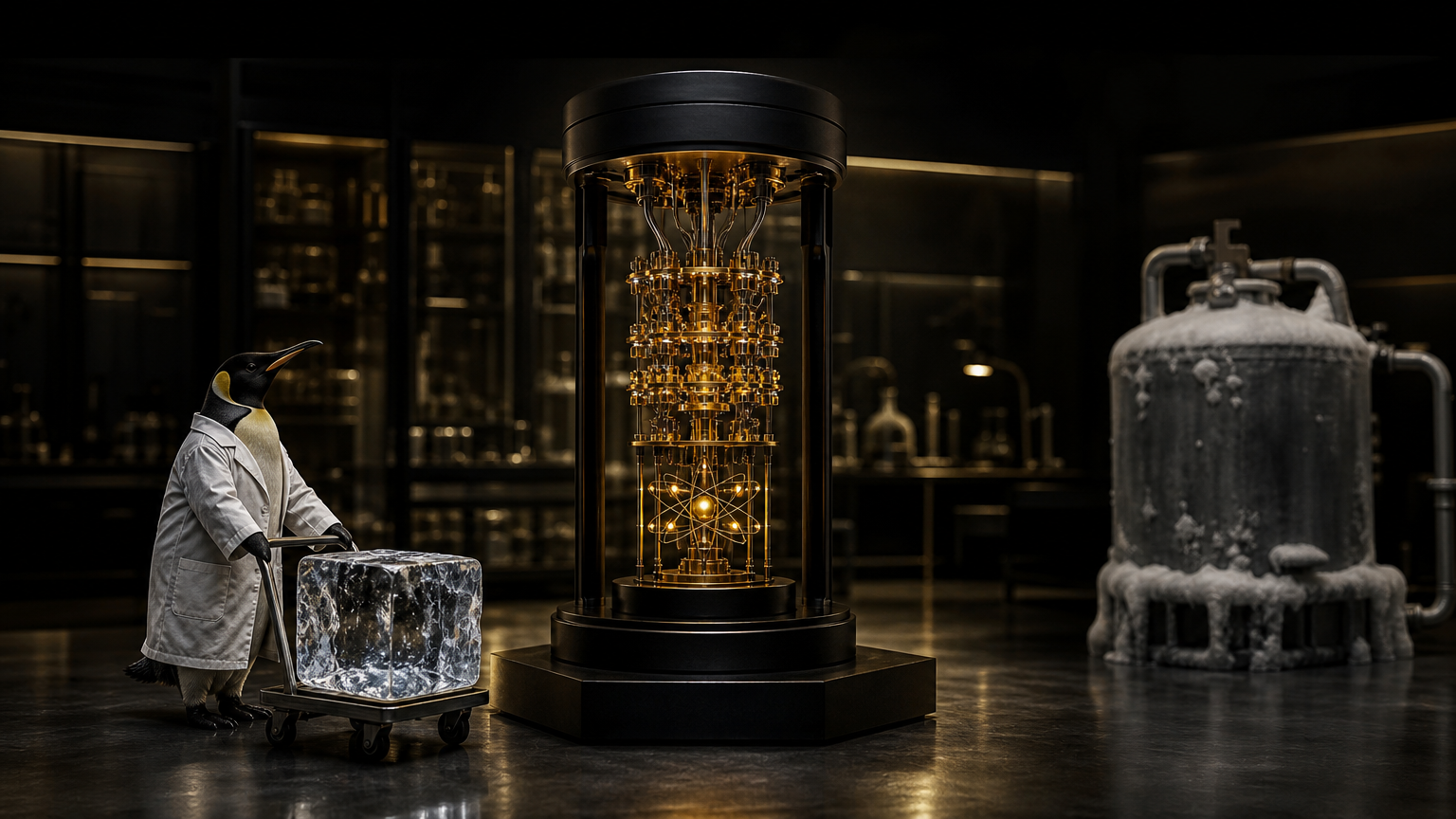
A different kind of quantum machine
Japan’s newly publicized Shunkai system is being presented as the country’s first full-stack neutral-atom quantum computer, a machine whose computing units are individual atoms rather than superconducting circuits or trapped ions . The reported milestone matters because it is not only another laboratory prototype: the claim is that the system has been powered up as an integrated platform, with the layers needed to connect users, software, control systems and the quantum processor .
That “full-stack” label is important. In quantum computing, many demonstrations focus on a processor or a narrow experimental setup. Shunkai is being framed more like a complete computing instrument, in which the quantum processing unit, control layer and user-facing software are meant to work together rather than as isolated research pieces . If that integration holds up in practice, Japan’s machine is less a single physics experiment and more a test of whether neutral atoms can become deployable computing infrastructure.
The system is associated with Professor Kenji Ohmori and Japan’s Institute for Molecular Science, with recent coverage describing the project as part of a broader national effort toward fault-tolerant universal quantum computing by 2050 . The computer’s name, Shunkai, now becomes shorthand for a larger question: can a neutral-atom architecture move from promising physics to reliable, programmable hardware?
Why single atoms change the refrigeration story
The attention-grabbing claim is not simply that Shunkai uses atoms. It is that these single-atom qubits may operate without the very large cooling systems associated with several competing quantum platforms . Superconducting quantum computers, for example, typically evoke dilution refrigerators, elaborate cryogenic plumbing and highly specialized facilities. Neutral-atom systems are different: atoms can be trapped, arranged and manipulated with light, and the recent reports stress that the relevant qubits may function without being cooled to near absolute zero .
This does not mean Shunkai makes all thermal engineering disappear. The wording around “room temperature” deserves caution. Recent coverage notes that the phrase can be slippery in quantum computing, because some subsystems may still require controlled environments even if the qubits themselves do not need deep cryogenic cooling . The key distinction is smaller but still significant: a neutral-atom machine could avoid the giant freezer infrastructure that shapes the cost, layout and maintenance profile of superconducting quantum computers .
That is why this story is about deployment as much as discovery. A quantum computer that does not need a huge refrigerator could be easier to install, easier to service and less intimidating for ordinary research labs, universities and data centers . The bottleneck in quantum computing is not only the number of qubits on a slide deck. It is also the mundane engineering around power, cooling, vibration isolation, calibration, uptime and operator expertise.
What “powered up” does and does not prove
The phrase “powered up” should be read carefully. Recent reporting says Shunkai is operational, but it also cautions that the announcement is not tied to peer-reviewed research and does not yet amount to a public demonstration of useful quantum workloads . In other words, the milestone appears to be a hardware and integration step, not proof that the machine has solved a commercially valuable problem.
That distinction is central to understanding the news. A powered-on quantum computer can still be far from fault-tolerant computing. It must show that it can prepare qubits reliably, perform gates with high fidelity, read results accurately, repeat operations without rapid degradation and eventually support error correction. The reports around Shunkai explicitly point to scalability and error correction as the practical challenges that remain for quantum computers .
For now, Shunkai’s significance is architectural. It strengthens the case that neutral atoms are not merely an academic alternative to superconducting and ion-trap platforms. They are a serious candidate for machines that could be built, controlled and made accessible as systems . But the hard proof will come from benchmarks, error rates, uptime, qubit connectivity, algorithm demonstrations and independent access.
The scaling question: more atoms, more control
Neutral-atom machines are attractive because atoms are naturally identical. In principle, that helps with manufacturing uniformity: nature has already made the qubits. The difficult part is control. Each atom has to be trapped, positioned, addressed and read out without disturbing its neighbors more than the computation can tolerate. Scaling from a compelling machine to a useful one is therefore not simply a matter of adding more atoms.
Recent coverage describes neutral-atom quantum computing as a modality expected to help address scalability and error-correction challenges, but those words are a roadmap, not a solved problem . If more atoms create more calibration complexity, crosstalk or readout errors, the advantage narrows. If the architecture can grow while keeping fidelity high, the lack of giant cryogenic infrastructure could become a major deployment edge.
The most important test will be whether Shunkai can preserve controllability as the system expands. Quantum computers are fragile because errors compound. A machine with many qubits but mediocre gate fidelity may be less useful than a smaller system with cleaner operations. Japan’s atomic approach therefore has to win on two fronts at once: it must remain easier to house and operate, while also becoming more accurate and programmable.
Why Japan’s milestone matters globally
The broader quantum race is not a single race with one finish line. It is a competition among architectures. Superconducting circuits, trapped ions, photons, silicon spin qubits and neutral atoms all offer different trade-offs in speed, connectivity, fabrication, operating environment and error correction. Shunkai matters because it pushes the neutral-atom option into the public hardware conversation with a national-scale Japanese project behind it .
For Japan, the symbolism is strong. A full-stack neutral-atom computer gives researchers and industrial partners a domestic platform around which to build software, control methods and applications . For the global field, the milestone is a reminder that future quantum computers may not all look like chandelier-shaped cryogenic systems. Some may look more like optical laboratories disciplined into data-center-ready instruments.
The practical implications could be large if the refrigeration advantage survives scale-up. Smaller cooling demands could reduce installation friction, lower energy requirements and make quantum systems easier to place near classical computing resources . That would matter because useful quantum computing will not happen in isolation. It will require tight loops between quantum processors and classical machines that prepare circuits, correct errors, optimize algorithms and interpret results.
The freezer gets smaller, the burden gets sharper
Shunkai does not end the quantum computing race. It sharpens it. By pointing toward an atomic machine that may not need a giant freezer, Japan is testing a route around one of the field’s most visible engineering burdens . But removing a refrigerator does not remove the need for precision. The freezer may shrink; the burden shifts to lasers, optics, atom control, software orchestration and error correction.
That is why the right reaction is neither hype nor dismissal. Shunkai is not yet a general-purpose, fault-tolerant computer. It is also not just another speculative diagram. It is a reported operational neutral-atom system that places Japan in a strategically important part of the quantum hardware map .
The next stage will decide whether the architecture can scale while preserving fidelity and controllability. If it can, Schrödinger’s server room may indeed need a smaller freezer. If it cannot, Shunkai will still have served a useful role: clarifying exactly where the neutral-atom promise meets the hard engineering of computation.
Comments
Be the first to comment.