
A flight test, not another lab demo
Saab’s latest autonomy announcement matters because it is not framed as a distant research concept: the Swedish company says its in-house artificial intelligence agents have already flown on the Gripen E fighter aircraft . The company describes the work as a step from developing and training AI toward integrating it into an operational fighter platform, with the agent autonomously controlling the aircraft during beyond-visual-range, or BVR, air combat scenarios .
That distinction is important. In fighter aviation, autonomy can look impressive in a simulator yet still face a hard transition when it meets aircraft flight controls, safety limits, sensors, human pilots, airspace rules and verification demands. Saab is arguing that its Gripen E trials show a practical chain: build the agents, train them, insert them into a software-defined fighter, and fly them under real conditions . Aviation Week summarized the move as Saab beginning to industrialize combat AI after Gripen trials, rather than merely experimenting with algorithms in isolation .
What Saab says it has built
The core of the announcement is a “family” of AI agents for future fighter systems . Saab says these agents use multiple AI techniques to handle tactical decision-making in complex operational environments . They are intended to collaborate with pilots and operators across mission tasks, either supporting a pilot in the cockpit or operating alongside human pilots from an uncrewed air platform .
That makes the story broader than one clever autopilot. Saab is trying to define an AI stack for future air combat: software agents, training environments, development tools and evaluation infrastructure . The company says these elements were developed internally, which gives Saab control over how the agents operate, how they are verified and how they evolve . Breaking Defense reported that Saab is positioning that sovereign control as a strategic point, especially as the company looks toward future aircraft platforms and uncrewed teammates .
The clearest operational use case disclosed so far is BVR air combat . In that environment, pilots and aircraft must manage detection, positioning, engagement geometry and timing before opponents are visible to each other. Saab says the BVR capability has now been validated under real flight conditions, with the agent autonomously controlling the aircraft during the trials . Shephard Media reported that Saab’s technology is designed to help pilots make tactical decisions in both crewed and uncrewed systems .
The AI Fighter Pilot Academy
A central piece of Saab’s autonomy plan is what it calls the AI Fighter Pilot Academy . The academy is not a schoolhouse for humans in the traditional sense; it is Saab’s infrastructure for developing, training and evaluating AI agents across scenarios and platforms . Saab says the agents accumulate millions of simulated flight hours across a wide range of operational scenarios, allowing them to explore tactical choices beyond what an individual pilot could encounter in a career .
Breaking Defense reported that Peter Nilsson, head of Advanced Programs at Saab’s aeronautics business, described the harder problem as turning a successful flight with agents into a dependable capability that can keep learning, improving and remaining relevant over time . That is the real challenge for military AI. A one-off demonstration can show promise; a fielded system must be predictable enough to trust, adaptable enough to remain useful and auditable enough to satisfy commanders, regulators and pilots.
Saab also links this training pipeline to Sferical AI, a Swedish sovereign AI initiative intended to provide secure large-scale computing capacity . Breaking Defense reported that Saab sees this as a way to avoid relying on hyperscale commercial providers for sensitive data and computing, with Nilsson emphasizing the value of keeping that capacity in Sweden . In defense autonomy, computing power is not just an IT issue; it shapes who owns the data, who can reproduce training runs and who can verify the resulting behavior.
Why Gripen E is central to the story
The platform in the flight tests is Gripen E, Saab’s modernized multirole fighter . Saab argues that Gripen E’s software-defined architecture allows new AI software to be integrated and flown in an operational fighter without needing a dedicated experimental aircraft . That claim is central to the business and military significance of the announcement: faster software insertion means more rapid iteration between simulation, test flights and operationally relevant behavior .
Breaking Defense reported that the latest in-house work follows a 2025 flight-test campaign in which Helsing’s Centaur AI tool was used to take control of a Gripen E and complete BVR maneuvers . Aviation Week also noted that Saab’s current work builds on earlier trials involving Helsing’s Centaur agent . The difference now is ownership. Saab is presenting the new family of agents as its own internally developed autonomy base, not simply a partner demonstration .
That matters for future procurement. Air forces buying next-generation systems will not only ask whether autonomy can fly; they will ask who owns the code, who can certify it, who can update it during a crisis and who can explain its decisions after a mission. Saab’s message is that sovereignty and integration are part of the product, not afterthoughts .
Crewed-uncrewed teaming moves closer
The most consequential implication is not that AI can fly a fighter task. It is that Saab is designing the agents for a future force in which crewed jets and uncrewed aircraft operate as a coordinated team . The company says the agents can assist cockpit pilots or operate in their own unmanned air platform . Breaking Defense reported that Saab wants to use the in-house AI technology to support its future air programs, including work toward loyal-wingman-style unmanned aircraft .
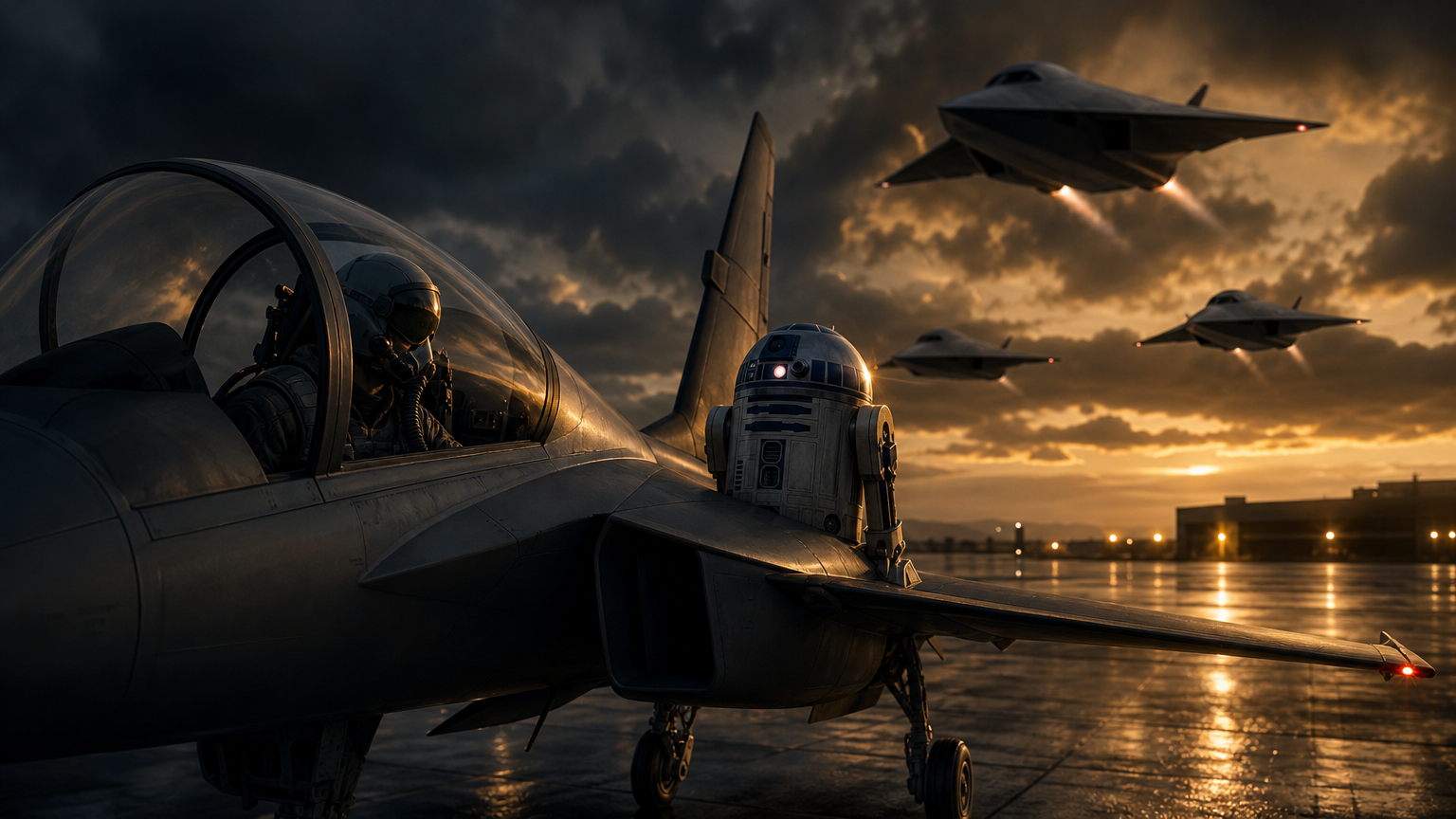
This is where the “R2-D2 as wingman” joke becomes strategically serious. The desired future is not a robot replacing a pilot in a simple one-for-one swap. It is a formation in which a human pilot can delegate tasks, receive AI-generated options, direct uncrewed teammates and manage risk without hand-flying every platform. In contested airspace, that could mean using uncrewed aircraft to extend sensor reach, complicate an adversary’s targeting, carry weapons, absorb risk or create tactical dilemmas.
Shephard reported that Saab expects the technology could move toward operational testing or use within months, while the company expands training capabilities, partnerships and ambitions for wider military applications . That does not mean fully autonomous combat formations are suddenly routine. It does mean the transition from research flights to operational experimentation is tightening.
Trust, control and the unanswered questions
Saab is careful to stress trust. The company says AI for fighter aircraft must be trusted, and that safety and control are being integrated from the start rather than added afterward . That is essential, because fighter autonomy lives in a domain where mistakes can escalate quickly: misread intent, mishandled engagements, unsafe maneuvers, communications loss or unpredictable behavior under electronic attack.
The announcement does not resolve every question. Saab has not publicly disclosed the full test envelope, the exact autonomy boundaries, the human override architecture, the number of flights, the rules under which the agents made decisions or how weapon-release authority would be handled in future operations. The current milestone is therefore best understood as a significant integration and flight-test step, not proof that autonomous fighter agents are ready for unrestricted combat use.
Still, the direction is clear. Saab has moved from partner-assisted AI trials toward a proprietary family of fighter agents, backed by a training academy, sovereign compute ambitions and Gripen E flight testing . For defense technology, the milestone sharpens the competition around trusted autonomy, mission assurance and human control in contested airspace. The wingman of the future may be software first, aircraft second — and Saab wants to own both the cockpit interface and the agent behind it.
Comments
Be the first to comment.