
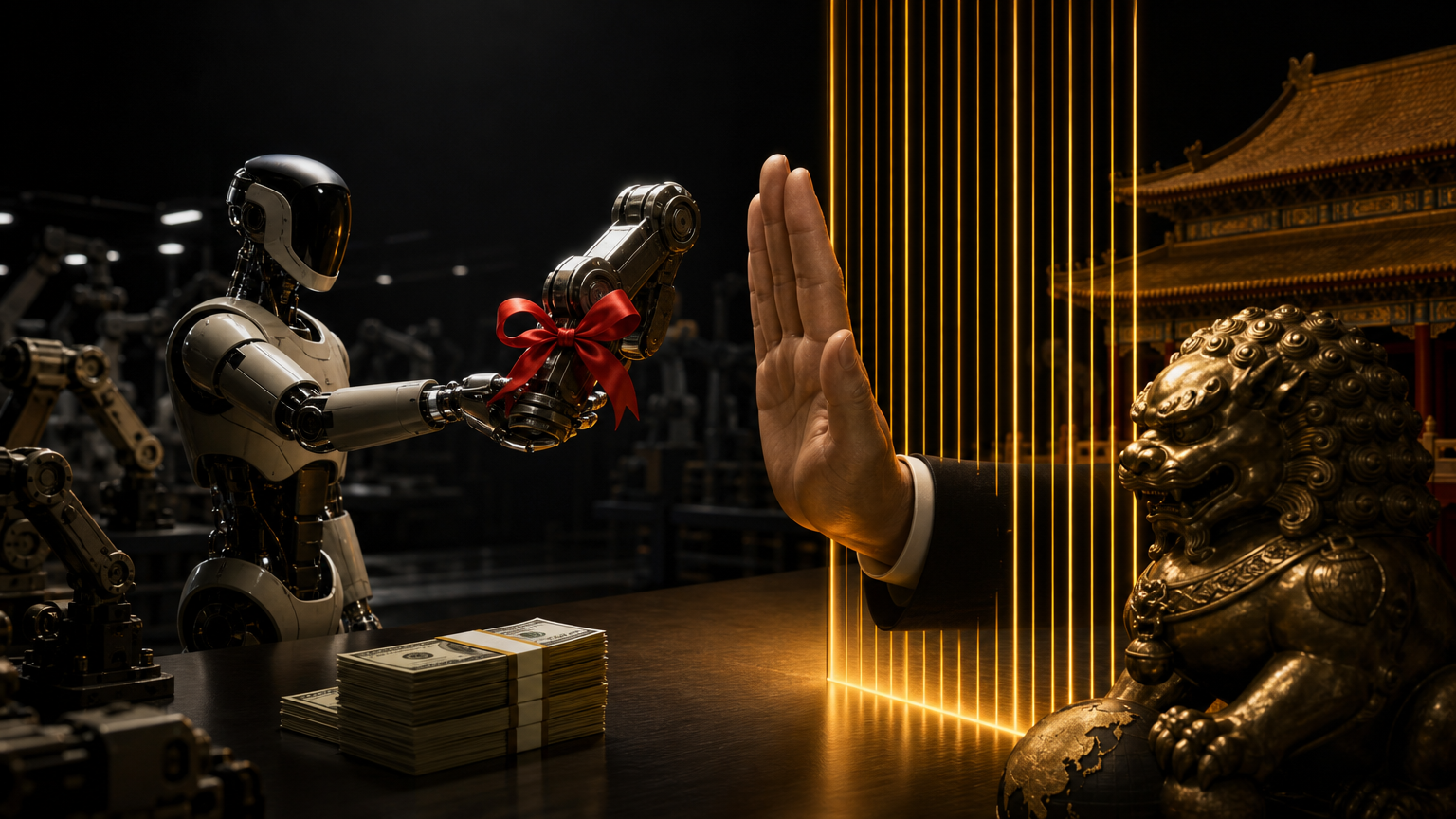
The transaction hit a geopolitical wall
China has blocked the China portion of SoftBank Group’s planned acquisition of ABB’s robotics business, turning a $5.375 billion industrial deal into a test case for embodied AI geopolitics . ABB said on November 5 that SoftBank had informed it that China’s Office of the Working Mechanism for Foreign Investment Security Review had prohibited the acquisition of ABB Robotics in China . The Swiss-Swedish group added that ABB and SoftBank remain in “close dialogue” and are still working constructively on the transaction, but the regulatory signal is unambiguous: for Beijing, robotics assets can be sensitive national infrastructure, not just manufacturing equipment .
The deal was announced in October 2025 at an enterprise value of $5.375 billion, with completion dependent on regulatory approvals and other closing conditions . That matters because China is not merely another approval box. ABB’s robotics business has a deep local footprint, and recent reporting says China is the division’s largest robotics market, representing roughly 30 percent of its robot-related business . A buyer can model revenues, synergies and financing, but it cannot spreadsheet away a security review that treats industrial robots as a strategic data and AI layer.
Reuters reported that China’s state planner told SoftBank it would not allow the acquisition of ABB’s robotics segment to proceed, and described the case as the second major China-blocked deal this year after Meta was ordered to unwind a more than $2 billion acquisition of AI start-up Manus . The pattern is important. Beijing is not only regulating Chinese start-ups or consumer platforms; it is scrutinizing who controls the systems that gather industrial data, operate in factories and may train or improve AI models.
Why ABB Robotics is more than a robot-arm maker
SoftBank wanted ABB Robotics because Masayoshi Son has been trying to position the group at the center of “physical AI,” where foundation models, chips, data centers and robots converge . Bloomberg’s report, carried by The Japan Times, said the acquisition was expected to strengthen SoftBank’s revenue and profit profile while giving it a large industrial robotics platform with more than 7,000 employees and customers including major manufacturers such as BMW . In that framing, ABB Robotics was not just another portfolio company. It was a bridge from AI software ambition into factories, logistics and production floors.
That bridge is precisely what makes the asset politically sensitive. Swissinfo, citing Financial Times reporting, said Chinese concerns included whether robotics production data could move abroad and be used to train AI models, potentially including models connected to OpenAI, in which SoftBank has a major stake . The same report said officials had examined whether intellectual property should remain in China and that a spin-off of parts of the business to Chinese owners had been considered . These details explain the core anxiety: industrial robots are sensors, actuators and process witnesses. They do not merely perform work; they can collect information about how work is done.
China’s action also complicates the idea that “AI dealmaking” is mostly about cloud services and model labs. In robotics, the strategic asset is distributed across hardware, motion-control software, manufacturing know-how, customer data, maintenance logs and deployment sites. A foreign buyer may own the equity, but regulators can still ask who will see the data, where software updates originate, which models learn from factory behavior and whether local intellectual property becomes part of a broader foreign AI stack.
Unitree shows the domestic side of the same strategy
The same 72-hour window produced a second signal from China’s robotics sector: Unitree is moving from spectacle toward state-linked commercialization. On November 4, the Beijing Municipal Administration for Market Regulation published a simplified merger filing for a new joint venture involving CNPC Kunlun Manufacturing, Kunlun Capital, Unitree Robotics and Beijing Fanjie Intelligent Technology . The public comment period runs from November 4 to November 13 .
Chinese media reports based on the filing said the planned company will focus on industrial embodied-AI robot solutions . Under the proposed structure, CNPC Kunlun Manufacturing and its concert party Kunlun Capital would hold 60 percent, while Unitree and Fanjie would each hold 20 percent; Kunlun Manufacturing, Unitree and Fanjie would jointly control the venture . The ownership split is telling. The state-linked industrial customer keeps the majority, Unitree brings robot hardware and embodied-AI capability, and Fanjie adds an AI-model layer .
This is the commercial counterpoint to the SoftBank block. China is constraining a foreign acquisition of a major robotics business while domestic players are building channels into oil, gas, energy equipment and other industrial environments. For embodied AI, those environments are precious. They provide repetitive tasks, budgets, safety constraints, acceptance tests and operational data. A humanoid that paints at an expo is a spectacle; a robot that inspects equipment, navigates industrial sites or supports hazardous work can become a procurement line.
The GPT-6 demo is a signal, but not yet proof
Unitree also attracted attention when founder and CEO Wang Xingxing said at the China International Import Expo in Shanghai that the company’s humanoid robots, powered by OpenAI’s GPT-6, could paint and play chess without prior task-specific training . According to the report, Wang said the robots could handle sequences such as changing brush water and blending pigments, guided by real-time model inference . The claim fits the industry’s direction: large multimodal models increasingly act as planning layers, while lower-level controllers handle balance, force, grasping and motion.
But the demo should be treated as a signal rather than proof of general-purpose autonomy. The available account is based on the company founder’s remarks, not an independent benchmark with disclosed failure rates, intervention levels or test conditions . For investors and industrial customers, those missing details matter. A robot that completes an artistic task once is not the same as a robot that works for eight hours in a refinery, warehouse or machine shop with measurable uptime and safety performance.
Still, the timing is striking. China is showing both sides of its embodied-AI policy. It wants domestic firms to pair models with cheap, capable hardware and real industrial customers. At the same time, it is willing to block a foreign-controlled transaction when the asset sits inside China’s robotics and data ecosystem.
What investors should learn
For SoftBank, the immediate lesson is that capital no longer guarantees access. Even a multibillion-dollar, board-approved transaction can fail if regulators see robotics data, local know-how or AI training pathways as strategic. The company may try to salvage the transaction, restructure the China assets or seek renewed approval, but any path now runs through the same national-security logic that stopped the deal in the first place.
For the broader market, the message is sharper. Embodied AI is becoming an industrial-policy asset class. Buyers must diligence not only valuation, customers and product roadmap, but also data residency, model access, export controls, foreign-investment reviews, local manufacturing obligations and state-linked customer relationships. The term sheet may still matter; the firewall now matters more.
That is the real significance of China’s move. The blocked SoftBank-ABB deal and Unitree’s parallel advance are not separate stories. Together, they show that the next robotics cycle will be shaped by who owns the machines, who controls the data, who trains the models and which governments decide those flows are too strategic to export.
Comments
Be the first to comment.