
From assisted cockpit to autonomous control
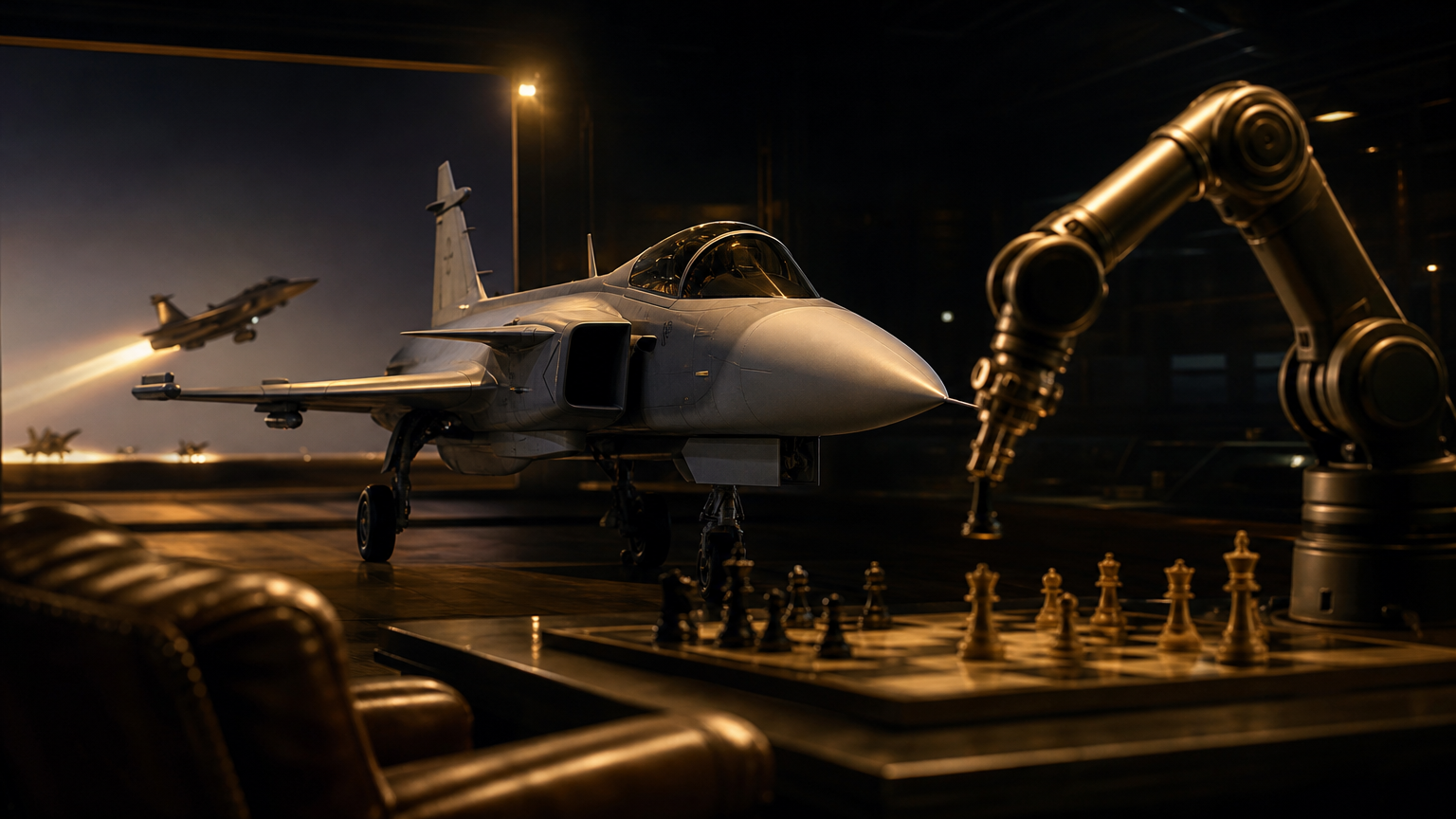
Saab’s latest disclosure is a clear escalation in the race to put agentic AI inside combat aircraft: the company says it has developed in-house, flight-proven AI agents and flown them on the Gripen E fighter . During flight trials, one agent autonomously controlled the aircraft in beyond-visual-range, or BVR, combat scenarios, according to Saab’s announcement . That matters because BVR air combat is not a simple autopilot problem; it combines sensor interpretation, tactical geometry, timing, weapons logic, threat behavior and uncertainty at speeds where hesitation can become failure.
The new announcement also changes the center of gravity of Saab’s earlier AI work. In 2025, Gripen E flights integrated Helsing’s Centaur AI agent under Project Beyond, but the current disclosure emphasizes Saab’s own family of agents, its own training environments and its own development tools . In other words, Saab is no longer only showing that Gripen can host an AI agent; it is arguing that it can own the stack that creates, trains, tests, integrates and evolves the agent .
That ownership is strategically important. Saab says the agents can either support a pilot in the cockpit or operate in an uncrewed air platform alongside crewed aircraft . Aviation International News reported that Saab has been testing AI agents in the Gripen E for around two years and that trial tasks have included area assessment and denial, and battle-damage assessment . The same report quoted Saab’s Peter Nilsson as saying the agents are ready for operational deployment, with the limiting factor being how quickly the Swedish defence customer and air force can absorb them into real operations .
Why Gripen is a useful testbed
The Gripen E is central to Saab’s pitch because of its software-defined architecture. Saab says the aircraft can rapidly integrate and test new technologies, including in civilian airspace, and that this lets AI software be flown in an operational fighter without requiring a dedicated experimental platform . AeroTime made the same point more plainly: Saab can test AI directly on a fighter already in service rather than build a separate demonstrator aircraft .
That architecture does not make AI safe by itself. But it does shorten the loop between simulation, integration, flight test and revised code. In military terms, that loop may become as decisive as the airframe. A fighter whose mission systems can absorb new autonomy faster than a rival can validate it may gain tactical options without waiting for a new aircraft generation.
This is why the story is bigger than “AI flies a jet.” Saab’s statement frames AI as one of the key technologies in future fighter development and says its agents are built to master tactical decision-making in complex operational environments . The company is also tying the effort to future networks of crewed and uncrewed systems rather than to isolated aircraft acting alone . In that vision, the Gripen becomes both a fighter and a flying integration lab for the behaviors that may later migrate into loyal-wingman aircraft, uncrewed combat aircraft and command-and-control networks.
The AI Fighter Pilot Academy
Saab’s internal structure for this work is the AI Fighter Pilot Academy, an initiative meant to create, train and evaluate agents across many scenarios and platforms . Inside that academy, agents are trained in simulated environments and accumulate millions of simulated flight hours, allowing them to explore tactical choices far beyond the lifetime experience of any individual human pilot . AeroTime reported that the agents’ decisions are continuously assessed against objectives, creating a feedback loop for refining behavior across different air-combat situations .
The “academy” label is useful because it captures what the technology race is really about. The advantage is not merely a clever algorithm. It is the industrial capacity to generate scenarios, run them at scale, evaluate performance, detect failure modes, update the agent and then re-test in conditions close enough to reality to matter. For agentic AI in a combat aircraft, the hallucination problem becomes a flight-safety and weapons-employment problem. An agent that invents a state of the world, misreads an adversary or optimizes the wrong objective is not producing a bad chatbot answer; it may be maneuvering a high-performance aircraft in contested airspace.
That is why Saab emphasizes verification and control. The company says safety and control are integrated from the start rather than added afterward . This is also why the boundary between autonomy and command will remain politically and militarily sensitive. Saab can train an agent to handle more of the tactical workload, but a military customer still has to decide when the agent may advise, when it may fly, when it may cue weapons and when a human commander must remain the final authority.
The supercomputer behind the pilot
The compute layer is now part of the fighter story. Saab says its ability to scale this work is supported by Sferical AI, a Swedish sovereign AI initiative that provides secure, large-scale computing capacity for advanced AI development, with Saab as a founding partner . Defence24 reported that the Swedish-built Sferical AI supercomputer is being used to train AI pilot agents intended to replace humans in combat aircraft in the future . The same report said the system was officially inaugurated in mid-October in Linköping, where Saab has facilities, and that companies connected to the Wallenberg sphere, including Saab, AstraZeneca, Ericsson and SEB, back the investment, with SKF as a strategic partner .
AIN provided the most concrete compute detail, reporting that Sferical is based on Nvidia DGX SuperPOD architecture and runs on 1,152 Nvidia Grace Blackwell GB300 GPUs . It also reported Saab’s comparison that a one-hour flight test could be run a billion times in the same period that a CPU-based environment would run it 1,200 times . Even if that figure is best read as an illustration of scale rather than a complete validation methodology, it explains why sovereign compute is becoming a defence asset: AI air combat requires repeated, varied and adversarial training at volumes that ordinary test programs cannot supply.
This is the “New Game Plus” moment for the autopilot. Classic autopilots stabilized aircraft and followed routes. These agents are being trained for tactical behavior, uncertainty and collaboration with humans and other machines. The pilot is no longer just delegating altitude or heading; the system is beginning to take on pieces of the fight.
Replacement, partnership or command layer?
The most provocative version of the story says AI agents will replace human fighter pilots. Defence24 used that framing while also explaining a more gradual operational model: AI pilots may support human pilots, take over flight control in some situations and control unmanned aircraft designed to fly without a person on board . The same report said future military pilots could become mission commanders who remain farther back while AI-controlled machines perform the most dangerous tasks .
That is the more credible near-term interpretation. Saab’s own wording presents the agents as cockpit support or as autonomy for an uncrewed platform operating alongside pilots . Shephard reported that Saab is targeting potential operational deployment within months and that the technology is designed to help pilots make tactical decisions in crewed and uncrewed systems . The direction of travel is clear, but the human is not simply erased; the human role is being pushed upward, from direct aircraft handling toward mission intent, authorization and supervision.
For defence technology, the implication is sharp. The future fighter contest will still involve range, sensors, weapons, stealth, electronic warfare and production capacity. But it will also hinge on who can train agents faster, verify them more rigorously, protect the compute supply chain, update software safely and define human-command boundaries before a crisis forces the question. Saab’s Gripen trials show that agentic AI has moved beyond the simulator and beyond the copilot metaphor. It is now touching the controls.
Comments
Be the first to comment.