
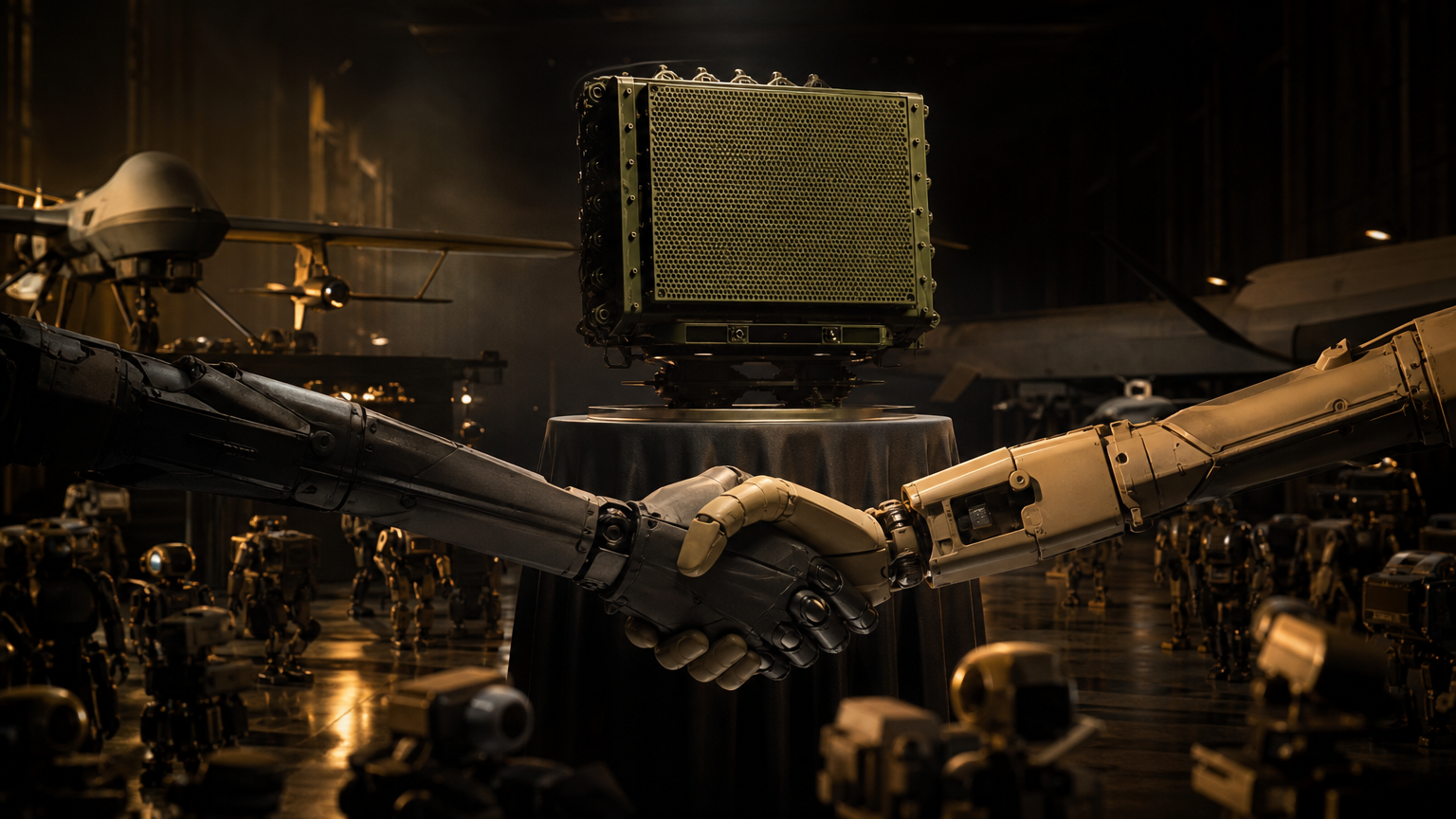
The deal: a $5.3 billion bet on sensing
Shield AI has signed a definitive agreement to acquire Echodyne, the Kirkland, Washington radar specialist, in a transaction valued at up to $5.3 billion . The structure matters: $4.8 billion is to be paid and issued at closing, while as much as $500 million more depends on Echodyne meeting agreed performance targets . The companies expect the transaction to close in early 2027, subject to regulatory approvals and other customary conditions .
The acquisition is paired with a planned $2.5 billion financing package. Shield says that includes $1 billion in Series H funding at a $28.8 billion post-money valuation, $1 billion in structured equity from funds managed by Blackstone, and $500 million in debt financing led by JPMorgan Chase Bank as sole arranger . The Series H is co-led by Disruptive and Innovation X Capital, with participation from Advent, JPMorganChase’s Security and Resiliency Initiative strategic investment group, Snowpoint Ventures, Apandion, Center15 Capital and others .
On paper, the transaction gives Shield a counter-drone radar business. Strategically, it gives the autonomous systems company a sensing layer it can combine with its Hivemind autonomy software, V-BAT and X-BAT aircraft, and Aechelon simulation and training technologies . In plain terms: Shield is not just buying another product line. It is trying to bring the eyes of the system closer to the brain.
Why Echodyne is worth the premium
Echodyne designs compact, solid-state radars built around its patented Metamaterials Electronically Scanned Array, or MESA, technology . Its radars are already built into hundreds of counter-drone and security systems used by defense, government and commercial customers in more than 40 countries . That existing installed base helps explain why the purchase price looks less like a typical component-company acquisition and more like a move to capture a scarce platform capability.
Counter-drone work depends on a fast chain: detect, track, identify, decide and defeat. Echodyne sits at the front of that chain. Its radars are integrated into remote weapon stations, high-energy laser systems and high-power microwave systems, and they can cue interceptors toward incoming drones . Civilian customers also use the same radar class to protect airports, stadiums and other sensitive sites from unauthorized drones .
The company’s recent contract momentum reinforces the timing. In September, Echodyne received a contract with a $250 million ceiling from Joint Interagency Task Force 401 to supply counter-drone radar to U.S. and allied forces . Defense News reported that the award covers counter-drone technology over 36 months and quoted Echodyne CEO Eben Frankenberg’s earlier view that demand for counter-drone detection radar could grow tenfold by 2030 .
Shield’s logic: autonomy needs better inputs
Shield CEO Gary Steele framed the company as three mutually reinforcing units: autonomy software, autonomous systems and mission systems . In that architecture, Echodyne belongs in mission systems, but its real value is cross-cutting. Autonomy software is only as useful as the sensor data feeding it; autonomous aircraft, perimeter-defense systems and counter-UAS weapons all need reliable perception before they can act.
Breaking Defense reported that the deal will give Shield an in-house counter-UAS offering, while also adding radar engineering, manufacturing capacity and a commercial customer base . A Shield spokesperson told Breaking Defense that the company is not announcing specific aircraft integrations now, but expects autonomous aircraft to need more capable onboard sensors in coming years . The same spokesperson said the Echodyne deal does not affect Shield’s separate work with RTX on radar for X-BAT .
That last point is important. Shield appears to be preserving flexibility rather than immediately forcing every radar decision through Echodyne. In the short term, Echodyne’s MESA radars will remain available as standalone products, and Echodyne will keep serving integrators and end customers in defense, government and commercial markets . If Shield manages that carefully, it can benefit from Echodyne’s existing customer network without frightening partners that may compete with Shield in other areas.
Seattle becomes a bigger defense-tech node
The acquisition also deepens Shield’s footprint in Washington state. Echodyne is based in Kirkland and recently opened an 86,350-square-foot manufacturing facility, a $40 million investment that Shield says will be able to produce about 30,000 radars per year . GeekWire reported that Echodyne has about 400 employees, up from 260 when the Woodinville facility opened in July, and that no layoffs are planned .
Shield is already planning to build its AI-piloted X-BAT fighter jet south of Seattle, and the company said in September that Washington would be the production home for that aircraft . GeekWire reported that Shield expects to employ about 4,000 people in the Seattle region by the early 2030s as X-BAT production ramps up, with the program projected to support about 8,000 regional jobs including suppliers .
That makes the Echodyne purchase a regional industrial story as well as a balance-sheet story. Shield is using the Seattle area not only as a software or engineering outpost, but as a manufacturing base for sensors and autonomous aircraft. For a region better known globally for cloud, e-commerce and enterprise software, the transaction is another signal that defense hardware, autonomy and AI are becoming part of its technology identity.
Investors, exits and consolidation
Echodyne was spun out of Intellectual Ventures in 2014 with early backing from Bill Gates and Madrona . GeekWire reported that Echodyne has raised about $200 million in total, while PitchBook placed its valuation at $485 million after its last priced round in 2022 . If the Shield transaction closes at the announced value, it would represent a dramatic step-up for early investors.
The deal is also notable in Washington venture history. GeekWire cited Madrona’s Tim Porter saying the acquisition is believed to be the second-largest purchase of a private venture-backed company in Washington state history, behind Okta’s $6.5 billion acquisition of Auth0 in 2021 . Madrona and other Echodyne investors are expected to become significant Shield shareholders, with Porter serving as a board observer at Shield .
For Shield, the acquisition continues a pattern of buying its way into adjacent capabilities. Washington Technology noted that this is Shield’s third acquisition since April 2025, following the purchase of an autonomy software business from Crowdbotics and the acquisition of Aechelon Technology for simulation and synthetic-reality capabilities . Breaking Defense also noted Shield’s earlier acquisition of Martin UAV, which became central to the V-BAT line and the path toward X-BAT .
The risks: valuation, regulation and integration
A $28.8 billion post-money valuation puts Shield in rare territory for a private defense-technology company. The valuation is more than double the $12.7 billion level GeekWire says Shield reached in March . That jump creates expectations: the combined company will need to turn customer demand, factory capacity and defense urgency into revenue at a speed that justifies the financing.
Regulatory review is another obvious checkpoint. The companies expect closing in early 2027, not immediately, and the transaction is subject to applicable approvals . Because the deal involves defense technology, counter-drone systems, manufacturing capacity and customers in more than 40 countries, review risk should not be treated as a formality even if the companies present a clear industrial rationale.
Integration may be the harder test. Echodyne’s value lies partly in being a trusted supplier to many system integrators. Once inside Shield, those customers will ask whether they are still buying from a neutral radar supplier or from a future competitor. Shield’s public commitment to keep MESA radars available as standalone products is therefore more than a courtesy; it is central to retaining the revenue base that helped justify the price .
The bottom line
Shield AI’s purchase of Echodyne is a defining consolidation move in defense technology. It joins autonomy software, autonomous aircraft, simulation and compact radar into a fuller sensing-and-decision stack. It also shows how private capital is now financing bets that look increasingly prime-contractor-sized, with Blackstone, JPMorgan Chase and growth investors helping underwrite a transaction measured in billions rather than tens of millions .
If the deal closes as planned, Shield will not simply add a radar company. It will own a key part of the loop that modern drone warfare requires: seeing the threat, understanding it quickly, and acting before the window closes. That is why this acquisition matters beyond its headline price. In the new defense-tech market, the winners are not just building drones. They are assembling the entire system around them.
Comments
Be the first to comment.