
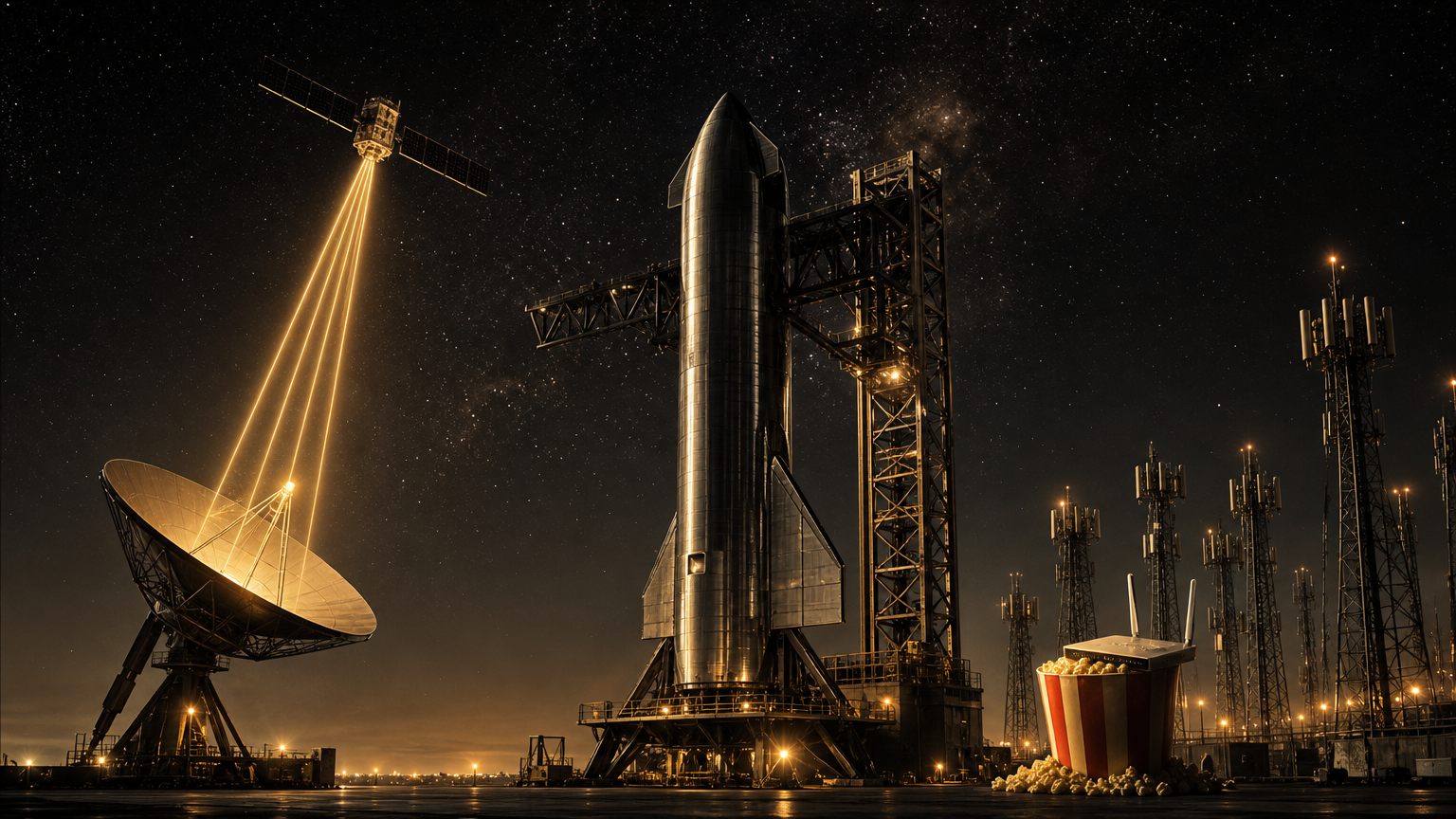
A mobile network that no longer stops at orbit
SpaceX’s Starlink Mobile strategy has crossed an important line: it is no longer only a direct-to-device satellite story, but a terrestrial wireless infrastructure story as well. Qualcomm announced on November 4 that SpaceX selected Qualcomm Dragonwing Cellular Infrastructure platforms for Starlink Mobile’s planned U.S. nationwide terrestrial 5G network, with the rollout expected to begin in 2027 and extend across tens of thousands of sites under a multi-year agreement . That confirmation gives SpaceX’s mobile ambitions a harder industrial outline than rumors about spectrum, roaming, or carrier negotiations could provide on their own.
The planned architecture matters because it places Qualcomm at the radio and baseband foundation of the network. Qualcomm says Starlink Mobile will use Dragonwing QRU100 and QDU100 platforms, commercial-grade Layer 1 software, and 64T64R Massive MIMO radio units designed to improve coverage, capacity, and spectral efficiency . Fierce Network reported that Qualcomm is positioning the deployment as macro-cell infrastructure rather than small cells, and that Qualcomm will provide the foundational Layer 1 technology while SpaceX builds higher network layers and related software above it . In other words, Starlink Mobile is not being described as a lightweight overlay; it is being framed as a conventional carrier-scale RAN build with SpaceX software and satellite assets wrapped around it.
That is why the reported 80,000-site ambition is so significant. Data Center Dynamics reported on November 4 that SpaceX has held talks to gain access to 80,000 U.S. cell sites, with Crown Castle identified among the infrastructure firms connected to the effort . Qualcomm’s own announcement stops at “tens of thousands” of sites, so the precise 80,000 figure remains a reported target rather than a line item in the Qualcomm release . Even so, the scale being discussed is close enough to national-carrier territory to force the wireless industry to treat Starlink Mobile as more than a rural dead-zone add-on.
From satellite supplement to hybrid carrier
SpaceX already has the brand, the satellite constellation, and a direct-to-cell narrative. What the Qualcomm agreement adds is a terrestrial execution path. Axios reported that SpaceX is moving ahead with plans for a nationwide cellular network, with Qualcomm providing Dragonwing chips and software for traditional cellular sites that SpaceX expects to begin deploying next year . Axios also noted the strategic tension: SpaceX has the financial resources, satellites, and spectrum portfolio to challenge incumbents, but matching Verizon, AT&T, and T-Mobile remains a costly and difficult undertaking .
The business case is therefore not simply “Starlink as a fourth U.S. phone carrier.” The hybrid design could give SpaceX a differentiated network for smartphones, but also for devices that need more continuous coverage outdoors: drones, robots, autonomous delivery systems, connected machinery, emergency systems, and remote enterprise equipment. Axios described this broader connected-device opportunity as a possible reason SpaceX may be building a network whose value extends beyond conventional smartphone subscribers . That is the real strategic shift: SpaceX is trying to merge coverage from orbit with terrestrial capacity where people and machines generate dense traffic.
Spectrum remains one of the open questions. Data Center Dynamics reported that SpaceX’s terrestrial plan comes after its public push to challenge AT&T, Verizon, and T-Mobile and alongside efforts to acquire additional wireless spectrum . Channel-focused reporting this week also framed SpaceX’s 800 MHz low-band spectrum as a coverage layer, especially useful indoors, while 2 GHz mid-band spectrum would provide capacity . The logic is familiar to mobile operators: low bands travel farther and penetrate buildings better; mid-band supports more throughput. What is less familiar is pairing those layers with a satellite operator that can also backstop coverage beyond cell-tower reach.
The competitive impact will depend on execution. Axios reported that SpaceX may spend enormous sums to build the combined satellite and terrestrial network, and analyst Joe Madden estimated the cost at at least 100 billion dollars including spectrum . Axios separately noted that a wholesale agreement with an existing carrier could be faster and cheaper than building a fully independent network, leaving open whether SpaceX ultimately builds every piece itself or uses the threat of doing so to negotiate partnerships . For towers, radio vendors, handset makers, and managed-service providers, the key point is that procurement assumptions are already changing: a satellite company is now acting like a national RAN customer.
Starship Flight 15: the other half of the scale equation
The orbital side of the story is equally important because Starship is the machine SpaceX needs to make its satellite ambitions cheaper, faster, and more frequent. Pad Zero reported on November 5 that SpaceX vice president of launch Kiko Dontchev said at the UP.Summit that the company is targeting Friday, November 13, 2026, for Starship Flight 15, while also stressing that SpaceX had not yet posted an official mission page or launch window . TeslaNorth reported the same target from Eric Berger’s UP.Summit account and emphasized that the date should be treated as provisional until SpaceX publishes formal launch details .
The milestone attached to Flight 15 is the first attempt to catch the Starship upper stage, not merely the Super Heavy booster. BASENOR reported on November 5 that the mission is expected to attempt the first-ever catch of the Starship upper stage with the launch tower’s arms, while also describing the November 13 date as tentative rather than a confirmed NOTAM window . Pad Zero, however, cautioned that Berger’s report on Dontchev’s remarks did not itself confirm the ship-catch profile and that SpaceX still had not published an official Flight 15 mission page confirming the detailed plan . The current state, then, is precise but not final: November 13 is the fresh target, and the ship catch is the expected milestone, pending SpaceX’s formal flight profile.
Catching the ship is harder than catching the booster. The booster separates earlier and returns without enduring full orbital reentry, while the upper stage must survive reentry heating, manage energy across a long return path, perform its flip and landing burn, and arrive at the tower with extraordinary precision . If SpaceX can recover the ship by tower catch, it removes another slow, expensive recovery step from Starship operations. That is central to the company’s plan for rapidly reusable heavy lift.
One strategy, two infrastructures
The terrestrial and orbital moves reinforce each other. A larger Starlink Mobile network needs more satellite capacity, more spectrum efficiency, and more capital discipline. Starship is the vehicle meant to deploy bigger Starlink payloads faster, while Starlink is one of the demand engines that can justify Starship’s flight cadence. Qualcomm’s role on the ground and Mechazilla’s role at Starbase look unrelated at first glance, but both are about compressing cost and time at infrastructure scale.
The risks are also parallel. On the ground, SpaceX must secure sites, install equipment, integrate spectrum, manage regulators, and convince customers or partners that Starlink Mobile is reliable enough to matter. At Starbase, it must prove that a giant launch tower can safely catch not only a booster but eventually the ship itself. If either effort slips, the ambition remains expensive theory. If both advance, SpaceX becomes harder to categorize: not just a launch company, not just a satellite broadband provider, and not just a would-be carrier, but a vertically integrated connectivity platform stretching from towers to orbit.
Comments
Be the first to comment.