
The pickup becomes the bridge, not the destination
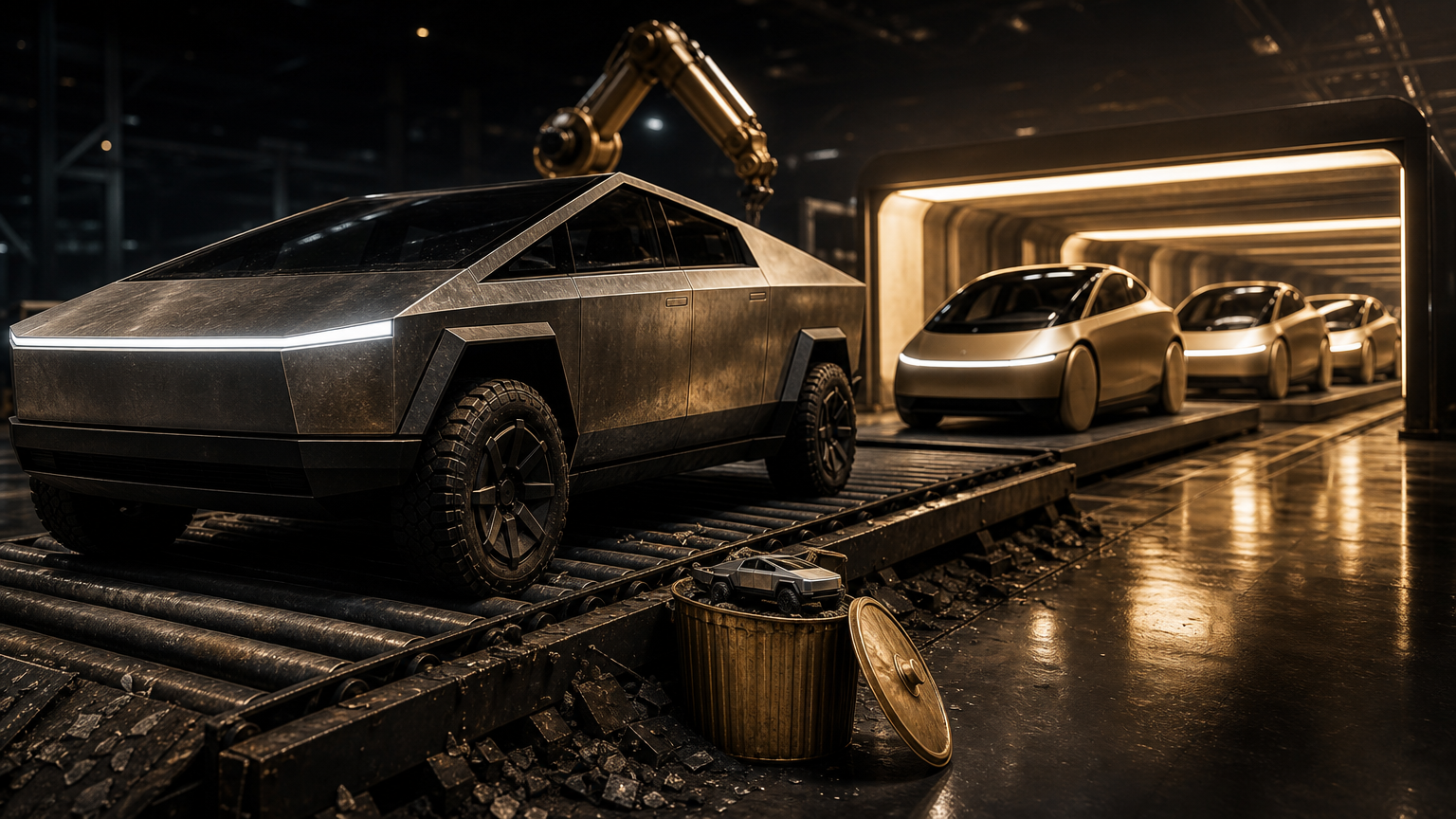
Tesla is preparing to retire the Cybertruck far earlier than most vehicle programs would expect. Elon Musk said Tesla will wind down Cybertruck production at Gigafactory Texas around the middle of 2027 to make room for increased Cybercab output, according to reporting published on November 6, 2026 . The Austin-area plant is the only known Tesla facility equipped for Cybertruck production, and the same factory is now being reprioritized around the company’s robotaxi ambitions .
The symbolism is hard to miss. The Cybertruck was once presented as a category-breaking electric pickup, a stainless-steel answer to the most profitable and culturally powerful segment of the U.S. auto market. Now it is being recast as a transitional product: a vehicle that helped Tesla test manufacturing ideas, materials and brand elasticity, but not the model that will define the company’s next phase. Musk’s public explanation was bluntly operational: Cybertruck capacity gives way to Cybercab capacity .
That makes this more than a model-cycle decision. Conventional automakers usually keep pickup platforms alive for many years, refreshing styling, powertrains and trim ladders along the way. Tesla’s move suggests a more volatile capital-allocation model, where factory space can be reassigned quickly if autonomy, AI and robotics promise better strategic leverage than another privately owned vehicle line .
Why Gigafactory Texas matters
Gigafactory Texas is the center of the story because it is not just another plant. It became closely associated with the Cybertruck, and TechCrunch notes that Tesla had once discussed the Texas factory in terms that made it sound like the Cybertruck’s industrial home . That matters for suppliers, tooling vendors and buyers because the truck’s unusual body, heavy stainless-steel panels and dedicated components are not easily shifted from one plant to another without fresh investment.
Reuters reported that it was not immediately clear whether Cybertruck production would move elsewhere or be phased out entirely, but it also noted that Austin is the only known Tesla site equipped to build the specialized components for the model . In practice, that leaves the Cybertruck facing a narrow runway unless Tesla later announces a replacement manufacturing plan.
The company’s stated beneficiary is the Cybercab. The Cybercab, a two-seat robotaxi concept without traditional driving controls, sits at the center of Musk’s effort to make Tesla less like a classic automaker and more like an AI and robotics company . The Guardian described the pivot as part of Musk’s preference for autonomous fleets, robotics and AI over the traditional carmaker playbook of regularly launching new private-use models .
The sales problem behind the strategy
The Cybertruck’s short life would be less striking if demand had clearly justified more capacity. Instead, the latest reports frame the wind-down against weak sales and fading momentum. Tesla does not break out Cybertruck deliveries separately, which makes the exact sales picture indirect. But AP cited Kelley Blue Book estimates showing Cybertruck sales fell 48% from 2024 to 2025 and were down 28% from January through September 2026 .
Reuters reported that Kelley Blue Book estimated 20,237 U.S. Cybertruck sales in 2025, down from 38,965 in 2024, while recalling that Musk had once predicted annual sales of 250,000 units around the time production began . That gap between expectation and realized demand is the core business story. Tesla did not merely miss an aggressive target; it failed to turn enormous early attention into a durable pickup franchise.
The truck’s design was always a feature and a filter. Its angular stainless-steel body generated unmatched visibility, but the same visibility limited mainstream appeal. AP said the vehicle’s polarizing shape, quality-control issues and recalls complicated its market reception, while sales declined almost from launch . For a premium lifestyle vehicle, that kind of attention can be useful. For a high-volume truck meant to challenge Detroit’s pickup economics, it becomes a ceiling.
Prices rise as the line winds down
The second twist is pricing. After the production wind-down emerged, Tesla raised U.S. Cybertruck prices and paused orders for the base Dual Motor AWD trim, according to Not a Tesla App . The Premium AWD trim now starts at $92,490, up $7,500 from $84,990, while the Cyberbeast rose to $102,490 from $99,990 . The Dual Motor AWD version is shown at $82,490 but is grayed out and unavailable for new orders .
That means the cheapest Cybertruck that can actually be ordered in the United States is now the $92,490 Premium AWD configuration . For buyers who followed the Cybertruck from its 2019 unveiling, the contrast is severe: the vehicle’s public promise began around a far more accessible pickup idea, while its final stretch appears to be defined by scarcity, higher stickers and trim pruning.
There is a business logic to the move. If Tesla has limited remaining production slots, it may prefer to allocate those slots to higher-margin configurations. A higher price can also slow demand, protect average selling price and reduce the risk that remaining orders outrun a shrinking production plan. But there is also reputational risk. Raising prices while signaling the model’s exit can make buyers question resale values, parts support and the long-term desirability of a truck that suddenly looks like a collector’s gamble rather than a growth platform.
A warning to suppliers and rivals
For suppliers, the lesson is uncomfortable. A component program tied to a Tesla vehicle can look strategically central one year and become transitional the next. Cybertruck’s tooling, materials and low-volume complexity already made it unusual; the mid-2027 wind-down adds a capital-planning shock. Vendors that scaled around expectations of a longer Cybertruck arc now have to watch capacity shift toward Cybercab, a vehicle with different components, economics and regulatory dependencies.
For EV rivals, the decision is equally revealing. Detroit and startup competitors spent years measuring their electric pickup ambitions against Cybertruck. But Tesla’s retreat suggests the electric pickup segment may not be where Musk sees the company’s highest return. If Cybercab works, the comparison set changes from trucks sold to households to autonomous miles sold as a service. If Cybercab stumbles, Tesla will have walked away from a high-profile product without yet proving the replacement business at scale.
The DeLorean problem
Every era has a vehicle that becomes more famous as an icon than as a business. The Cybertruck is now drifting toward that category. It was instantly recognizable, technically ambitious and culturally loud. But its production life may last less than four years from first customer deliveries in late 2023 to the planned mid-2027 wind-down . For a vehicle once meant to disrupt pickups, that is a remarkably compressed arc.
The DeLorean comparison is not perfect, but it is tempting: stainless steel, radical design, celebrity gravity and a future that arrived strangely fast. The difference is that Tesla is not collapsing around the Cybertruck. It is choosing to move factory capacity elsewhere. That makes the Cybertruck less a corporate failure than a strategic sacrifice.
The bet is now clear. Tesla is not trying to win the next decade by expanding the normal vehicle lineup one model at a time. It is betting that autonomy, robotaxis and robotics deserve the factory space more than an electric pickup with falling demand. The Cybertruck may remain on roads for years, as Musk indicated, but as a product program it has become a bridge to Cybercab. Even Mario Kart has gentler rubber-banding.
Comments
Be the first to comment.