
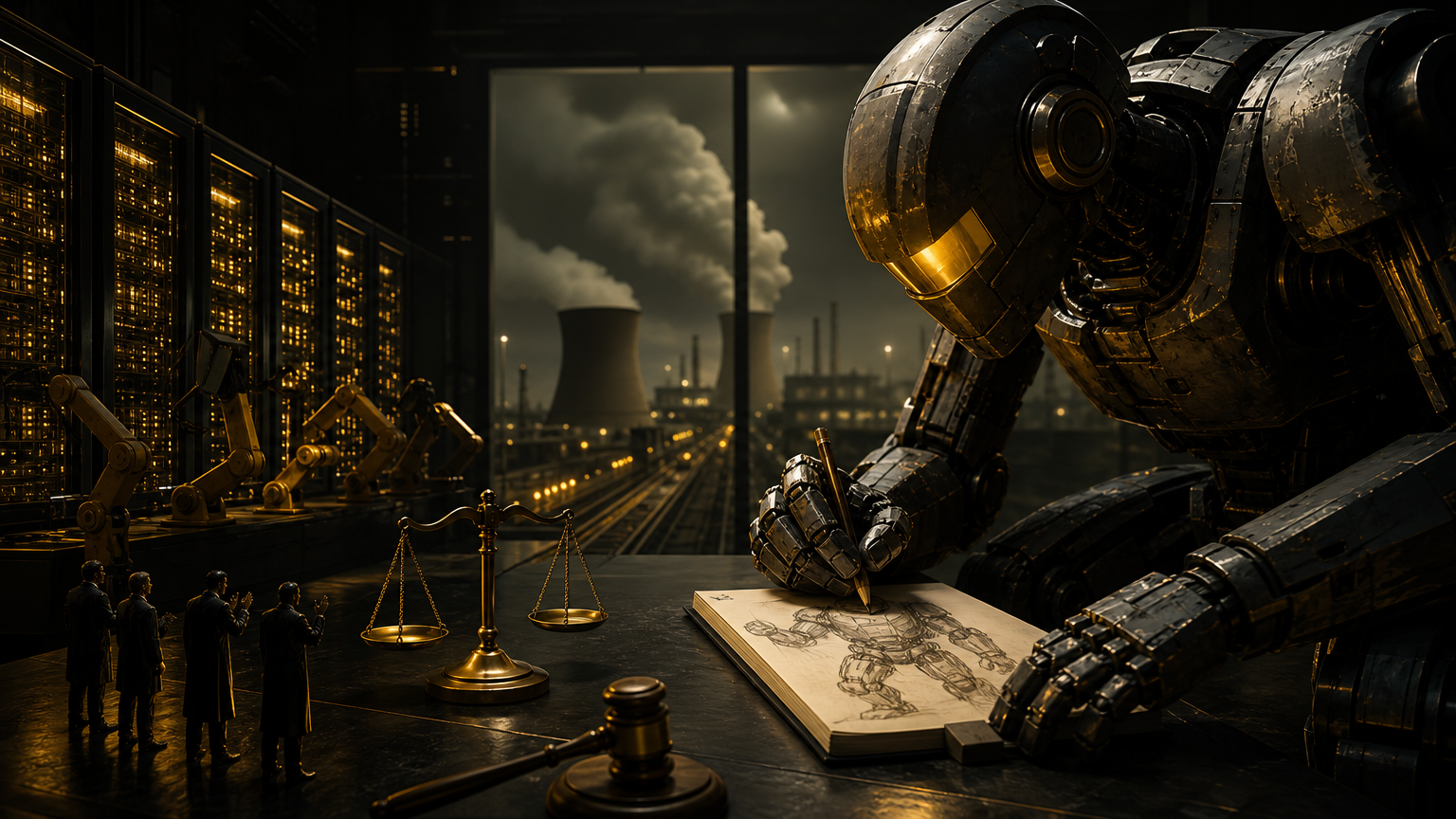
The image model becomes a motion tool
OpenAI’s Images 2.6 is not just another quality bump in text-to-image generation. The release adds a more practical layer: faster iteration, stronger continuity across edits and the ability to generate animated GIF-style sequences from prompts, sketches, photos and reference images . In other words, the model is being positioned less as a one-shot image maker and more as a compact visual production system.
The most obvious change is motion. OpenAI describes use cases such as animating a brand mascot, producing reaction GIFs, creating memes or building animated storyboards before full video production . That matters because GIFs sit between static illustration and video: cheap to make, quick to share and expressive enough to establish a character or product identity. For creators, the format lowers the threshold for motion. For businesses, it turns a still brand asset into a repeatable animated language.
The speed claim is also important. OpenAI says Images 2.6 generates images 50% faster than before, and its API now offers GPT-Image-2.6 Flare and GPT-Image-2.6 Sunburst: Flare is tuned for speed, with low-quality generations possible in as little as six seconds, while Sunburst is presented as the higher-quality option with stronger consistency across edits . That split points to an increasingly professional market: one model path for quick drafts, another for polished output.
Control is the other half of the update. Image markup comes to the API, SVG exports make assets easier to use across web, app and print workflows, and a new complexity parameter lets developers decide how much planning the model should apply to an image task . TechRadar’s hands-on test also highlights a consumer-facing feature: users can save a persistent reference image, so they do not have to re-upload the same source every time they ask for another edit . That is exactly the kind of small workflow improvement that makes character consistency more usable outside demos.
Musk’s political bet fails in Texas
The second part of the week’s story is not technical but political. Elon Musk’s attempt to influence the 2026 midterms, especially in Texas, became a stress test for billionaire-backed AI-era politics. According to Associated Press reporting carried by The Washington Post, Musk spent at least $445 million to support Republicans, but the party lost control of Congress and suffered major defeats in Texas .
The Texas result is the symbolic center. Musk spent at least $5 million trying to reelect Republican governor Greg Abbott, who lost, while Republican attorney general Ken Paxton benefited from $158 million of Musk-linked spending and lost the U.S. Senate race to Democrat James Talarico . Democrats also won the Texas House, and the result marked the party’s first statewide Texas win in more than 30 years .
This matters for the AI story because Texas is not just a political map. It is one of the major battlegrounds for energy, data centers, chip infrastructure, electric vehicles and launch operations. Musk’s companies have large Texas footprints, and the victorious Democratic candidates campaigned partly on scrutiny of Musk, tax breaks and the relationship between public resources and private empires . The result suggests that technological scale can become a liability when voters feel that land, power, water and tax policy are being reorganized around a few giant companies.
Data centers move from infrastructure to ballot issue
The same election cycle sharpened the public fight over AI infrastructure. AP reported that data centers took a beating in the midterms, with many winning candidates supporting stronger regulation, restrictions or moratoriums . The numbers are striking: among gubernatorial races where AP had called a winner, Data Center Watch found that 32 of 34 victorious candidates supported stronger regulation or restrictions, and 12 supported bans or moratoriums .
The concern is not abstract. Communities are asking who pays for grid upgrades, how much water and electricity campuses consume, and whether residents get a meaningful say before projects are approved. AP reported that Wisconsin governor-elect David Crowley discussed possible requirements for developers to disclose water and energy consumption, prove community support and shield ratepayers or taxpayers from project costs .
OpenAI appears to understand the political shift. AP noted that the company published a framework with new commitments to communities where it develops data centers and called for clear rules for the industry . That is a revealing move. The AI boom is not only constrained by algorithms or chips; it is increasingly constrained by permitting, local trust, electricity planning and environmental politics.
Texas again becomes central. AP reported that Texas is poised to overtake northern Virginia as the world’s largest data-center market by 2030, while governor-elect Gina Hinojosa said she would block a data-center permit if it was not a good deal for Texans or residents had not had a say . The “joules per calculation” question is no longer a niche engineering metric. It is becoming a campaign issue.
AI enters physics, but not as a magic wand
The week’s most intellectually ambitious claim comes from mathematical physics. World Science Festival’s Brian Greene framed OpenAI’s Yang-Mills-related claim as a possible major step toward putting a central part of the Standard Model on firmer mathematical footing . The key distinction is essential: the claim concerns mathematical existence, while the mass gap portion of the Millennium Prize problem remains open and under review .
That distinction prevents both overhyping and dismissing the development. If the proof holds up, it would be a landmark in how AI systems assist with extremely long, formal chains of reasoning. But it would not mean that AI has “solved physics” or replaced the scientific community. World Science Festival explicitly notes that what has been claimed still sits with a review committee and that the mass gap remains unresolved .
The lesson is that AI may be entering science less as an oracle than as an accelerator. It can propose structures, formalize arguments and push into terrain where human verification is slow. But the final authority remains mathematical validation, peer scrutiny and reproducibility.
The giant robot is real, but still tethered
The final image of the week is Neo1, a four-meter humanoid robot from China’s NeodraDynamics. Generation NT reports that the 1.2-ton machine was presented with JD Industrial at the Shanghai industrial fair and is claimed to lift up to 500 kilograms with two arms . Its target jobs are the classic “4D” categories: dangerous, dirty, difficult and dull, including nuclear dismantling, mining, offshore platforms and port handling .
The reality check is just as important as the spectacle. Neo1 is still cabled, remotely controlled and unable to walk; its current motion relies on preprogrammed sequences from a remote computer, and the company plans to mount its upper body on a wheeled base for future industrial trials . That makes it less a finished humanoid worker than a giant actuator platform testing whether human-shaped manipulation can be useful at construction-machine scale.
Taken together, Images 2.6, Musk’s Texas loss, AI in physics and Neo1 show the same transition from demonstration to consequence. AI is producing motion, mathematical claims, political backlash and machines that can lift half a ton. The future may indeed be coded in frames per second and joules per calculation, but this week shows that the real question is who controls the frame rate, who pays for the joules and who gets to stand safely outside the robot’s reach.
Comments
Be the first to comment.