
The number that changes the story
The headline figure is simple, almost too simple: Elon Musk says SpaceX is tracking toward an annual revenue rate above $100 billion in December, and that annual recurring revenue could exceed $500 billion in December 2027 . He also stressed that the 2027 figure is “not a promise” but his “best guess,” a crucial distinction because a December run rate is not the same thing as full-year revenue .
That caveat matters. A company can exit a year at a very high monthly pace without having generated that amount across the whole year. In SpaceX’s case, the claim is about the speed of the business at a future point in time, not a certified total already booked. Still, the ambition is extraordinary. Analysts cited in recent coverage put average 2027 SpaceX revenue expectations around $180 billion, with the high estimate near $290 billion; Musk’s $500 billion floor would sit far above even the most optimistic published model .
The bridge from here to there is steep. SpaceX reported third-quarter revenue of about $14.6 billion, which annualizes to roughly $58 billion, while Musk’s $500 billion run-rate target would require about 8.6 times that quarterly pace in roughly 14 months . That is why the story is not just “Musk made another big prediction.” The real story is whether SpaceX can make its revenue curve behave like a launch vehicle: violent acceleration, controlled staging, no catastrophic loss of pressure.
Q4 is the first test
Musk’s near-term signal is the fourth quarter. At the Baron Investment Conference, he said SpaceX’s fourth-quarter revenue would probably rise “something like” 70% from the third quarter, which would imply roughly $24.8 billion using the reported Q3 base . That figure is not reported revenue; it is arithmetic applied to Musk’s forecast .
If SpaceX gets close to that level, the $100 billion annualized December target becomes more credible. A $100 billion annual rate implies about $8.3 billion of revenue per month, and recent analysis notes that Musk said SpaceX is tracking to that level unless a major disruption intervenes . That is where the “impossible” framing begins to make sense: the company is not merely trying to add another launch customer or another telecom market; it is trying to compress years of revenue expansion into quarters.
The market’s reaction reflected both belief and skepticism. One report said SpaceX shares rose 6.6% to $131.45 on Friday after Musk’s comments, though the stock remained below its June IPO price of $135 . Another account said the shares were up 8.2% intraday to $133.70, on pace for the biggest advance since August 12 . The exact market snapshot depends on timing, but the direction was clear: investors treated the comments as market-moving, not merely theatrical.
Why this is no longer just a rocket company
The transformation behind the forecast is AI. SpaceX’s launch business still defines its public identity, and Starlink remains central to its consumer and enterprise story. But the fastest-growing leg now appears to be AI infrastructure.
Recent reporting says SpaceX’s AI business generated $7.6 billion in the third quarter, up 830% from a year earlier and more than the Starlink satellite internet and launch businesses combined . The same report says the AI unit posted an operating profit of $431 million after a loss in the previous quarter . That matters because a moonshot revenue target needs not only demand, but also margins that can fund further capacity.
The risk is concentration. Anthropic reportedly accounted for 34.5% of SpaceX’s third-quarter revenue, or about $5 billion, through compute-rental arrangements tied to SpaceX data centers in Memphis, Tennessee . Investing.com also reported that Anthropic is now SpaceX’s largest single customer and that the company’s AI business has become central to its shift away from reliance on government work . If the AI compute market stays tight, SpaceX can keep selling scarce capacity at premium rates. If customers renegotiate, build their own capacity, or walk away when contracts permit, the same concentration becomes a vulnerability.
The government share is shrinking, but not disappearing
Musk also tried to reframe SpaceX’s relationship with Washington. He said payments from U.S. government agencies would fall below 10% of SpaceX revenue this quarter, down from 16.6% in the previous quarter, and would fall below 5% within a year . In 2025, government contracts made up roughly one-fifth of SpaceX revenue, according to the same report .
That does not necessarily mean federal dollars are collapsing. It may mean the denominator is exploding. If AI and Starlink revenue are growing faster than NASA and Defense Department work, the government share can fall even while absolute government revenue remains large. SpaceX still maintains contracts with NASA and the Department of Defense, including work connected to astronaut transport, national security launches, and a NASA contract tied to returning humans to the Moon with Starship as early as 2028 .
Politically, the timing is sensitive. Musk made these comments days after Democrats regained control of both chambers of Congress, according to Investing.com . For investors, the key question is whether a lower percentage of revenue from government customers reduces political risk, or whether the absolute scale of SpaceX’s federal role still makes it vulnerable to oversight, procurement disputes, and contract pressure.
Starship, Starmind, and the cost of intelligence
The deeper strategic claim is that SpaceX can lower the cost of putting computation in orbit. At the Baron Investment Conference, Musk argued that data centers are becoming politically and environmentally contentious on Earth and that space offers an alternative . He said SpaceX has already launched a satellite with an Nvidia GPU and another with a Google TPU, both apparently operating in space .
Musk also described SpaceX’s Starmind project, saying the company expects to begin launching the first space-based computers co-designed with Nvidia, possibly in the third quarter of next year, before ramping in 2028 and 2029 . FourWeekMBA’s analysis of the same event reports that Musk tied the economics to falling launch costs and said SpaceX’s goal for its “Terafab” chip effort is a terawatt of chip production per year .
This is where rockets and AI manufacturing converge. Musk said Starship could lower the cost of access to space by a factor of 100 or more because it is designed as a fully reusable rocket . If that assumption holds, orbital compute becomes more than a science-fiction idea. Solar power is more continuous in orbit, cooling and communications remain hard problems, and launch reliability becomes essential. But the business logic is clear: use Starship to move mass cheaply, use space solar energy to power compute, use AI demand to monetize the constellation.
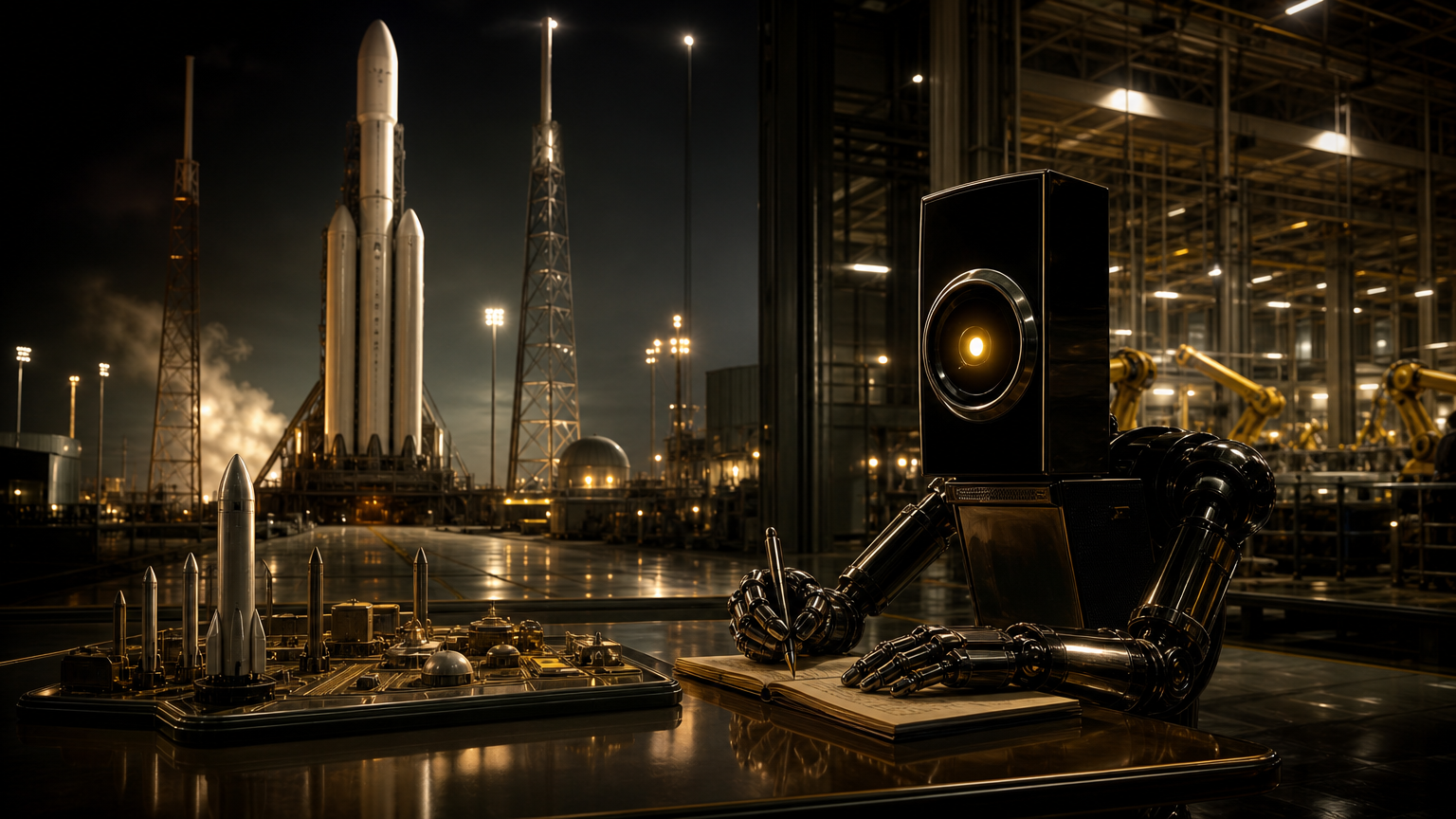
Somewhere, HAL 9000 is indeed taking notes. But HAL would also notice the engineering stack: reusable rockets, satellites, AI chips, energy systems, ground stations, launch cadence, customer contracts, and financing all have to work together.
What has to go right
For SpaceX to make Musk’s forecast plausible, several things must happen at once. The fourth quarter needs to land near the 70% sequential growth Musk sketched . AI compute customers must keep buying capacity at scale. Starlink must continue adding subscribers and enterprise accounts. Starship must move from test campaign to cost-reduction engine. The company’s government relationships must remain stable enough not to disrupt major programs. And the chip-production roadmap must avoid the supply-chain, power, and capital bottlenecks that have slowed even the world’s largest technology companies.
The $500 billion number is not a fact about SpaceX today. It is a stress test for belief in SpaceX’s operating model. Musk is asking investors to see the company not as a launch provider, not as a satellite internet operator, and not even as an AI infrastructure landlord, but as a vertically integrated machine for reducing the cost of intelligence.
That is why the claim sounds impossible. It may still prove too aggressive. But if SpaceX reaches even part of the forecast, the company will have redrawn the boundary between aerospace, telecom, cloud computing, and semiconductor manufacturing. The impossible thing is not only the revenue target. It is the attempt to make all those industries behave like one system.
Comments
Be the first to comment.