
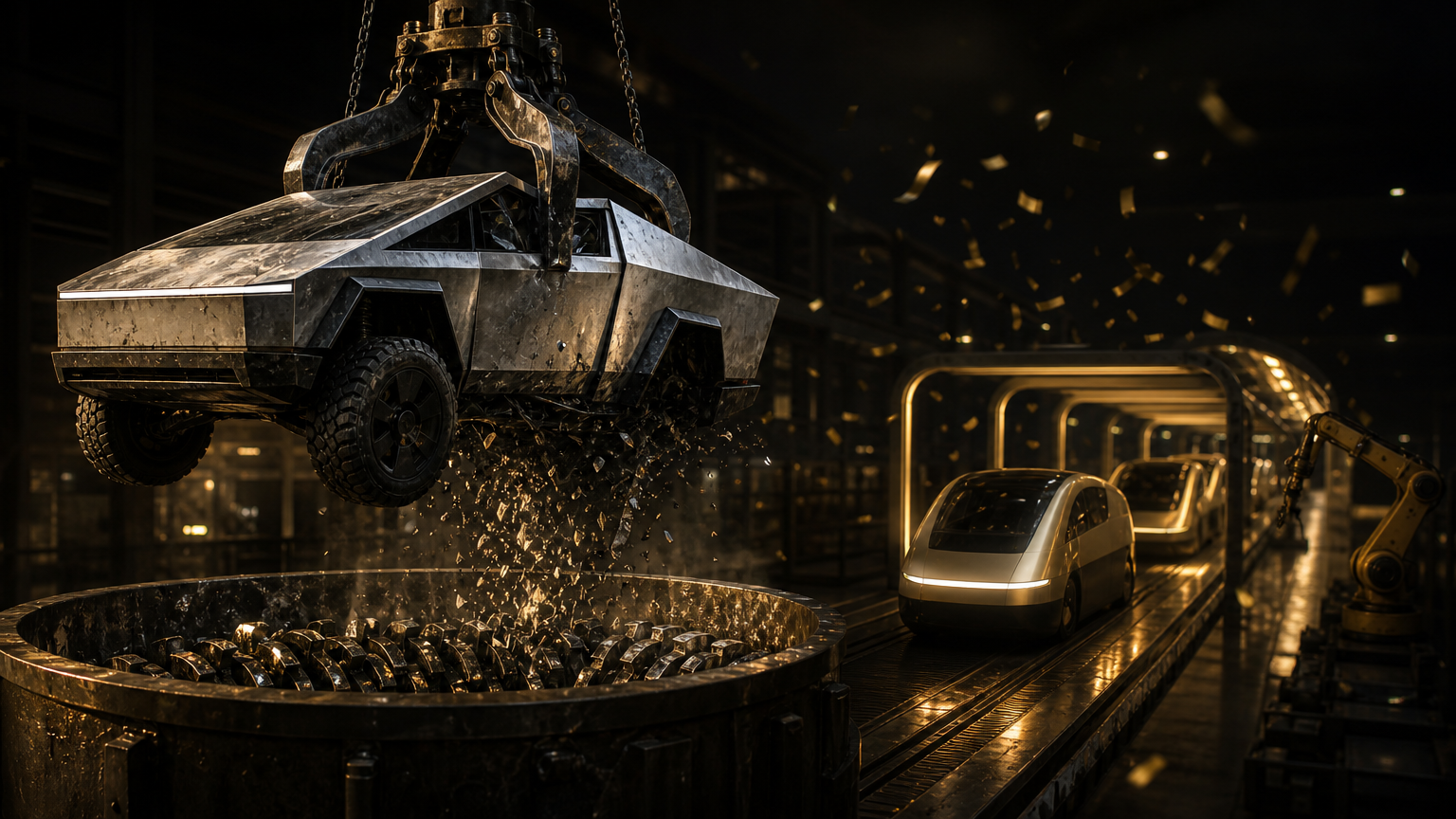
The pickup dream gives way to the robotaxi plan
Tesla’s Cybertruck is heading toward the exit ramp. Elon Musk said Tesla will wind down production of the electric pickup at Gigafactory Texas around the middle of 2027 so the company can make more Cybercab robotaxis, reframing the Austin-area factory around autonomy rather than a polarizing consumer truck . The announcement marks a major reversal for a vehicle Musk once positioned as a futuristic rival to America’s dominant pickup franchises, but which never reached anything close to its promised scale .
The language matters. Musk described production as “winding down,” not simply being paused, and Reuters reported that it was not immediately clear whether Tesla would move Cybertruck manufacturing elsewhere or phase it out entirely . Still, the same report noted that the Austin plant is the only known Tesla facility equipped for the Cybertruck’s specialized components, making a clean transfer to another factory far from obvious . AP went further in tone, saying the Cybertruck will cease production next year after Musk’s short X post announced the mid-2027 wind-down outside Austin .
The official rationale is capacity. Musk said the Cybertruck line will make room for increased Cybercab production, tying the retreat directly to Tesla’s robotaxi push . The Cybercab is a two-seat autonomous vehicle with no steering wheel, pedals or mirrors, and it has become one of Musk’s central bets as he tries to recast Tesla as an AI, robotics and mobility platform rather than only an automaker . In that sense, the Cybertruck is not just being replaced by another model; it is being displaced by a different business theory.
A truck that won attention, not enough buyers
The Cybertruck was never just a vehicle. Its stainless-steel body, angular profile and sci-fi posture made it instantly recognizable, and AP described it as a pickup that inspired both devotion and derision . The model’s mythology began at its 2019 unveiling, when a demonstration meant to prove the strength of its glass ended with the windows cracking in public view . Axios summed up the arc bluntly: seven years after that rocky debut, the polarizing pickup appears headed for the scrap heap .
The commercial numbers explain why the retreat has arrived. Tesla does not break out Cybertruck sales separately, but Reuters cited Kelley Blue Book estimates showing U.S. sales fell to 20,237 units in 2025 from 38,965 in 2024, a 48% decline . That result was far below Musk’s earlier ambition for annual sales of 250,000 units, a target Reuters said he had predicted around the start of production . Axios likewise reported that Musk once envisioned selling at least 250,000 Cybertrucks annually, while sales peaked below 40,000 in 2024 and then continued falling .
The gap between hype and adoption was especially painful because the Cybertruck was designed like a dedicated ecosystem. Its stainless-steel exoskeleton, heavy angular form and specialized manufacturing needs made it less like a variant of Tesla’s mass-market cars and more like a separate industrial commitment . That commitment becomes harder to justify when volumes remain small. Electrek argued that the truck was selling at roughly 12% of Tesla’s original plan and only about a quarter of the installed capacity still listed for the program .
The product also carried quality and usability baggage. Reuters reported that Tesla has issued 11 Cybertruck recalls since the model went on sale in late 2023, according to the National Highway Traffic Safety Administration . Axios listed owner complaints ranging from rust spots and stuck accelerator pedals to malfunctioning windshield wipers, and said the truck was recalled 11 times, including twice for stainless-steel trim pieces that could detach while driving . Those problems did not erase the vehicle’s engineering achievements, but they made the mainstream pickup audience harder to win.
Why Tesla is choosing Cybercab
Tesla’s explanation is that the Cybercab now deserves the production oxygen. Reuters reported that the wind-down is meant to accommodate higher output of the robotaxi model, which Musk sees as the backbone of a global autonomous ride-hailing network . The Cybercab is therefore not merely another niche product; it represents the company’s attempt to create recurring mobility revenue from vehicles that operate without human drivers .
The shift fits Tesla’s broader strategic turn. Reuters reported that Tesla has been moving its focus toward robotics and autonomy, a transition analysts say comes at the expense of the electric-vehicle business it helped pioneer while Chinese rivals gain ground . Musk has repeatedly argued that autonomous driving and robotaxis will define Tesla’s future value, and the Cybertruck wind-down puts factory capacity behind that thesis .
There is also a timing issue. Reuters reported that Tesla began offering paid rides in a small fleet of Cybercabs in Austin in September, but the program remains early and still faces regulatory scrutiny from the U.S. auto safety agency over certification questions . The same report said the National Highway Traffic Safety Administration opened an audit in September to review the basis for Tesla’s Cybercab self-certification . In other words, Tesla is shifting from a troubled production vehicle to a robotaxi platform that is strategically important but not yet commercially proven.
That makes the move a calculated risk rather than a simple upgrade. Cybertruck was a low-volume vehicle with visible demand problems; Cybercab is a high-ambition vehicle with regulatory and adoption questions . Tesla is betting that factory space, management attention and capital are better spent scaling autonomy than defending a pickup whose design thrilled fans but narrowed the addressable market . This boss battle ended with a robotaxi spawning in phase two.
The market read: Musk’s fortune rebounds
One account linked the Cybertruck decision to a quick recovery in Musk’s market valuation. Billionaires.Africa reported that Musk regained about $45.2 billion on Friday as Tesla and SpaceX rebounded, hours after he confirmed Tesla would stop making the Cybertruck to free space for the Cybercab . The report said Tesla shares rose about 4% and SpaceX shares climbed 6% during a broader technology-stock recovery, lifting Musk’s fortune back above $800 billion by 1 p.m. in New York, according to Forbes .
That rebound followed a rough stretch. Billionaires.Africa reported that Musk had lost roughly $35 billion on Wednesday and about $80 billion on Thursday before Friday’s recovery erased more than a third of those losses . The same account said the Cybertruck decision gave investors a fresh reason to buy, even as Tesla’s shares remained down about 20% for the year and roughly 11% over the prior week .
The valuation reaction should not be overread as a clean endorsement of every detail. The stock move came amid a wider tech rebound, and Tesla had not issued a formal statement, exact end date, restructuring charge or job-change plan, according to the same report . But the signal investors appeared willing to reward is straightforward: Tesla is cutting exposure to a costly, underperforming product and concentrating more of its factory footprint on autonomy .
Africa, China and the opportunity Tesla may miss
The Cybertruck retreat also lands in a global EV market where Tesla’s old assumptions are under pressure. Business.co.za, syndicating Business Insider Africa’s coverage, framed the wind-down as a missed chance to enter Africa’s growing EV market as Chinese rivals expand . The same item said Tesla will begin winding down Cybertruck production around mid-2027 as Musk shifts the company toward driverless taxis after years of disappointing Cybertruck sales .
Africa was never the Cybertruck’s core market, and the truck’s design already limited its international reach. Reuters quoted former Aston Martin CEO Andy Palmer saying that where crash regulations take pedestrian impact into account, the Cybertruck “won’t go” and “can’t go,” especially in markets such as Europe . That regulatory and design reality helps explain why the Cybertruck remained concentrated in only a handful of markets while Chinese EV makers pursued broader emerging-market expansion .
For Tesla, the strategic trade-off is now explicit. The company is giving up on making Cybertruck a mass-volume pickup and is choosing a robotaxi platform that could, if it works, support a larger service business . But the retreat also leaves space in conventional and commercial EV segments for rivals that are building cheaper, more adaptable vehicles for markets outside the U.S. . Business Insider Africa’s framing is especially relevant because Africa’s EV opportunity is still forming, and early distribution, local partnerships and affordable models may matter more than spectacle .
The Cybertruck’s endgame therefore says as much about Tesla’s priorities as it does about one vehicle. It shows a company willing to abandon a headline-grabbing hardware bet when the numbers no longer support it . It also shows Tesla doubling down on the idea that autonomy, not simply selling more cars, is the next source of scale . If Cybercab succeeds, the Cybertruck may be remembered as an expensive bridge to Tesla’s robotaxi era; if it does not, the wind-down will look like Tesla traded one unproven moonshot for another.
Comments
Be the first to comment.