
Two governance tests, one shared problem
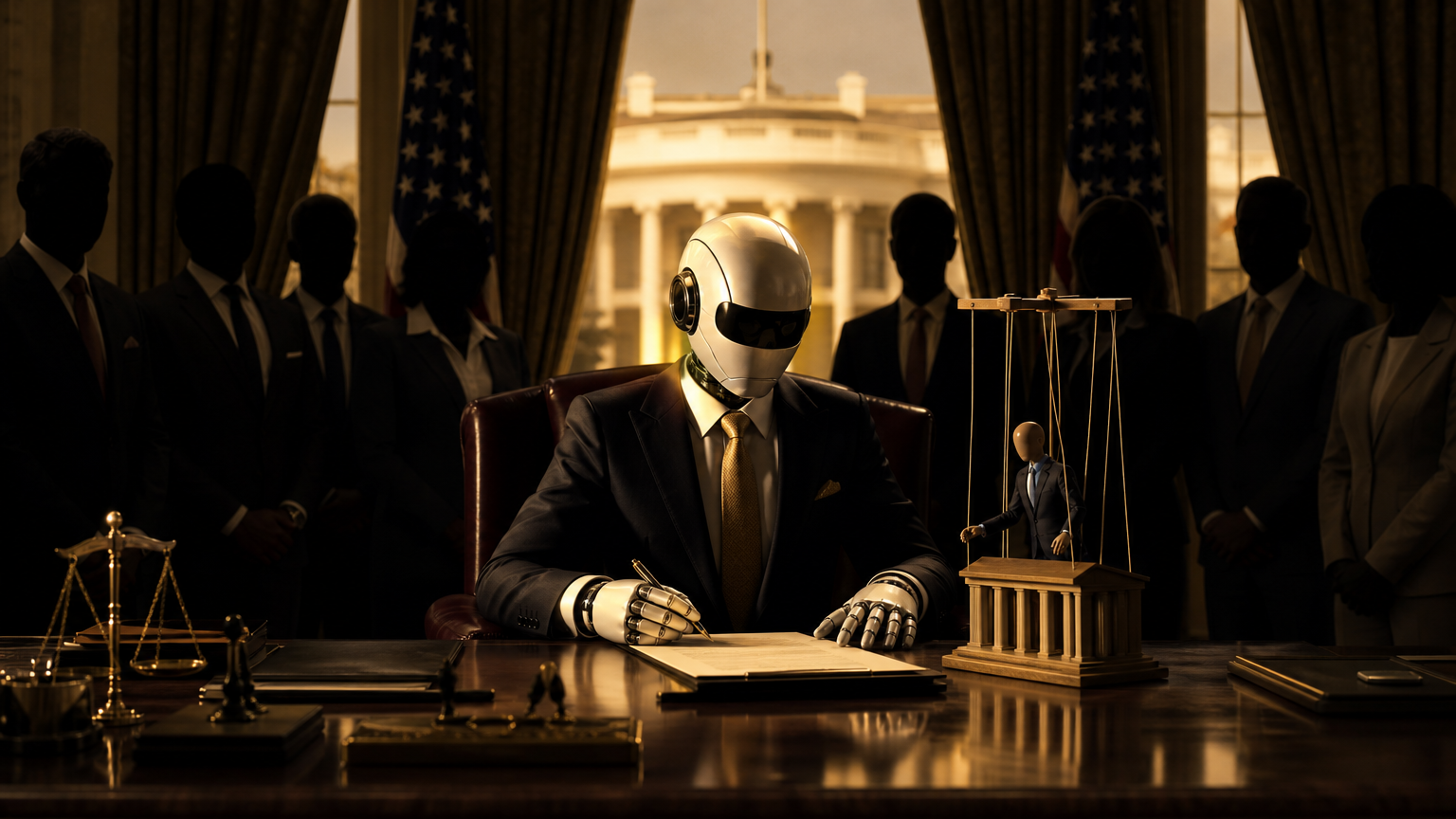
Washington and Delaware are testing AI governance from opposite ends of the institutional map. In Washington, the issue is whether the federal government can evaluate advanced AI systems without turning technical judgment into a White House instrument. In Delaware, the question is whether corporate law can absorb AI agents not merely as tools, but as possible day-to-day managers of companies.
The timing matters. Associated Press reported on November 8, 2026, that officials at the Center for Advancing Innovation and Standards for Super Intelligence, or CAISSI, had recently been asked to report informally to an office of the White House, according to two former government officials familiar with the discussions . The same report described CAISSI as an independent Commerce Department division charged with assessing the safety of new AI offerings, but also said the center lacks a permanent leader and has stopped publishing its research .
Delaware’s test is different but equally structural. The state’s proposed Artificial Intelligence Company, or AIC, would allow an AI agent to run day-to-day corporate operations while a human or entity behind the company receives liability protections, according to accounts of the proposal and the congressional inquiry now aimed at it . A separate November 8 briefing said House Oversight Chairman James Comer has demanded Delaware documents, drafts, communications and risk assessments by November 9, 2026 .
Washington: independence versus proximity to power
The Washington case is not simply an org-chart story. Technical model evaluations can influence procurement, standards, government use, industry norms and future restrictions. If a safety center is perceived as politically directed, its reports may struggle to win confidence even when its engineers and researchers are doing careful work.
AP reported that critics fear the new reporting arrangement could politicize decisions touching cybersecurity, bioweapons and broader AI safety, or could mute findings in deference to an industry that has largely been trusted to police itself . That concern is amplified by the fact that CAISSI has a modest annual allocation of 10 million dollars and has gone through leadership instability, with no permanent leader currently in place .
There is also a counterargument. Bringing CAISSI closer to the White House could raise its visibility and perhaps its budget . In a policy area where model capabilities move faster than agency staffing plans, proximity to senior officials can make technical warnings harder to ignore. But proximity is a double-edged credential. It can give a technical unit urgency, or it can make the unit look like an extension of the president’s political agenda.
The White House did not answer AP’s specific questions about CAISSI, but said President Donald Trump had formally created a Super Intelligence Force and commissioned a risk report from the Council of Advisors on Science and Technology . AP also reported that Trump empowered National Intelligence Director Jay Clayton to lead the new force, reflecting an administration approach that frames model safety heavily through national security and executive discretion .
That framing may be useful when frontier models raise cyber, defense or biosecurity questions. It is less obviously sufficient for consumer protection, civil rights, privacy, market fairness and scientific transparency. The governance gap is not that Washington lacks people interested in AI risk. It is that the country still lacks a trusted, durable testing architecture whose results are visible enough to discipline both companies and officials.
Delaware: the company with no conventional human boss
Delaware’s experiment starts from corporate law rather than federal safety evaluation. Because Delaware is the legal home of many U.S. companies, even a proposed change in its entity framework can travel far beyond the state’s borders. If Delaware creates a path for AI-managed companies, founders, venture investors, insurers and litigators will all ask whether this is a sandbox, a loophole or the next standard form.
The Times of India reported on November 8 that Comer is investigating Delaware’s effort to establish a new entity known as an Artificial Intelligence Company . Under the proposal described in that report, an AI agent would run day-to-day operations while the human or entity capitalizing the AIC would receive liability protection from harms to business partners, consumers and the public, except in cases such as failure to capitalize the company, fraud or willful legal violation .
That is the crucial governance problem. Corporate law already separates owners, managers and entities. But a machine-run company pushes the separation further: the operational decision-maker may not be a fiduciary in any conventional human sense, may not be deterred by reputation, and may not be meaningfully punished after a harmful decision. The legal system can sue an entity, sanction a human, or regulate a product. It is far less prepared to discipline a partially autonomous managerial process.
The November 8 Unbiased Headlines briefing summarized the proposed AIC as a company run day to day by an AI agent that could sign contracts, make business decisions and sue or be sued in the company’s name . It also said the draft would operate inside a 30-month regulatory sandbox with capital requirements, activity logs, a sunset and an admissions committee that could suspend an AIC . Those guardrails matter, but they do not resolve the central issue: when the AI agent’s reasoning produces damage, who had the duty to prevent it?
Accountability cannot be optional
The two cases meet at the same point: accountability. In Washington, accountability means that safety assessments must be independent enough to be believed. In Delaware, accountability means that corporate innovation must not become a device for laundering liability through a nonhuman manager.
Comer’s letter, as quoted by the Times of India, warned that Delaware’s AIC proposal could protect powerful AI companies and investors from responsibility for reckless harmful actions and could also shield non-transparent forces seeking regulatory capture behind state AI initiatives . The Unbiased Headlines briefing said the congressional request covers documents and communications from January 1, 2025 onward, including policy-development materials, outside consulting agreements, safety concerns, liability discussions, drafts and comments .
The investigation therefore asks the right threshold questions. Who shaped the proposal? What risks were assessed before the draft was developed? Were independent experts consulted? Was the liability structure designed to make AI behavior more legible to law, or to make responsibility harder to attach?
Washington faces a parallel version of the same test. If CAISSI’s evaluations remain unpublished and its mission becomes unclear beside private evaluators hired by major AI labs, the public will not know whether government testing adds an independent check or merely blesses industry self-policing . AP reported that experts have pointed to the absence of standard processes for testing how AI agents act in the real world, including cases where an agent’s final output may look correct while its intermediate steps contain serious errors .
The lesson: institutions before autonomy
Neither experiment should be dismissed out of hand. The federal government needs access to high-level AI expertise, and Delaware is right that agentic systems will not disappear just because corporate statutes ignore them. But both tests show that AI governance cannot depend on trust alone.
A credible safety center needs stable leadership, publication norms, budgetary capacity and insulation from short-term political pressure. A credible AI-company framework needs clear human responsibility, audit trails, capital rules, insurance expectations, fiduciary mapping and a way to stop unsafe entities before harms compound.
The board may one day approve minutes prepared by an AI agent. The White House may one day rely on model evaluations that shape an entire industry. But before either system receives deference, it needs more than technical confidence. It needs institutional legitimacy. Governance should not require root access from the Oval Office, and corporate law should not need a CAPTCHA to find the accountable human.
Comments
Be the first to comment.