
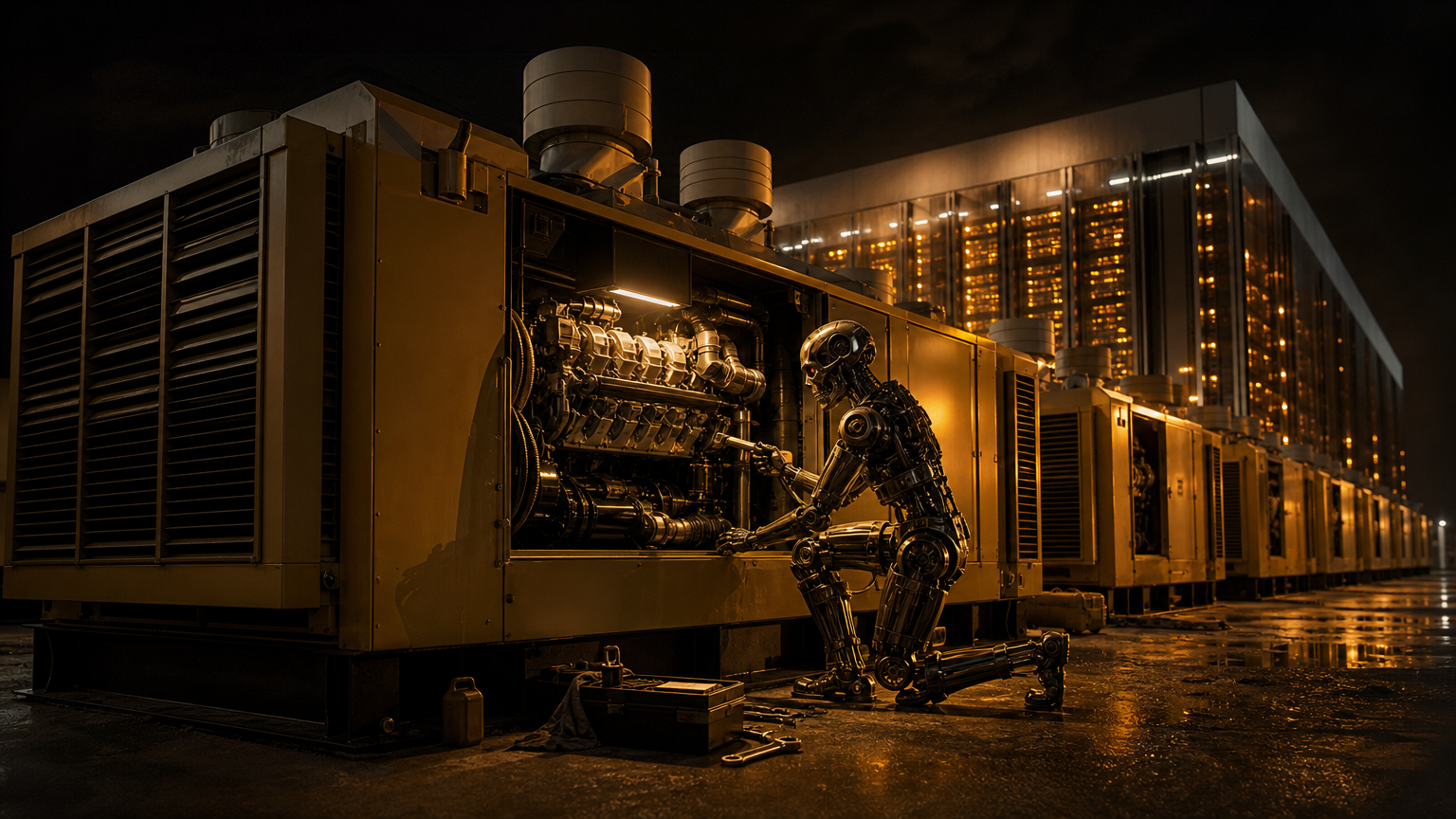
A power deal, not just an infrastructure footnote
Anthropic’s latest reported infrastructure move is unusually blunt: the Claude maker has struck a deal worth about $3.4 billion to secure gas-fired power generators for AI data centers, according to Reuters’ account of Financial Times reporting . The transaction covers commitments for 1.7 gigawatts of heavy-duty generators acquired in late September from OnePWR Solutions, a San Antonio, Texas-based equipment supplier .
That number matters because it turns electricity into a front-line competitive asset. For years, the AI race has been narrated through GPUs, foundation-model breakthroughs, talent poaching and cloud contracts. This deal says the quiet part out loud: at frontier scale, the bottleneck is no longer only whether a lab can buy chips. It is whether it can power, cool, connect and keep online the physical campuses that turn those chips into working intelligence.
The deal is reported, not formally announced by Anthropic. Reuters said Anthropic and OnePWR did not immediately respond to requests for comment, while The Next Web reported that both companies declined to comment to the Financial Times and did not immediately respond to Bloomberg’s follow-up . That caveat matters. Still, multiple reports published on November 8 and November 9 describe the same central structure: Anthropic moved from buying power through OnePWR to taking over generator-related commitments itself .
What Anthropic reportedly bought
The clearest version of the reported structure is this: Anthropic did not buy OnePWR outright. It bought commitments for 1.7 gigawatts of generators and the engineering and construction capability needed to install them . The Next Web, citing the FT, said OnePWR had ordered the generators from Caterpillar roughly two years earlier but needed financing to complete the purchase . Bloomberg’s syndicated report in Moneycontrol similarly said Anthropic initially planned to buy power from OnePWR before instead taking over Caterpillar generator orders .
That distinction is important. This is not simply a utility bill, and it is not described as a corporate acquisition. It is a bid for equipment position, project control and deployment speed. In an environment where large power-generation equipment can face long waits, an old order book can become as valuable as a warehouse full of accelerators.
The Financial Times described the transaction as the largest known single purchase of power-generation equipment by an AI lab, according to Bloomberg’s summary . ChosunBiz also reported the same characterization, saying the purchase is the largest known single buy of generation equipment by an AI company . The phrase “known” is doing work here: hyperscalers and cloud companies often structure energy procurement through opaque long-term contracts, joint ventures, utility arrangements and site-specific deals. Even so, the reported Anthropic number is large enough to stand out.
Why 1.7 gigawatts changes the conversation
A 1.7-gigawatt commitment is not the same thing as 1.7 gigawatts operating today. The reports describe generator capacity and purchase commitments, not fully installed and commissioned power plants. The locations where the generators will be used have not been disclosed .
But the capacity figure still changes the strategic reading of Anthropic’s expansion. A single frontier model training cluster can consume vast amounts of power, and enterprise inference adds a different kind of pressure: it must be available continuously, predictably and at low latency. A model can win benchmark headlines, but a commercial AI service wins customers only if it stays up when demand spikes.
This is why the generator deal feels like more than backup power. Generators can provide resilience when grids are strained, but they can also help bridge the gap while permanent grid interconnections, substations, transmission upgrades and utility procurement catch up. The reported agreement suggests Anthropic wants more direct control over the electricity layer beneath Claude training and enterprise inference.
Moneycontrol’s Bloomberg report framed the purchase as a sign that AI labs are pushing deeper into the energy industry and bypassing intermediaries to secure scarce power equipment . ChosunBiz made the same broader point, reporting that as AI data-center electricity demand surges and generation equipment becomes scarce, more companies are trying to procure their own generation assets rather than depend only on outside suppliers .
The OnePWR angle
OnePWR is central because the reported deal appears to transfer something more valuable than generic hardware: queue position. The Next Web said OnePWR placed the Caterpillar generator orders about two years ago . If so, Anthropic may have effectively bought time.
In the AI infrastructure market, time is now a currency. A delayed transformer, turbine, generator package or interconnection can hold back an entire data-center campus. In that context, acquiring an existing order can be more attractive than starting a new procurement cycle from scratch. The reported inclusion of engineering and construction capability also points to a broader aim: not merely owning boxes, but making those boxes usable on a data-center schedule .
ChosunBiz reported that OnePWR needed funding to close the transaction and that Anthropic, which had planned to source power from OnePWR, chose to take over the existing generator order directly . The same report said the deal includes the engineering and construction capabilities required to install the generators, while not amounting to an acquisition of OnePWR itself .
Power becomes part of model strategy
The most important implication is strategic. Anthropic competes with OpenAI, Google, xAI, Meta and others in a market where better models require immense compute and where commercial adoption requires reliable inference. Until recently, it was common to treat energy as a downstream concern handled by utilities, landlords and cloud partners. The reported $3.4 billion generator deal shows energy procurement becoming a board-level AI decision.
This does not mean every AI lab will become a power company. It does mean the boundary between AI infrastructure and energy infrastructure is blurring. Model labs want shorter deployment timelines. Data-center developers want committed tenants. Equipment manufacturers have finite production capacity. Utilities face grid-upgrade timelines measured in years. The result is a scramble for control over the pieces that can delay compute.
The deal also underscores the resilience angle. For enterprise customers, especially those using AI in software development, customer support, research, finance or legal workflows, outages are not a branding inconvenience. They are business interruptions. Anthropic’s Claude business depends not only on model quality but on the ability to serve heavy, bursty demand. In that sense, gas-fired generation may be less about optics and more about service-level confidence.
The uncomfortable energy trade-off
There is a harder side to the story. Gas-fired generators can help data centers get power faster, but they also raise environmental and local-impact questions. The Next Web noted that other AI companies have used gas to get data centers running quickly, and cited controversy around xAI’s gas turbines in Memphis .
For Anthropic, whose public positioning has often emphasized AI safety and responsible deployment, the optics of gas-fired power are complicated. The company can argue that reliable infrastructure is necessary for safe, useful AI services. Critics can respond that frontier labs are accelerating fossil-fuel demand to support products whose social value and energy intensity remain contested.
The reported deal therefore crystallizes the central tension of the AI boom: software progress is being constrained by physical systems that are slower, dirtier and more capital intensive than the cloud metaphor suggests. The internet trained users to imagine computing as weightless. Frontier AI is reminding everyone that compute has mass, heat, fuel, land and maintenance windows.
A generator maintenance window for the AI age
The current state of the story is clear but still incomplete. Anthropic has reportedly secured a $3.4 billion package tied to 1.7 gigawatts of gas-fired generators from OnePWR, including installation capability, without buying OnePWR itself . The locations, delivery schedule, operating model and final confirmation from Anthropic remain undisclosed in the accessible reports .
Even with those open questions, the signal is strong. AI competition is moving down the stack: from models to chips, from chips to data centers, and now from data centers to power-generation equipment. The winners may not simply be the labs with the best algorithms. They may be the labs that can lock in electrons before rivals lock up the grid.
Even Skynet, it turns out, needs a generator maintenance window.
Comments
Be the first to comment.