
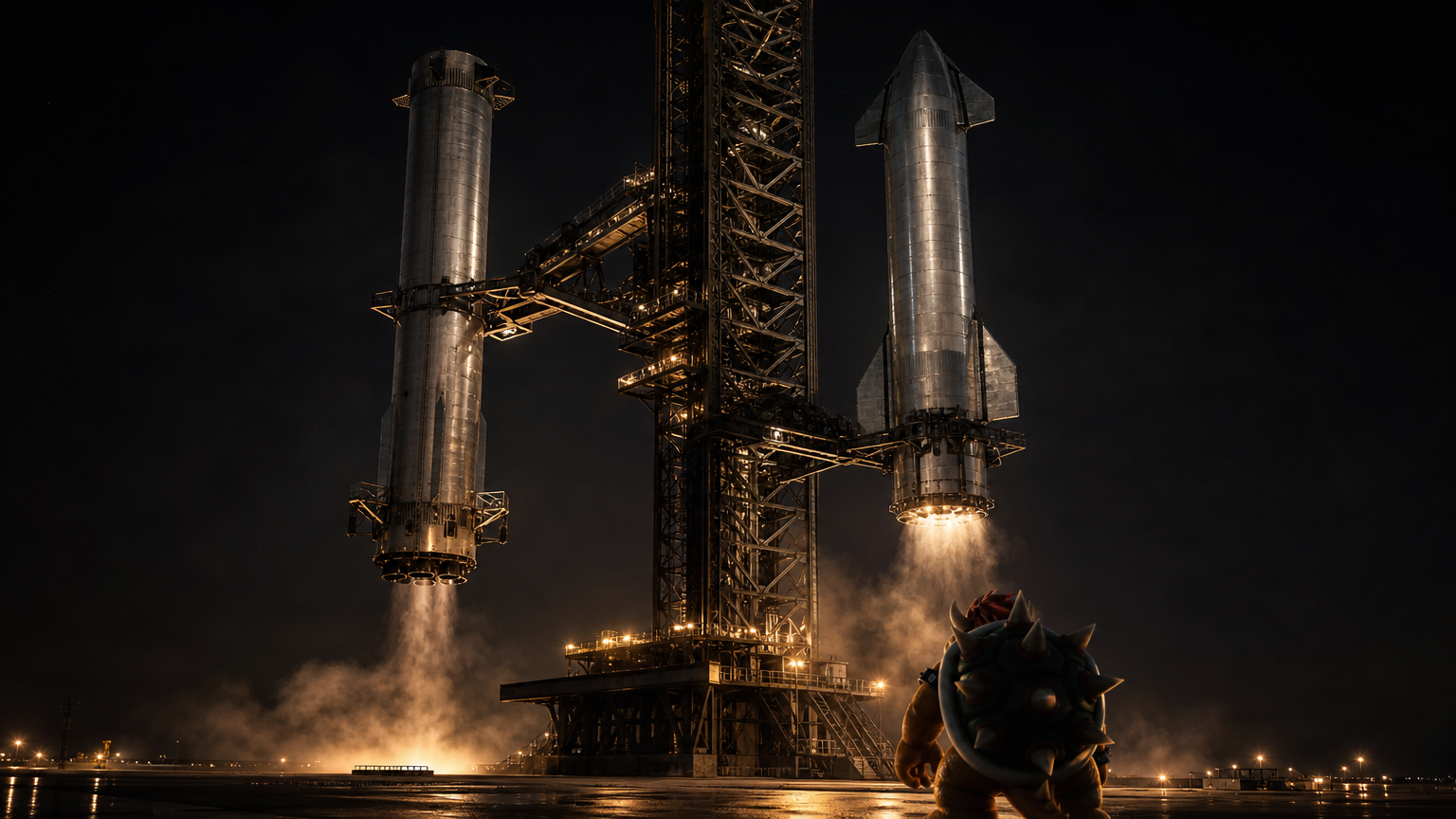
A milestone headline, with one important caveat
The working headline is clear: SpaceX completes first double catch. The fresh reporting around this exact Starship story, however, points to a more precise current state: SpaceX is preparing for the first attempt to catch both the Super Heavy booster and the Starship upper stage on Flight 15, targeted no earlier than Friday, November 13, 2026 . That distinction matters because “double catch” is not a routine recovery phrase; it would describe the first full return of both stages of an orbital launch system to the launch site for capture by tower infrastructure .
Several reports published on November 9 describe the same architecture and the same stakes. SpaceX has scheduled a 75-minute window opening at 4:45 p.m. Central Time from Starbase, Texas, and the company’s own mission description, as cited by Space.com, says the upcoming flight is planned to be the first return of both Starship and Super Heavy to the launch site for catch . Aerospace Global News likewise reports that Flight 15 is targeted for November 13, subject to regulatory approval, and will attempt to return both stages to mechanical catch arms rather than splash them down . Quartz, citing SpaceX’s timeline, describes the booster catch at roughly six minutes and 35 seconds after liftoff, with the ship catch planned around 22 hours and 32 minutes after launch .
So the story is not merely “a rocket lands.” It is a test of whether SpaceX can convert Starship from a spectacular prototype into a reusable transport system whose most expensive hardware comes home to the pad.
What the double catch is supposed to prove
Starship is a two-stage system: Super Heavy is the first-stage booster, while Starship, often called Ship, is the upper-stage spacecraft . Previous Starship flights have already shown parts of this recovery concept. SpaceX has caught Super Heavy boosters before, but it has not yet completed a tower catch of the Starship upper stage . Flight 15 is therefore the first mission designed to bring both halves back to Starbase for tower capture, with the upper stage presenting the harder challenge because it travels higher, faster and longer before returning .
The plan compresses two very different recoveries into one mission. The booster’s job is brief but violent: help lift the full stack, separate, reverse course, guide itself back using grid fins and engines, and arrive at the tower within tight positional and speed limits . If the vehicle meets SpaceX’s automated criteria, the launch tower’s arms close around the booster’s catch points; if not, the vehicle is directed away from the tower .
The upper stage is more demanding. SpaceX expects Ship to reach an orbit of about 275 kilometers and complete roughly 14 orbits over more than 22 hours before attempting to return . That long coast is central to the mission because teams must check the spacecraft’s engines, control systems, navigation, communications and thermal-protection condition before committing to a return over land and a tower approach . If systems do not meet the required criteria, the mission design includes opportunities to avoid the catch attempt and dispose of the vehicle over preselected ocean areas .
Why flying back over Texas changes the story
A double catch is a technical event, but it is also an operational and community event. Autoevolution’s November 9 report emphasizes that returning Starship to Starbase requires a path over populated areas in northern Mexico and southern Texas, with expected sonic booms near the return corridor . That is not an incidental detail. The very act of making Starship reusable at the launch site pushes high-energy aerospace operations closer to communities, regulators, airspace managers and local infrastructure.
For the public, the most noticeable effect may be sound. A spacecraft returning from orbital speed must decelerate through the atmosphere, and parts of the flight profile involve supersonic motion that can produce audible booms . For SpaceX, the engineering question is whether the vehicle can fly the corridor precisely enough to satisfy safety criteria before it is allowed to approach the tower . For regulators and residents, the question is whether the operational burden of more frequent returns can be managed as Starship’s cadence rises.
That tension is likely to define the next phase of Starship as much as Raptor engines or heat-shield tiles. Reusability only pays off if the operation can be repeated, licensed, cleared and accepted. A successful catch that creates unmanageable disruption would not be enough; a repeatable system must work technically and socially.
Why catch instead of splash down?
The appeal of catching both stages is straightforward: a rocket recovered at the pad can, in principle, be inspected, refurbished, refueled and flown again faster than hardware recovered from the ocean. Aerospace Global News notes that tower recovery eliminates the need for landing legs on Super Heavy and avoids transporting a booster back from a separate landing zone or platform . That logic becomes even more powerful for Starship’s upper stage, which is central to SpaceX’s ambitions for Starlink deployment, lunar missions and eventually Mars transport.
Flight 15 is also not just a recovery demonstration. The mission is planned to deploy 26 Starlink V3 satellites, matching the commercial payload profile that SpaceX used on Flight 14 . Aerospace Global News reports that three of those satellites are expected to carry cameras to inspect Starship’s heat shield during flight, giving engineers imagery before the return attempt . Quartz adds that the satellites are intended to contribute additional network capacity after deployment and checkout .
That combination is important. SpaceX is not separating “test flight” from “useful mission” as cleanly as traditional development programs might. It is trying to test heat-shield upgrades, demonstrate orbital operations, deploy satellites and validate recovery infrastructure in one long flight.
The heat shield is the quiet gatekeeper
The most dramatic images will be the tower arms, but the heat shield may decide whether a ship catch is even attempted. Reentry is the part of the mission that turns orbital speed into survivable descent, and the ship cannot be allowed to approach Starbase unless teams are confident its thermal protection, attitude control and engines are healthy . Quartz reports that Flight 15 includes heat-shield improvements derived from Flight 14, including additional tile-retention mechanisms and a curved tile design intended to reduce heating in gaps .
That focus explains the long orbital duration. A booster catch happens before viewers have time to exhale; a ship catch requires patience. Over roughly 14 orbits, SpaceX can gather telemetry, inspect the heat shield, evaluate the vehicle’s condition and then decide whether to proceed . In other words, the double catch is not a single stunt. It is a sequence of go/no-go decisions, each designed to prevent a damaged upper stage from becoming a public-safety problem.
What success would mean
If both catches succeed, Flight 15 would mark a breakthrough in reusable rocketry: the first full recovery of an orbital launch system using launch-site infrastructure . It would not instantly prove aircraft-like turnaround, nor would it guarantee that Starship can be reflown without heavy refurbishment. But it would demonstrate that the recovery concept can work for both stages in one mission, which is the prerequisite for the rapid reuse model SpaceX has been pursuing.
The larger implication is economic. Every stage that avoids seawater, transport delays and heavy recovery logistics has a better chance of being turned around quickly. If the maneuver becomes routine, it could lower marginal launch costs, increase Starlink deployment capacity and support NASA’s lunar architecture, where Starship-derived systems are expected to play a major role .
The operational implication is just as large. A reusable Starship is not only a vehicle; it is a launch-and-return network involving towers, pads, road closures, airspace restrictions, maritime zones, acoustic impacts and public tolerance. Flight 15’s double-catch attempt therefore sits at the intersection of engineering ambition and community constraint.
The bottom line
The current, freshly sourced record does not show that SpaceX has already completed the first double catch as of November 9, 2026. It shows that SpaceX is targeting Flight 15 for the first such attempt on November 13, with a booster catch minutes after launch and a possible ship catch more than 22 hours later . If SpaceX completes both recoveries, the company will have moved closer to the rapid full reusability it has advertised for years. And yes, with two giant catches in one mission, even Bowser would probably envy the timing.
Comments
Be the first to comment.