
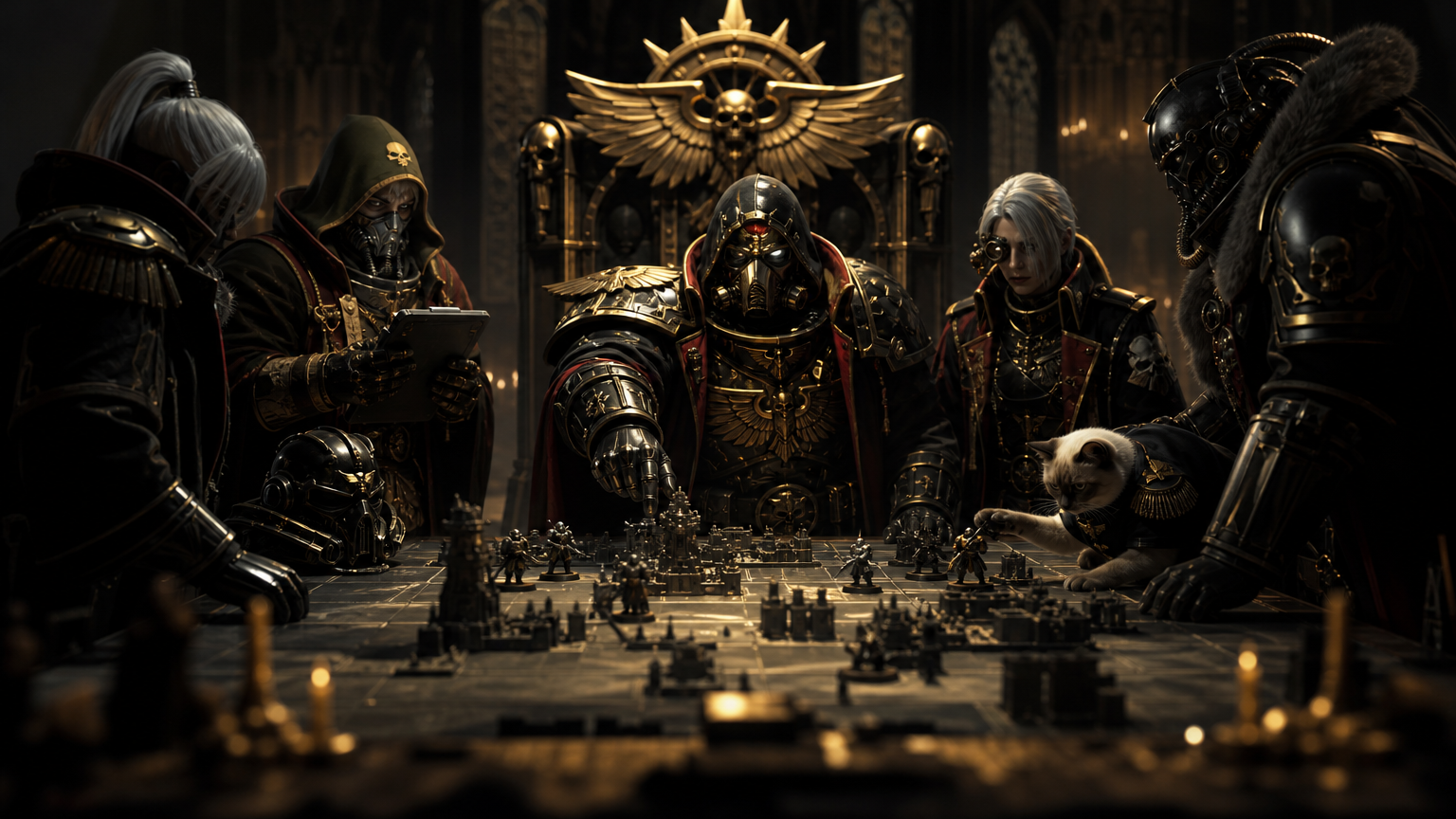
A date for the Inquisition
Owlcat Games has confirmed that Warhammer 40,000: Dark Heresy will launch on January 28, 2027, giving the studio’s next grimdark CRPG a specific place on the early-2027 calendar . The launch is set for Windows PC via Steam, GOG, and the Epic Games Store, plus PlayStation 5 and Xbox Series X|S . A Nintendo Switch 2 version is still planned, but Owlcat says details for that release will come later .
That matters because this is not just another licensed Warhammer 40,000 announcement. Dark Heresy is being positioned as Owlcat’s next major 40K role-playing project after Warhammer 40,000: Rogue Trader, and multiple reports from the new announcement cycle describe it as a party-based, story-driven cRPG tied directly to the Inquisition rather than dynastic exploration . Where Rogue Trader gave players a vast mandate to command a trade empire, Dark Heresy narrows the lens to suspicion, interrogation, and judgment.
The fresh release-date trailer and accompanying announcement also clarify the final pre-launch runway. Founder’s Packs remain available until the beginning of January, while the current beta, available to founders, is scheduled to close on January 7, 2027, three weeks before release . For a dense Owlcat RPG, that beta shutdown is not a minor scheduling note. It signals the transition from community-facing test build to final launch preparation.
What kind of 40K RPG is Dark Heresy?
The premise is pure Inquisition: players begin as acolytes operating in the Calixis Sector, where cults, conspiracies, apostasy, and servants of the Archenemy lurk across both slums and elite spires . Owlcat’s release describes a war band assembled from zealots, outcasts, sanctioned threats, and morally uneasy allies, with the player responsible for deciding how far to go in the name of Imperial salvation .
The emphasis is not only on fighting. Recent coverage repeatedly frames Dark Heresy as an investigation-focused CRPG, with players examining evidence, identifying suspects, and deciding whether the truth is worth the cost . Dot Esports describes the structure as evidence gathering and case work, including the possibility of accusing the wrong people, while PC Gamer highlights the investigation of heresy as the game’s key distinction from Owlcat’s previous power-fantasy formats .
That change of fantasy is significant. Owlcat’s earlier RPGs often gave players command over kingdoms, crusades, starships, or dynasties. Dark Heresy, by contrast, places the player in an institution whose authority is immense but whose work is paranoid and corrosive. In Warhammer 40,000 terms, that is a strong fit: the Inquisition is terrifying precisely because its agents can be righteous, compromised, pragmatic, fanatical, or all of those at once.
The official pitch leans into consequence. Owlcat says companions can contribute both in revamped tactical combat and through advice during investigations, while players decide whether to pursue truth at all costs or sacrifice innocents for advantage . The studio’s own language makes one thing clear: Dark Heresy is not selling clean heroism. It is selling the burden of power in a setting where innocence is rarely enough to save anyone.
Platforms, beta, and the Switch 2 question
At launch, Dark Heresy’s confirmed platform list is clean: PC, PS5, and Xbox Series X|S on January 28, 2027 . Gematsu reports the same lineup and notes that the Switch 2 version will follow later, matching Owlcat’s own wording . RPGamer likewise reports PC, PlayStation 5, and Xbox Series X|S for launch, with Nintendo Switch 2 planned afterward .
The absence of a Switch 2 date is the one conspicuous gap in the announcement. It does not cancel the version; it simply leaves it outside the January 28 day-one group. That makes practical sense for a large CRPG with complex interface demands, long text sequences, and tactical encounters. Still, for players hoping to take the Inquisition handheld on day one, the current answer is: not yet.
The beta timeline is clearer. Owlcat says Founder’s Packs can still be purchased through the beginning of January and that the beta will close on January 7, 2027 . Dot Esports reports that the beta has been running with around 20 hours of content and includes a look at noble spires, an investigation in a governor’s palace, and access to recruit Chorda . Even if that build is not the final game, it offers a useful glimpse of Owlcat’s priorities: companion reactivity, investigative structure, and revised tactical systems.
Companions in the gray zone
Dark Heresy’s companion roster is already doing a lot of world-building. Owlcat’s announcement names potential recruits including Cogg, an abhuman; Saro, a psyker; Discordance, a Pariah; Laarthyr, an Aeldari Corsair; and Ra’akhti, a Kroot . It also mentions more human figures such as the Catachan fighter Haymar, the Rogue Trader Chorda, and Touma .
That list is important because it shows the game’s central tension: an Inquisitorial war band often uses tools the Imperium claims to despise. Psykers, xenos, abhumans, and pariahs are not comfortable allies in the 41st Millennium. They are liabilities, weapons, temptations, and, in the hands of a player, character-building choices.
Dot Esports expands on this by identifying Cogg as an Ogryn, Saro as a psyker, Discordance as a Pariah, Laarthyr as an Aeldari corsair, and Ra’akhti as a flesh-eating Kroot, while also noting that Aspyce Chorda comes from the Rogue Trader side of the setting . That carryover is a smart bridge for Owlcat’s existing audience. It does not make Dark Heresy a direct retread; it gives Rogue Trader players one familiar thread while moving the overall premise from command and commerce to suspicion and prosecution.
Tactical changes and Owlcat’s launch challenge
Combat is still turn-based, but the latest reporting points to more than a simple reskin of Rogue Trader. Dot Esports reports that Owlcat rebuilt many systems rather than simply reusing Rogue Trader, and describes changes such as morale-influenced outcomes, reworked cover and line of sight, and the ability to aim at specific body parts . GamingBolt similarly reports that combat follows familiar Rogue Trader principles while emphasizing a darker tone and investigation-driven objectives .
That is promising, but it also raises expectations. Owlcat’s audience tends to like complexity: builds, edge cases, party synergies, branching consequences, and systems that creak under the weight of player experimentation. PC Gamer’s coverage notes both enthusiasm for Dark Heresy’s investigative shift and lingering caution around Owlcat launch states, recalling earlier pre-release and review-period issues with the studio’s RPGs .
That caution is fair, especially for a game built around consequences. Investigation systems are only satisfying if outcomes feel legible, reactive, and durable. If an innocent can be condemned, the game must make that error narratively meaningful rather than just a failed dialogue check. If companions advise the player, their input must feel grounded in personality, ideology, and knowledge. If tactical combat now includes morale, body targeting, and revised cover, those systems must be clear enough to support planning instead of guesswork.
Why January 28 is a strong date
The January 28 date gives Owlcat roughly seven weeks between the beta closure and public launch. It also places Dark Heresy early enough in 2027 to become one of the year’s first major RPG talking points rather than fighting for attention in the crowded holiday window. The timing is especially useful for Warhammer 40,000 fans: Rogue Trader’s legacy is still recent, and the Inquisition offers a different fantasy inside the same universe.
Most importantly, the announcement gives the game a concrete identity. Dark Heresy is not merely “the next Owlcat 40K game.” It is the studio’s Inquisition CRPG, a secret-war story about evidence, corruption, and the cost of certainty. The Emperor may protect, but in Dark Heresy, players will still have to decide whom to trust, whom to burn, and whether the save file before a major judgment is worth keeping.
Comments
Be the first to comment.