
Two incidents, one operational warning
Two very different cybersecurity stories broke into public view this week: France accused an Iranian Revolutionary Guard-linked cyber unit of sabotaging supermarket refrigeration controllers, while Vanderbilt University told its community to shut down or disconnect university devices during an active incident affecting campus technology. They are not the same attack, and there is no public evidence connecting them. Their common thread is more important: both show how cyber incidents now become operational crises almost immediately.
In France, the target was not a government database or a defense contractor. It was refrigeration. The French Foreign Ministry said that, during the night of October 11 to 12, a cyber campaign hit refrigeration controllers deployed at more than 700 large-retail sites, causing major material damage, food losses estimated at tens of millions of euros and fire outbreaks . France attributed the destructive activity to Shahid Kaveh, a cyber-offensive unit affiliated with the electronic and cyber center of Iran’s Islamic Revolutionary Guard Corps .
At Vanderbilt, the impact was institutional continuity rather than cold-chain logistics. The university said on November 9 that it was responding to an active cybersecurity incident that could affect university devices, systems and cloud-based services, and asked students, faculty and staff to shut down university devices, disconnect from university Wi-Fi and watch for suspicious activity . By Monday evening, campus Wi-Fi had returned, but access to most Vanderbilt systems and applications remained restricted, with classes scheduled to proceed normally on Tuesday, November 10 .
France’s frozen aisle becomes geopolitical terrain
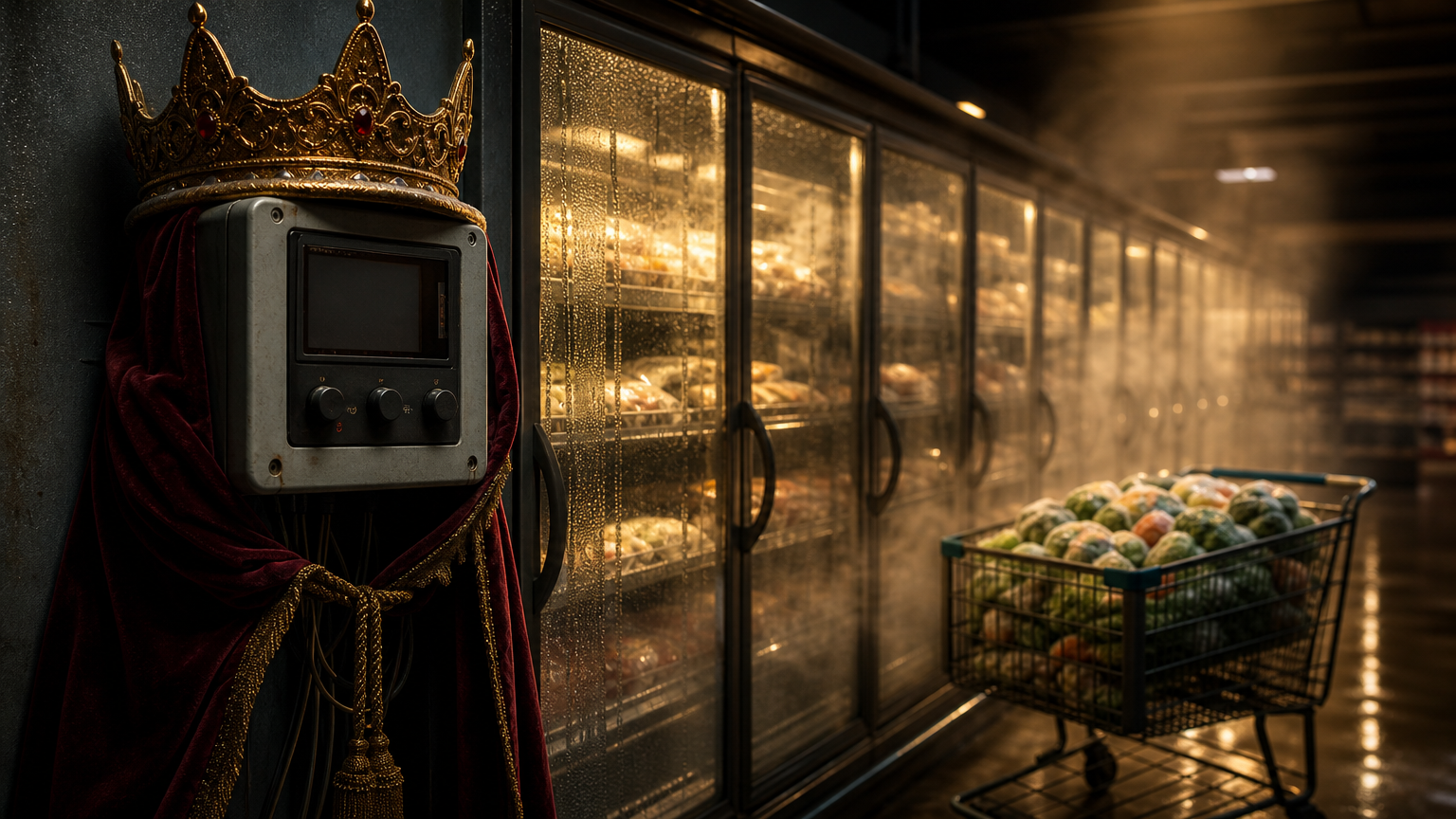
The French case is striking because it turns supermarket refrigeration into a national-security issue. CERT-FR’s public report says the Cyber Crisis Coordination Centre was alerted on October 12 to an attack on cold controllers at about 700 retail sites in France, after attackers compromised equipment overnight and modified defrost settings to high temperatures . The report says this caused significant merchandise losses and at least 15 fire outbreaks .
This is not a symbolic website defacement. Refrigeration is a physical process with health, safety and supply-chain consequences. A successful manipulation of temperatures can force retailers to discard food, interrupt sales, create insurance and repair costs, and undermine trust in the basic reliability of a grocery network. The Foreign Ministry called the episode the first cyber-offensive campaign conducted purely for sabotage on French national territory, describing it as unprecedented in scale and aggressiveness .
The scope also appears broader than the most visible supermarket losses. CERT-FR said affected entities were mainly in large retail, including Casino, Leclerc, Coopérative U, Metro, Carrefour and Intermarché, but also noted other victims in the agri-food sector, including small butcher shops, a slaughterhouse and cooperative food-processing facilities . The same report said the C4 observed contemporaneous targeting of several Schneider Electric devices belonging to small hydroelectric installations in France, with moderate effects .
France’s response moved beyond technical remediation. The Foreign Ministry said it would summon Iran’s ambassador, propose new European sanctions against Iranian entities and individuals involved, and reserve the right to take additional public or non-public measures judged necessary and proportionate . Associated Press reported that Paris prosecutors opened a judicial investigation into suspected organized cybercrime with the aggravating circumstance of serving a foreign power, and that the prosecutor’s office would seek international arrest warrants .
Attribution raises the stakes
Attribution is often the most politically sensitive layer of a cyber incident. Here, France did not merely describe a technical compromise; it named a state-linked structure. CERT-FR said C4 members attributed destabilization attacks against French interests to Shahid Shoostari and Shahid Kaveh, units operating within the IRGC’s electronic and cyber center . For the refrigeration attack, the report pointed to indicators including reuse of infrastructure for reconnaissance against industrial equipment, use of the FOFA scanning tool, promotion through CyberbanNews and traces of Farsi in attack infrastructure .
That attribution matters because it reframes what might otherwise look like criminal vandalism. If a state-linked actor manipulates mundane industrial controllers, every poorly segmented operational network becomes potential geopolitical surface area. Supermarket cold rooms, small energy installations and food processors are not usually designed or staffed like defense systems. Yet once connected, remotely administered or exposed, they can be targeted in ways that produce physical consequences.
The lesson is not that every refrigerator is a strategic asset. The lesson is that dependency chains have changed. Food safety depends on temperature. Temperature depends on controllers. Controllers may depend on remote access, monitoring software, credentials and network segmentation. If those layers are weak, a diplomatic conflict can arrive through the frozen aisle.
Vanderbilt: a campus becomes an incident-response zone
The Vanderbilt incident shows the same operational pattern inside a university. The first concern may be cyber containment, but the second is continuity: classes, coursework, research, payroll, student services and health-adjacent operations depend on shared systems.
Vanderbilt’s official update said the incident could affect university devices, systems and cloud-based services, and listed warning signs such as unexpected pop-ups, unusual changes to files or permissions in OneDrive or Box, missing or modified files, unfamiliar applications and unexpected password or authentication prompts . The university told anyone seeing suspicious activity not to click, troubleshoot or investigate, but to shut down the device immediately and contact the IT service desk from a separate device or phone .
Local reporting captured the friction such instructions create. WSMV reported that, by Monday evening, Wi-Fi was available again, but most online systems remained restricted; it also reported that some students and staff saw a threatening message saying they had been compromised by “BYOD” . The station quoted students describing disruption because so much of their academic work depends on laptops and online platforms .
That is the higher-education version of an operational cyber event. A university is not one network; it is an ecosystem of classrooms, labs, cloud storage, identity systems, administrative tools, student devices and third-party platforms. A shutdown order may be exactly the right containment move, but it also freezes normal activity. The result is not just an IT ticket backlog. It is a continuity problem.
Claims, uncertainty and containment
The Vanderbilt data picture remains unsettled. BleepingComputer reported that the BYOD ransomware group claimed responsibility and alleged it had encrypted Vanderbilt databases and stolen sensitive student, employee and research data . But the same report noted that Vanderbilt had not publicly confirmed whether data was stolen, whether systems were encrypted or whether BYOD was responsible . That distinction matters: attacker claims are evidence to investigate, not facts to repeat as established.
Vanderbilt Health, which is separate from the university’s core IT environment, also moved defensively. Vanderbilt Health told employees not to use or log into Vanderbilt University IT resources until further notice, not to connect removable media to university systems, and said its own systems had not been impacted so far while patient care continued at hospital and clinic locations . That statement illustrates a crucial containment principle: even adjacent institutions need clear barriers when one network is under investigation.
By the university’s Monday evening update, Vanderbilt planned to operate on a normal schedule Tuesday, with classes proceeding and student services operating normally, while access to most systems and applications remained restricted . That is an awkward but familiar middle state: the organization is open, yet portions of its digital nervous system are deliberately constrained.
The shared lesson: operational resilience is cyber resilience
Taken together, France and Vanderbilt show why cybersecurity has become a board-level and public-safety issue. The most damaging question is no longer only “Was data stolen?” It is also “What can no longer function safely if this system is compromised?”
For retailers, that question points to refrigeration, food safety, store operations and logistics. For universities, it points to classes, research, identity systems, cloud storage and student services. In both cases, resilience depends on more than perimeter security. It requires segmentation, tested shutdown procedures, offline communications, asset inventories, vendor-risk controls, monitoring of operational technology and rehearsed decisions about what can be disconnected without creating a bigger failure.
The immediate stories are still developing. France has moved from investigation to formal attribution and proposed sanctions. Vanderbilt is still containing and assessing. But the direction is already clear: the next frontier of cyber risk is operational. When attackers can heat supermarket refrigerators or force a university to restrict its digital systems, cybersecurity stops being a back-office function and becomes the discipline of keeping ordinary life running.
Comments
Be the first to comment.