
The headline check: the story is scale, not hype
Quantum hardware has had plenty of “breakthrough” weeks, but this one is unusually coherent. The common thread is not that a universal fault-tolerant machine has arrived. It has not. The sharper point is that multiple hardware paths are now being tested against the same practical question: can quantum processors become large, stable and operational enough to do useful work outside a protected laboratory setting?
The most algorithmically direct result is a new Nature paper on the quantum approximate optimization algorithm, or QAOA, implemented with cat qubits . The most industrial results come from Quantum Motion’s reported 10,000-fold leap in quantum-chip integration, Diraq’s silicon-spin deployment inside an Equinix commercial data center in Sydney, and IBM’s Quantum System Two installation in Chicago . A separate molecular-qubit result adds a more radical route: a single molecule that can be addressed optically, suggesting that chemistry and photonics may become part of the scaling stack .
Together, these are not proof of near-term quantum advantage in logistics, drug discovery or power-grid optimization. They are stronger evidence that the bottleneck has moved from “can we make a qubit?” to “can we control many qubits, connect them, cool them, manufacture them and run algorithms that survive noise?”
Cat qubits meet QAOA’s noise problem
QAOA matters because it is one of the best-known candidates for near-term optimization problems. It alternates problem-specific and mixing operations in shallow circuits, making it attractive for tasks such as Max-Cut and other combinatorial optimization workloads discussed in the Nature study . But shallow does not mean easy. On noisy intermediate-scale hardware, every additional layer can improve the ideal algorithm while also creating more opportunities for decoherence and gate errors.
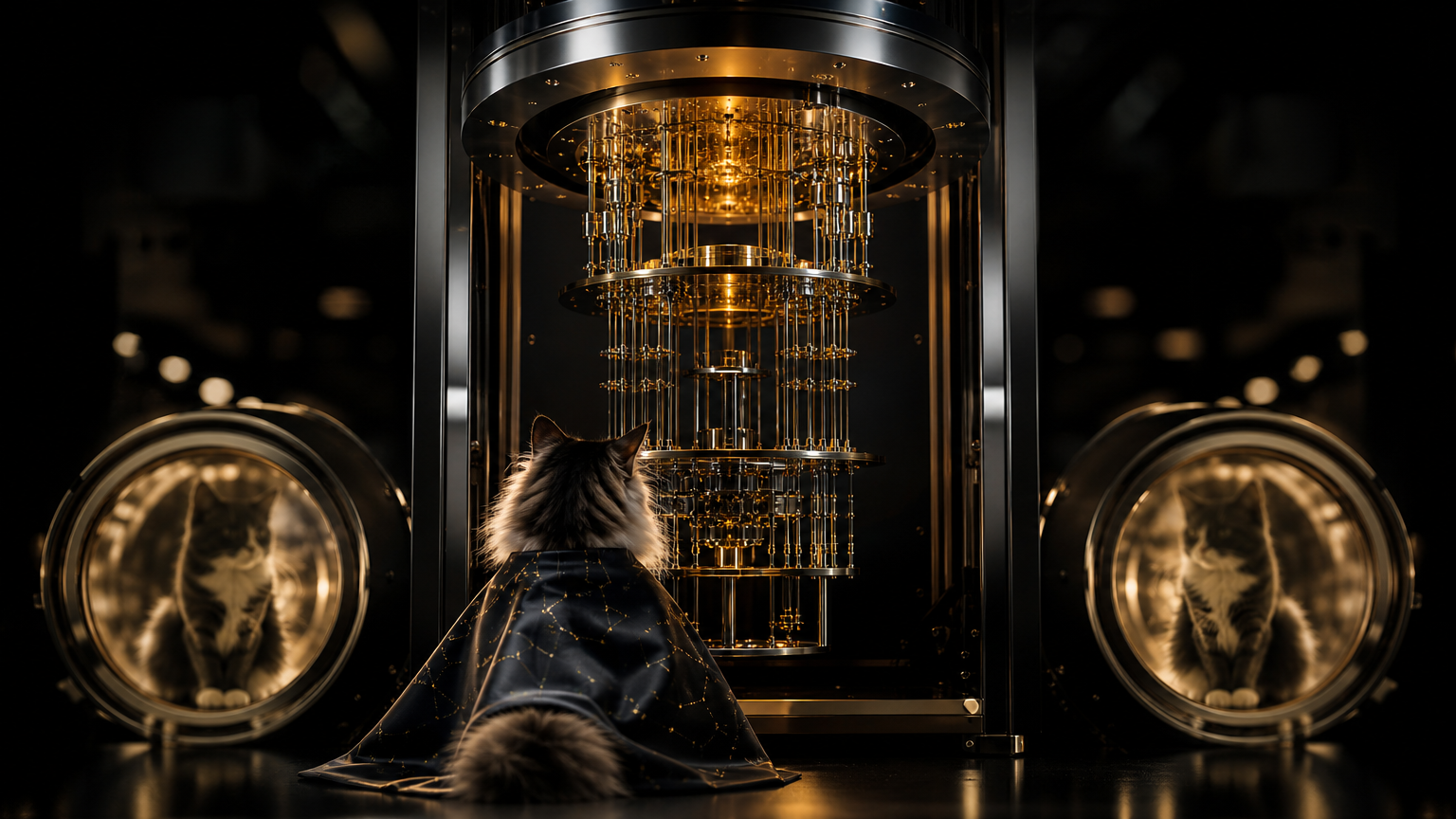
The cat-qubit paper attacks that problem at the encoding level. Instead of encoding a qubit only as a two-level system, cat qubits use superpositions of oscillator states, with logical states represented by coherent states of opposite amplitudes . In the implementation studied, photon loss becomes biased toward a phase-type error rather than producing all error types equally . That bias is the key. If the dominant errors are predictable, algorithms and gates can sometimes be designed to preserve the bias or exploit it.
The authors numerically simulated QAOA with cat qubits for Max-Cut instances and reported better approximation ratios than standard two-level qubit encodings when compared at equal average gate fidelities . That is an important distinction: the claim is not simply that cat qubits were assumed to be cleaner. The benchmark asks what happens when average gate quality is held constant, and the error structure differs.
This matters for useful scale because full quantum error correction remains expensive. If hardware can suppress or bias the errors that hurt a given workload, some optimization problems could become accessible with less overhead than a fully general-purpose fault-tolerant machine would require. The result is still a numerical and architectural step, not a commercial solver. But it tightens the connection between hardware physics and application-level performance.
Silicon moves from density claims to control questions
The silicon branch of the story is more manufacturing-oriented. Quantum Motion reported a 10,000-fold increase in quantum-chip integration, a milestone framed around moving quantum components closer to semiconductor-style density . The caveat is just as important as the number: precise qubit control remains the decisive test .
That caveat is not a footnote. Quantum computing does not scale like ordinary transistor count. More devices on a chip can help only if they can be initialized, addressed, coupled, measured and corrected without cross-talk or thermal overload. In that sense, Quantum Motion’s milestone is best read as progress on the physical integration side of the ledger, while the control layer remains the gatekeeper to practical use.
Diraq’s announcement pushes the same silicon-spin logic into infrastructure. The company said it installed what it calls the world’s first silicon spin quantum computer inside a commercial data center, now live at Equinix in Sydney . The system currently operates with eight qubits, while Diraq says it is targeting up to 256 qubits in the same deployed system within the next year . The company also emphasized compact infrastructure claims: less than 20 kW for the current system and a 170-square-foot footprint .
The important part is not that eight qubits will transform enterprise computing. They will not. The important part is environmental: a silicon-spin system is being positioned to run in the same kind of facilities that host banking, healthcare, utility and retail computing infrastructure . If quantum machines are ever to become accelerators attached to classical workflows, they must fit into operational data-center constraints. Diraq’s system is a test of that premise.
IBM’s Chicago deployment adds institutional scale
IBM’s Chicago deployment adds a different kind of scale: ecosystem scale. IBM, the University of Chicago, the State of Illinois and the Illinois Quantum and Microelectronics Park unveiled an IBM Quantum System Two in Chicago, initially located at Hyde Park Labs and intended to anchor the National Quantum Algorithm Center . HPCwire reported that the system is fueled by IBM Quantum Nighthawk and is IBM’s first quantum computer in Illinois .
This matters because quantum usefulness will not emerge from hardware alone. Researchers need access, benchmarking discipline, algorithm development, error-mitigation work, software tooling and domain experts willing to translate real problems into quantum-native forms. IBM’s Chicago system is explicitly framed around collaborations with universities, national labs, startups and enterprises, including work on molecular simulation, optimization and high-energy physics .
The deployment also shows how national and regional quantum strategies are shifting. Instead of treating quantum computers only as remote cloud curiosities or lab instruments, governments and research institutions are building hubs around them. That does not guarantee useful results. But it shortens the loop between hardware builders, algorithm designers and potential users.
Molecules join the photonic group chat
The molecular-qubit result broadens the hardware race. Chemistry World reported that researchers at NVision Quantum Technologies and Ulm University demonstrated a molecule that can serve as an individually optically addressable qubit . The molecule is designed so that laser light can read spin information from a single molecule, rather than averaging over groups of molecules .
That is a major conceptual move because molecular qubits offer atom-scale design through chemistry, while optical links could connect modules in a larger architecture. According to the report, the molecule provides several properties needed for addressability and stability, including spin states that last long enough to be useful and fluorescence bright enough for readout . NVision’s stated direction is to place such molecular qubits onto photonic chips with HyperLight, using photonic integrated quantum circuits as the architecture .
This route is early, but it is strategically important. The dominant hardware stories often center on superconducting circuits, trapped ions, neutral atoms and silicon spins. A reproducible molecular component with an optical interface would add another scaling model: manufacture the qubit through chemistry, connect it through photonics, and integrate it through chip processes.
The useful-scale verdict
The week’s message is not that quantum computing is suddenly solved. It is that useful scale is becoming a concrete engineering target. Cat qubits are being tested against optimization performance, not only coherence metrics . Silicon approaches are being judged by integration and control, not only by isolated qubit demonstrations . IBM is placing major systems inside regional research ecosystems . Molecular qubits are trying to turn optical connectivity into a native feature rather than an afterthought .
The hard part remains brutal: controlling every qubit, preserving fidelity as systems grow, linking modules without adding new error channels, and proving that algorithms outperform the best classical alternatives on real workloads. But the direction is clearer. Quantum hardware is moving from a science experiment about individual components toward a systems problem about manufacturable, connected and operational machines.
That is what “useful scale” now means: not merely more qubits, but qubits that can be controlled, benchmarked, networked and used by researchers solving problems that matter.
Comments
Be the first to comment.