
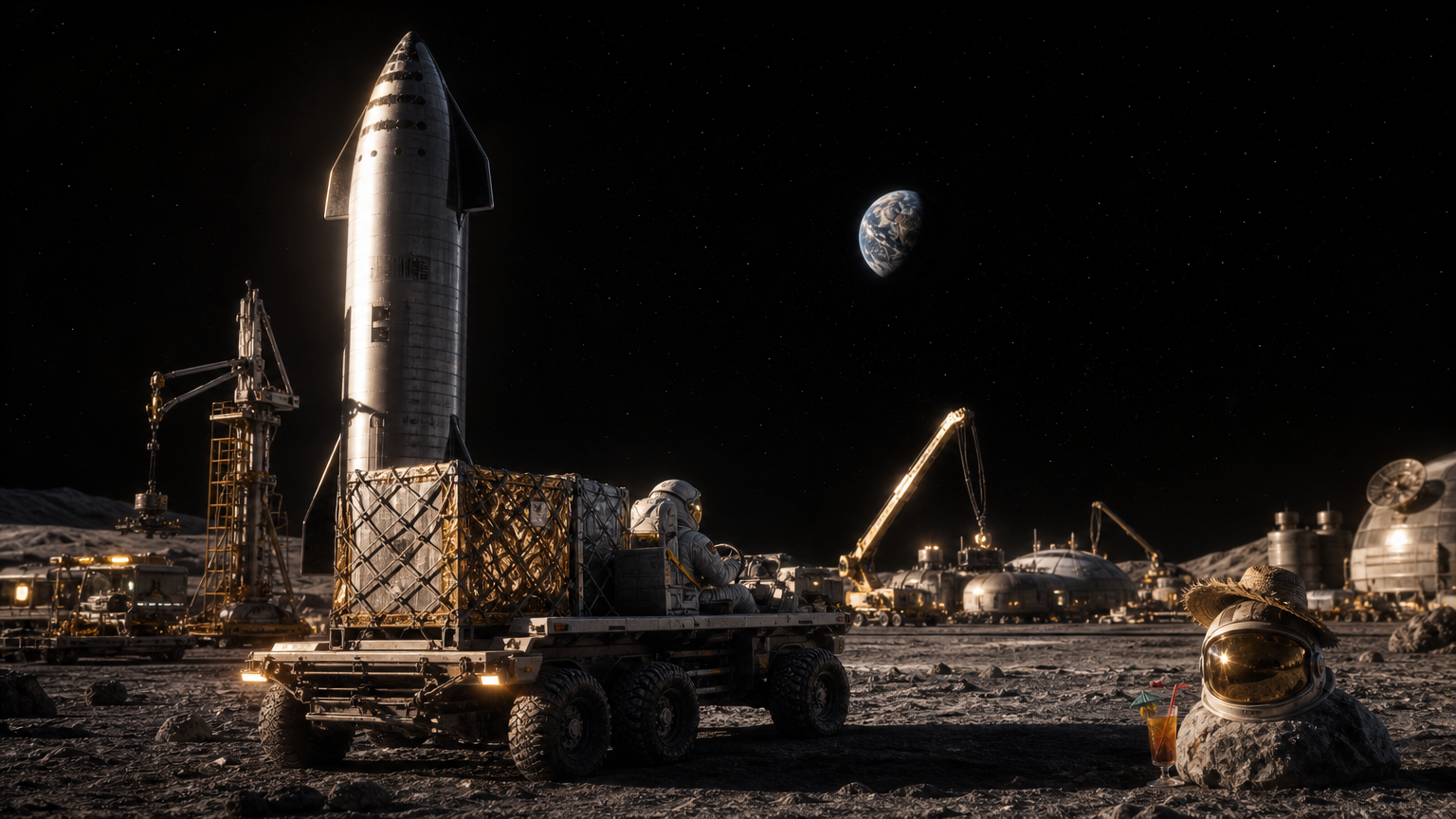
The story: one company, two government front doors
SpaceX’s week is best read through two doors of the same federal building. One door opens toward the Moon, where NASA is turning lunar exploration into a supply-chain problem. The other opens toward Washington’s defense establishment, where launch capacity, military satellites and future weapons planning increasingly overlap.
On the lunar side, NASA’s new Moon Base awards put SpaceX among eight companies eligible to compete for future Commercial Lunar Payload Services 2, or CLPS 2, delivery missions under a 10-year, multiple-award framework with a combined ceiling of 10 billion dollars . The same package also gives SpaceX a separate 2028 Starship task: launch communications satellites into cislunar space under NASA’s Cislunar Communications Deployment Demonstration . That is the concrete milestone Starship has needed in the government market: not only a test program, not only a Mars-shaped ambition, but a dated federal mission tied to lunar infrastructure.
On the Washington side, SpaceX remains central to national-security launch planning. The current public mission briefing for USSF-266 describes a classified United States Space Force mission on Falcon 9 from Space Launch Complex 4E at Vandenberg Space Force Base, with the flight now targeting mid-November and a Pacific droneship landing planned after stage separation . Separately, Elon Musk is co-leading Project Meridian, a Pentagon effort to map the weapons and technologies the U.S. military should prioritize, while SpaceX has collected more than 8 billion dollars in defense contracts so far in 2026, according to reporting published Monday .
Together, these developments deepen a pattern: SpaceX is no longer merely a launch vendor. It is becoming a contractor embedded in civil lunar logistics, military space architecture and even the advisory machinery that helps shape future procurement.
The Moon becomes a market before it becomes a base
The most important word in NASA’s announcement is not “Moon.” It is “contract.” NASA’s CLPS 2 framework does not hand SpaceX or any other company 10 billion dollars immediately; it creates a decade-long master contract under which selected companies can compete for task orders . The eligible firms are Blue Origin, Firefly Aerospace, Intuitive Machines, ispace-U.S., Lockheed Martin Space, Northrop Grumman Space Systems, SpaceX and Voyager Technologies .
That distinction matters. NASA is building optionality. Instead of buying one giant government lander and hoping the whole architecture survives a delay, the agency is creating a catalog of commercial providers that can move science payloads, infrastructure, cargo and eventually base-support systems to the lunar surface . In that model, the Moon becomes a logistics marketplace before it becomes a polished human outpost.
SpaceX’s place in that marketplace is especially notable because NASA also chose the company for the Cislunar Communications Deployment Demonstration. Under that task order, Starship is scheduled to carry communications satellites to cislunar space in 2028, helping NASA test the network layer needed to keep astronauts, robotic systems, mission controllers and surface infrastructure connected . The mission value was not disclosed in the NASA-linked reporting, but the schedule and vehicle choice are the point: Starship now has a named, dated government mission beyond its own development campaign .
The wider Moon Base package also shows that NASA is trying to buy an ecosystem, not just rockets. The agency’s plans include the PROMISE nuclear-powered rover, launch and orbital transfer demonstrations, and surface power-and-communications components . Blue Origin won a 94 million dollar base contract, with an additional 140 million dollar option, to deliver PROMISE to the lunar South Pole on its Blue Moon Mark 1 lander . That makes the coming lunar economy less a SpaceX monopoly than a competition among a small group of heavily capitalized contractors.
Still, SpaceX’s role is unique. Blue Origin may be a direct lunar-cargo competitor, but SpaceX brings Falcon 9 cadence, Starship ambition and a satellite-network playbook. A cislunar communications demonstration naturally echoes Starlink: mass-produced spacecraft, network operations and iterative deployment. If that approach migrates from low Earth orbit to the Earth-Moon corridor, NASA’s future base could depend on commercial network economics as much as on classical exploration hardware.
Starship gets a procurement milestone
For years, Starship has been described in spectacular terms: the biggest rocket, the fully reusable system, the Mars ship, the Artemis lander. NASA’s 2028 cislunar communications mission makes the vehicle less abstract. A government customer has now attached Starship to a defined infrastructure job, and that changes how the program will be judged .
A test flight can succeed by proving a subsystem. A procurement mission succeeds only if it delivers a service on schedule. That difference is crucial for NASA. The Moon Base architecture depends on predictable cargo, communications, power and mobility. Starship’s 2028 assignment therefore becomes a bridge between experimental launch development and operational lunar logistics.
It also gives Washington a lever. Once a commercial system is assigned to a mission in a larger federal architecture, delays are no longer only company problems. They become schedule risks for a public program. That is why NASA’s CLPS 2 competition matters: it gives the agency more suppliers, but it also ties those suppliers into a sequence of dependencies that must work if the Moon Base plan is to remain credible.
The defense side: launch, satellites and influence
The national-security side of the story is more politically sensitive. USSF-266 is described publicly as classified, but the available mission briefing identifies Falcon 9, Vandenberg, a polar-orbit profile and a reusable booster flying its 29th mission . Even without payload details, the pattern is clear: Space Force missions continue to lean on SpaceX’s operational cadence.
That cadence is now paired with a broader Pentagon role for Musk. Project Meridian, announced earlier in the fall and covered again this week, asks Musk, Anduril founder Palmer Luckey and former House Speaker Newt Gingrich to help assess future battlefields, capability gaps and technologies the military should master . The project’s findings are due January 28, 2027, and watchdog groups have sued the Defense Department, arguing that the panel raises transparency and conflict-of-interest concerns .
This is where the governance question becomes strategic. SpaceX is not just selling launches. It is building and launching military satellites, supporting secure communications and sitting near discussions about the future shape of weapons demand. A company can be both technically indispensable and institutionally risky if the government lacks backup providers, clear conflict rules and transparent advisory processes.
Why this matters
The United States has spent years moving from government-owned space systems toward commercial services. That shift has produced real advantages: faster iteration, lower launch prices, reusable rockets and private capital absorbing some development risk. SpaceX is the proof case.
But the same success creates concentration risk. If one company is central to NASA’s lunar cargo chain, Starship’s cislunar communications milestone, Space Force launch cadence and Pentagon technology planning, then vendor resilience becomes a national policy issue. Washington has effectively unlocked the SpaceX tech tree at maximum speed. The next challenge is making sure the game does not depend on a single save file.
The Moon is becoming a marketplace before it gets decent Wi-Fi. SpaceX is already bidding to deliver both the cargo and the connection.
Comments
Be the first to comment.