
A flagship product reaches the endgame
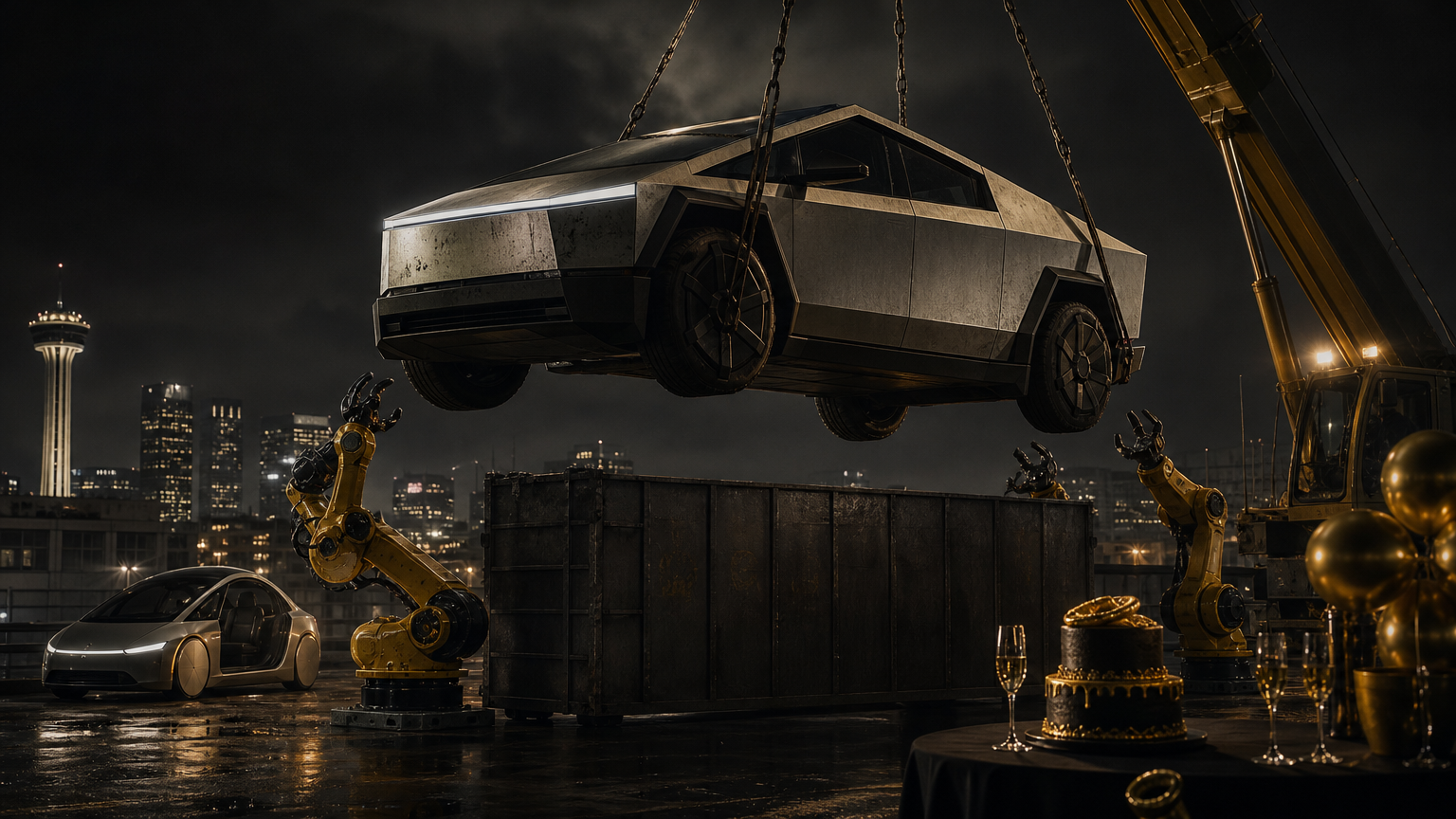
Tesla’s Cybertruck is not merely being trimmed, repriced or refreshed. Elon Musk has said Tesla will shut down the line in about eight months and return deposits to “a lot of people,” while defending the decision as a manufacturing-capacity trade-off rather than a simple profitability failure . In practical terms, that means the stainless-steel pickup that once served as Tesla’s most recognizable design provocation is being put on a countdown toward the middle of 2027.
The timing matters because Tesla is not describing a quiet retirement of a niche trim. Musk’s explanation links the end of Cybertruck production directly to the need for more Cybercab output, saying the opportunity cost of the truck’s complexity is outweighed by incremental production of the robotaxi platform . That phrase turns the cancellation into a strategic confession: floor space, tooling, suppliers, labor planning and executive attention are now more valuable when aimed at autonomy than when locked into a polarizing pickup.
Tesla also appears to be trying to squeeze the final wave of Cybertrucks out before dismantling the line. Reuters reported that Tesla would add an extra production shift to complete more outstanding orders before the line is taken apart for Cybercab expansion around June or July of next year . That is a delicate message to customers: the company still wants to build as many trucks as possible, but it is also openly saying the product’s future has already been decided.
The refund problem is a brand problem
The immediate test is not just industrial. It is emotional. Cybertruck reservations were part of the vehicle’s mythology from the beginning: a low-cost signal of loyalty, curiosity or faith in Tesla’s ability to make the impossible look inevitable. Now some of those reservation holders are being told that their place in line may end with a refund rather than a delivery .
Fortune reported that Musk said the Cybertruck order rate exceeds the company’s production rate, but that Tesla will have to return deposits to many buyers before the shutdown . That leaves Tesla with a tricky communications problem. If demand is still strong enough to exceed production, why kill the line? Musk’s answer is opportunity cost. The harder business question is whether customers will accept that answer after waiting for a vehicle that became part of Tesla’s identity.
The Cybertruck’s commercial record makes that answer more complicated. Fortune noted that the model struggled to reach and sustain high sales after its 2023 release, and cited Kelley Blue Book estimates showing 11,586 Cybertrucks sold through the third quarter of 2026, far below Tesla’s Model Y and Model 3 volumes over the same period . That does not prove the truck had no devoted audience. It does suggest that devotion did not translate into the kind of scale Tesla once expected from a mass-market pickup.
Why this is bigger than one vehicle
The Cybertruck was always more than a pickup. It was a rolling manifesto for Tesla’s willingness to ignore the car industry’s design grammar. Its angular body, stainless-steel exterior and meme-ready silhouette turned it into a cultural object before it became a mature product line. Ending it therefore reads differently from ending a sedan variant or delaying a minor update.
The strategic cost of such a vehicle is also unusually high. A platform with distinctive materials and manufacturing requirements ties up engineering resources, supplier commitments and factory procedures that cannot be instantly repurposed. Musk’s own framing recognizes that complexity as the core issue: not that the Cybertruck could not be sold, but that every unit competes internally with a Cybercab future Tesla now wants to scale faster .
That makes the cancellation a pivot point. Tesla is choosing a less visible but potentially more repeatable business: autonomy-enabled rides, high utilization and recurring mobility revenue. The trade is symbolic as much as financial. Cybertruck sold attention. Robotaxi must sell reliability.
San Antonio becomes the next Robotaxi test
At the same time, Tesla expanded its Robotaxi service to San Antonio, saying rides would be available starting at 5 a.m. local time on Monday, November 9 . The launch adds another Texas market to Tesla’s autonomy map and makes the Cybertruck decision look less like a retreat than a reallocation: the company is closing one spectacle and opening another service zone.
TechCrunch reported that Tesla did not provide full operational details for San Antonio, including hours, fleet composition or whether vehicles would carry human safety monitors . That uncertainty is important. Robotaxi launches are not judged only by whether an app opens in a new city. They are judged by vehicle availability, response times, ride completion, edge-case behavior and how quickly the service becomes ordinary rather than novel.
Electrek reported that Tesla’s posted San Antonio launch geofence covers about 274 square miles, the company’s biggest day-one map, but warned that a posted geofence may not equal a fully bookable service area . That distinction should guide how investors and riders read the launch. A large polygon on a map is a statement of ambition. A functioning ride network is a logistics and safety operation.
Big map, small unknowns
San Antonio is an especially revealing place to test that distinction. Electrek noted that Robotaxi Tracker measured the launch zone at 274 square miles, covering about 1 million residents and 721,000 jobs, while San Antonio International Airport sits inside the polygon but is not served . Axios separately reported that Tesla is not yet authorized to take riders to and from the airport, while Waymo is authorized for airport trips .
Axios also reported a sharp reality check: Tesla appeared to have just one robotaxi vehicle in San Antonio, according to Robotaxi Tracker, even as Waymo had about 100 vehicles locally . If that count changes quickly, the launch could become the start of a serious local ramp. If it does not, San Antonio risks looking like a map-first expansion where coverage claims run ahead of useful capacity.
Tesla has used this pattern before: launch, learn, expand and normalize. TechCrunch noted that Tesla began its robotaxi service in Austin in June 2025 with limits and human support, later removing safety monitors there and expanding across several Texas and Florida cities . That history gives Tesla a playbook. It also creates a higher bar, because each new city invites comparison with earlier promises and with competitors already operating in the same market.
The pivot Tesla wants investors to see
Taken together, the Cybertruck wind-down and the San Antonio Robotaxi launch show a company trying to move its center of gravity. Tesla still sells cars, but the story it wants the market to price is increasingly about autonomy, fleet economics and software-like service revenue. Ending the Cybertruck line makes that story more concrete because it shows Tesla is willing to sacrifice an iconic vehicle to free capacity for Cybercab.
The risk is that both sides of the pivot create scrutiny at once. Cybertruck customers may ask why a vehicle with apparent backlog is being killed before their orders are fulfilled. San Antonio riders and regulators may ask how large the Robotaxi service really is, how safe it is, and whether the operational zone reflects available cars or just future intent. Tesla’s answer has to be execution, not theater.
For years, the Cybertruck made Tesla look fearless. Now the company is betting that Robotaxi can make Tesla look inevitable. The stainless-steel side quest is ending; the autonomy campaign is expanding. What happens next depends on whether Tesla can turn factory space, refunded deposits and a large San Antonio map into a service people actually use every day.
Comments
Be the first to comment.