
A bigger number, but not just a bigger number
IBM’s latest quantum announcement is deliberately easy to summarize and harder to evaluate: in 2027, the company plans to connect two Nighthawk r3 processors into one 1,040-qubit system . Each Nighthawk r3 chip is designed to support 10,000 quantum operations across 520 programmable qubits, while the full processor package contains 2,034 physical qubits . That is the headline milestone, but IBM is presenting it less as a trophy qubit count than as a test of modular architecture.
The distinction matters. Quantum computing has repeatedly produced spectacular-looking numbers that do not automatically translate into useful computation. More qubits can mean more room for algorithms, error mitigation, and eventually error correction; they can also mean more noise, more wiring, more calibration work, and more ways for the system to fail. IBM’s current message is that the next scaling step must preserve speed and quality while increasing size .
The company is also making this announcement in the context of its Quantum Developer Conference 2026, where it framed 2026 as a year in which demonstrations of quantum advantage moved from ambition to claimed reality, while stressing that advantage is only a milestone on the path to useful applications . That framing is important: the 1,040-qubit system is not being described as a finished universal fault-tolerant machine, but as part of a staged roadmap.
What Nighthawk r3 is supposed to change
Nighthawk r3 builds on Nighthawk r2, which IBM says already supports accurate computations with more than 7,500 quantum operations on 120 programmable qubits . IBM says r2’s high-speed reset architecture can reach up to 100,000 samples per second, a 25-fold throughput gain over IBM Quantum Heron . In quantum computing, samples are not a footnote: each circuit execution produces one result, and useful workloads may require millions or billions of samples .
That is why IBM keeps pairing qubit count with speed. According to IBM, clients and partners including E.ON, Algorithmiq, and Q-CTRL have run more than 34 billion circuits on Nighthawk r2 and reported performance improvements of up to 19 times compared with previous IBM quantum processors . IBM also cites an E.ON energy-grid optimization workload with a 15-fold speedup and an Oak Ridge National Laboratory magnetic-materials experiment with a 12-fold speedup over earlier work on Heron .
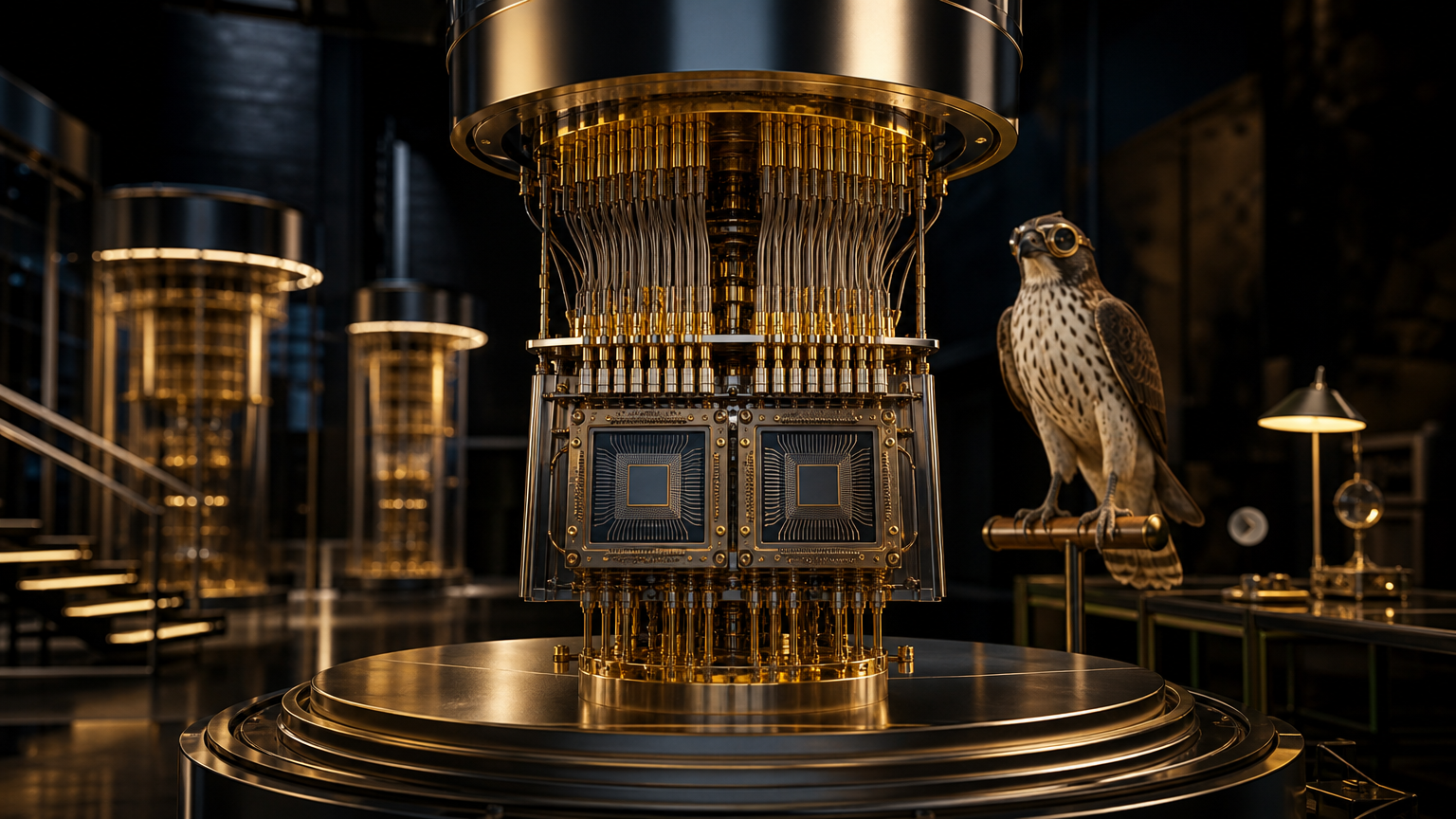
The r3 design target is larger and more integrated. IBM says the new processor will retain square-lattice connectivity and fast operations while adding 10 chip-to-chip interconnects, called l-couplers, to connect processors into larger systems . In 2027, the company wants to use those interconnects to join two 520-qubit chips into a single system with 1,040 programmable qubits .
The modular bet
The most consequential part of the announcement may be the decision to scale by linking chips, not simply by making one monolithic quantum processor. Ars Technica noted that IBM’s earlier public-facing roadmap had pointed toward reaching a roughly similar total qubit count by linking nine 120-qubit Nighthawk chips, whereas the new plan reaches 1,040 qubits by connecting two much larger chips . In other words, IBM is changing both the size of the building block and the number of links required.
That can be read two ways. Fewer chips could simplify system integration, reduce the number of interconnects, and make the 2027 machine easier to deliver. But it also raises the stakes for each r3 processor: the chip itself must become much larger while maintaining enough quality for meaningful workloads. Ars Technica described the larger r3 target as keeping IBM on its roadmap “sort of,” because the final qubit number remains close to the earlier promise even though the route has changed .
IBM says it has already demonstrated two technologies relevant to that modular approach. The company reports that it connected Nighthawk r1 processors using four l-couplers and achieved 99.3 percent quantum state transfer fidelity while progressing toward a 99.9 percent target . In a separate update on its path to IBM Quantum Starling, IBM said recent l-coupler work between Nighthawk processors achieved an average 1 percent error rate, with the best result at 0.7 percent .
Those figures are encouraging, but they also show the gap between demonstration and production-scale certainty. IBM says Starling, its planned fault-tolerant machine for 2029, will ultimately need more than 100 l-couplers per module with 0.1 percent error rates . The 2027 Nighthawk r3 system is therefore an important scaling step, but not the end of the connectivity problem.
Why 1,040 qubits does not settle the race
The 1,000-qubit threshold is powerful marketing shorthand, yet qubit count by itself is a poor measure of practical quantum advantage. IBM’s own announcement emphasizes that frontier applications demand both computational quality and speed, because larger circuits must be executed many times and results must remain trustworthy . The Next Web made the same point in its coverage, noting that useful work can require millions or billions of runs and that speed is therefore as important as size .
This is the central tension in IBM’s roadmap. A 1,040-qubit system would give customers and rivals a concrete hardware target for 2027, but it will still have to prove itself through circuit depth, fidelity, throughput, software integration, and cost. IBM is trying to make that argument before critics make it for them: the r3 target is not just more qubits, but 10,000 quantum operations on 520 programmable qubits per chip .
The competitive message is also clear. IBM wants to show that its superconducting-qubit architecture can scale in a modular way while staying connected to real workloads through the IBM Quantum Platform. The company says the platform is bringing high-performance classical computing and quantum computing into a single managed environment, including workflows that can combine quantum jobs with laptops, supercomputers, or platform-provided classical resources .
The link to Starling
Nighthawk r3 sits on IBM’s public-facing processor track, but it also supports the deeper engineering program aimed at fault tolerance. IBM says it still plans to deliver IBM Quantum Starling in 2029, with a target of 100 million quantum operations on 200 qubits . The Starling roadmap depends on more than processor size: IBM lists progress in c-couplers, qLDPC codes, decoders, l-couplers, modular cryogenics, and cryogenic control electronics .
That matters because the industry’s long-term goal is not merely to run larger noisy circuits, but to build machines that can correct errors well enough to sustain long computations. IBM says its Relay-BP decoder now meets Starling performance requirements, and it says its modular cryogenic design is intended to house linked processors in future systems . As of November 2026, IBM says two Nighthawk r2 devices attached with l-couplers are cooling in those cryostats, with l-coupler quality factors in the usual range of 1 million to 2 million .
Seen this way, the 1,040-qubit target is both a customer-facing milestone and a systems-engineering rehearsal. If IBM can make two r3 processors behave like one useful system, it strengthens the case for a modular architecture. If the link becomes a bottleneck, the qubit count will look less like a breakthrough and more like a warning label.
What to watch next
The next test is not whether IBM can say “more than 1,000 qubits.” It is whether the 2027 system can deliver enough usable, repeatable computation to justify its complexity. Watch for three signals: whether IBM keeps the 10,000-operation target on each r3 chip, whether l-coupler fidelity improves toward the company’s 99.9 percent goal, and whether early users report speedups that remain meaningful outside carefully selected demonstrations.
IBM has made the roadmap tangible. Two chips, 520 programmable qubits each, one 1,040-qubit system in 2027 . But quantum roadmaps live in a strange state: ambitious and on schedule until measured. The Nighthawk r3 target is a credible and important step. It is not yet proof that practical quantum advantage has arrived at scale.
Comments
Be the first to comment.