
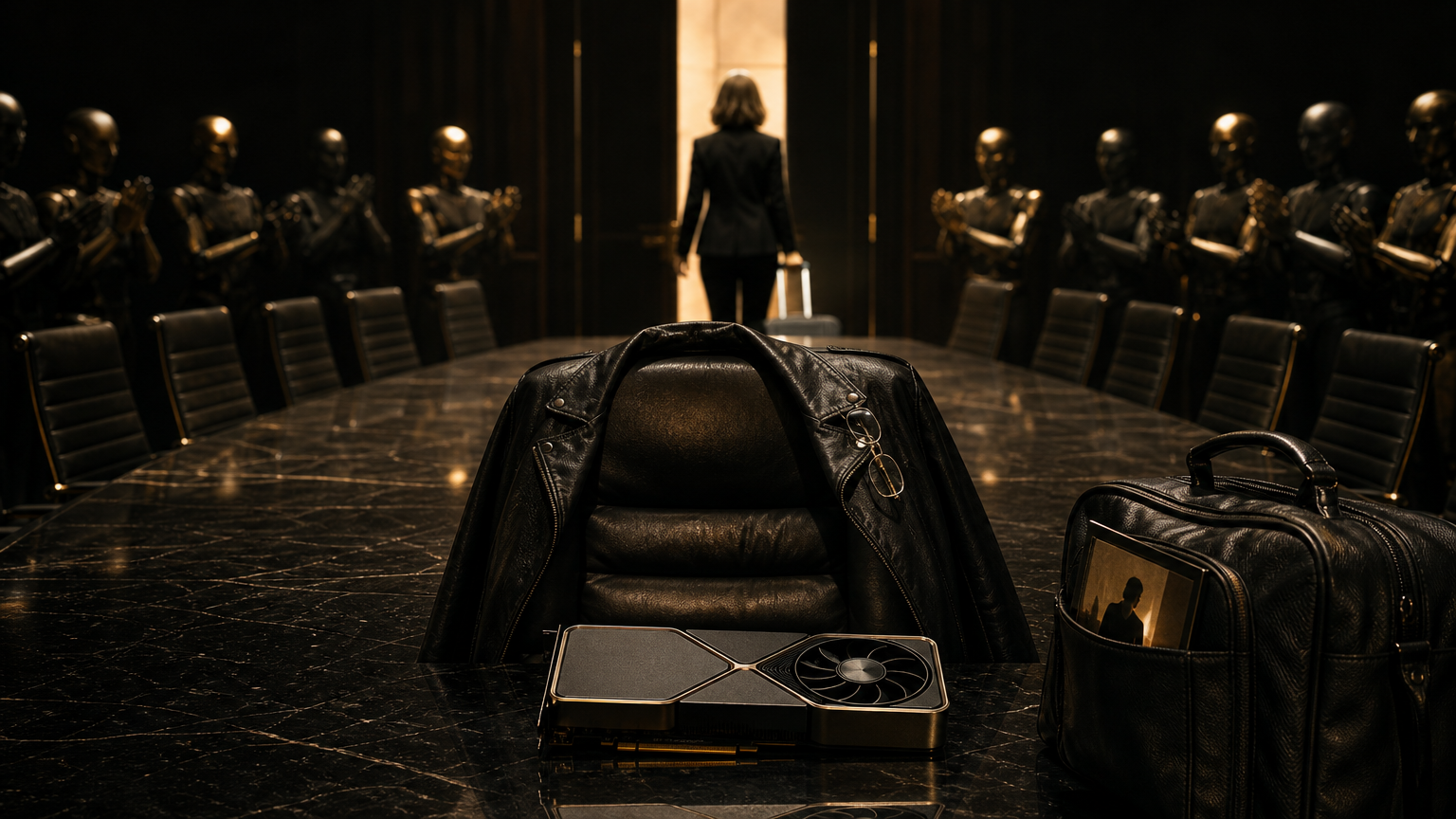
The sudden end of the Jensen era
Jensen Huang’s run at the top of Nvidia has ended with unusual speed and almost no soft landing. Nvidia announced on Thursday, November 12, 2026, that Huang had resigned as president, chief executive officer and a member of the board “effective immediately,” closing a leadership tenure that began with the company’s founding in 1993 . The same transition was reflected in the company’s Form 8-K disclosure, which says the board accepted Jen-Hsun Huang’s resignation on November 11, 2026, effective immediately .
The handoff is not a standard retirement plan, and Nvidia is not pretending otherwise. CFO Colette Kress has agreed to serve as interim CEO while continuing as executive vice president and chief financial officer, and the board says it will consider both internal and external candidates for the permanent role . Harvey C. Jones, a Nvidia director since 1993, has been appointed the company’s first-ever chair of the board, a governance shift that matters because Nvidia had long been defined by Huang’s personal authority and founder-led operating style .
The immediate message from Nvidia is continuity. Jones said the board has full confidence in Kress and the leadership team and expects operations, customer commitments and the product roadmap to continue without interruption . Kress, in her own statement, said Nvidia would keep advancing the work that made it a leader in accelerated computing and AI while serving customers, partners, developers and shareholders . That reassurance is necessary because this is not simply a personnel change; it is a shock to the public identity of one of the most important companies in gaming hardware and artificial intelligence.
Why the controversy became a board-level crisis
The resignation follows days of escalating controversy around Huang’s personal relationships and possible national security exposure. WIRED reported that Nvidia had opened an internal investigation into Huang’s affair with Alice Huang, also known as Huang Le, described in reports as an alleged asset of China’s Ministry of State Security; WIRED also noted that the Chinese government has rejected the claims that Alice Huang was a spy . The Associated Press reported that Huang’s affair with a Chinese businesswoman reportedly acting as a spy for Beijing raised U.S. national security concerns, while also noting that it could not independently confirm reports of a second alleged affair with a Nvidia executive .
That distinction matters. The confirmed corporate event is Huang’s immediate resignation and Kress’s interim appointment; the surrounding allegations remain a mix of company investigation, intelligence reporting, media reporting and political scrutiny. AP reported that the FBI is investigating Huang’s affair with an alleged Chinese government agent and that U.S. lawmakers still expected a briefing from Huang about his interactions, Nvidia’s security protocols and related topics . The Register likewise tied the resignation to the revelation of the affair with a woman suspected of being a Chinese spy and reports of another relationship with a company employee .
For Nvidia, the issue is broader than personal scandal. The company sits at the center of AI infrastructure, advanced semiconductor supply chains, export-control politics and gaming hardware. A CEO’s private relationships become a corporate risk when they intersect with foreign intelligence concerns, potential conflicts of interest, and customer confidence in a supplier whose chips underpin data centers, research labs, game PCs and cloud platforms.
Colette Kress inherits the hardest possible interim job
Kress is not an unknown placeholder. She joined Nvidia in 2013 and has served as executive vice president and CFO since then . Nvidia says she previously spent nearly 25 years in finance roles at major technology companies including Cisco and Microsoft . AP reported that, as CFO, Kress was a key architect of financing deals with major customers in the AI ecosystem, including companies such as Anthropic and CoreWeave .
That experience gives Nvidia a credible continuity figure, but the interim CEO role is still unusually demanding. Kress must steady investors, reassure enterprise and hyperscale customers, preserve confidence among developers and board partners, and keep the GeForce and RTX gaming pipeline from becoming a secondary casualty of an AI-centered leadership crisis. The official press release says Nvidia’s third-quarter fiscal 2027 results remain scheduled for Tuesday, November 17, 2026, at approximately 1:20 p.m. PT, followed by an earnings call at 2 p.m. PT . That call now becomes the first major public test of the Kress era.
Her challenge is also structural. Axios reported that Huang’s importance to Nvidia, the AI buildout, the stock market and the wider economy is hard to overstate, and that his exit may not ease congressional scrutiny of the company or of Huang himself . In other words, Kress is not merely filling a seat; she is taking temporary command of a company whose founder became a market symbol.
The GeForce angle: gaming cannot be treated as collateral damage
The AI story will dominate Wall Street, but the gaming front is where Nvidia’s brand first became personal to millions of users. GeForce buyers, PC builders, developers and board partners care less about executive scandal than they do about driver stability, pricing, supply, launch timing and whether future GPUs still arrive on schedule. Jones’s promise that the product roadmap should continue without interruption is therefore important for gamers as well as data-center customers .
Tom’s Hardware reported the resignation in direct connection with Nvidia’s consumer and GPU audience, noting that Huang was out, Kress was interim CEO, and the board had started a search for a permanent replacement . The article also reported that Nvidia shares plunged more than 10 percent in early trading after the news and were down more than 23 percent over the prior month . AP’s live coverage said Nvidia shares had fallen after the announcement and were down 5.3 percent as of 10:30 a.m. EST on Thursday, after tumbling at the open .
The market reaction matters for gamers because Nvidia’s consumer GPU business operates inside the same capital machine as its AI business. If investor pressure pushes the board to emphasize data-center continuity above all else, gaming could become a messaging problem rather than a strategic priority. That does not mean GeForce is about to disappear; it means the interim team must be explicit about consumer graphics, developer relations, software support and channel stability.
A succession battle with no save point
Nvidia’s board has chosen the safest available short-term path: elevate the CFO, name a board chair, promise continuity and start a broad CEO search . That buys time, but it does not answer the biggest question: can Nvidia remain Nvidia without Huang as its chief storyteller, dealmaker and technical evangelist?
AP quoted Forrester research director Stephanie Balaouras saying Huang’s resignation is a test not only for Nvidia but for the AI boom, because sustained pressure on Nvidia’s stock, financing relationships or ecosystem commitments would expose fragility in the broader AI infrastructure trade . AP also cited eMarketer analyst Asa Hiken calling the resignation a watershed moment because Nvidia now must prove it can maintain AI dominance without the leader largely responsible for building it .
The board’s next decision will define the scale of the disruption. An internal successor could preserve culture and execution speed but may struggle to separate the future from the founder era. An external hire could reset governance and credibility but risk slowing a company whose competitive advantage depends on rapid execution across chips, systems, software and developer ecosystems. Kress’s interim period must therefore do two things at once: keep the machine moving and prove that the machine is not dependent on one person.
For now, Nvidia has triggered its own boss battle at the worst possible difficulty setting. The company has a trusted interim leader, a newly formalized board chair, a public commitment to the roadmap, and an earnings date only days away . It also has investigations, lawmakers, market pressure and a founder-sized vacuum. The next phase will show whether Nvidia’s empire was built around Jensen Huang alone, or whether the architecture he created can survive his immediate exit.
Comments
Be the first to comment.