
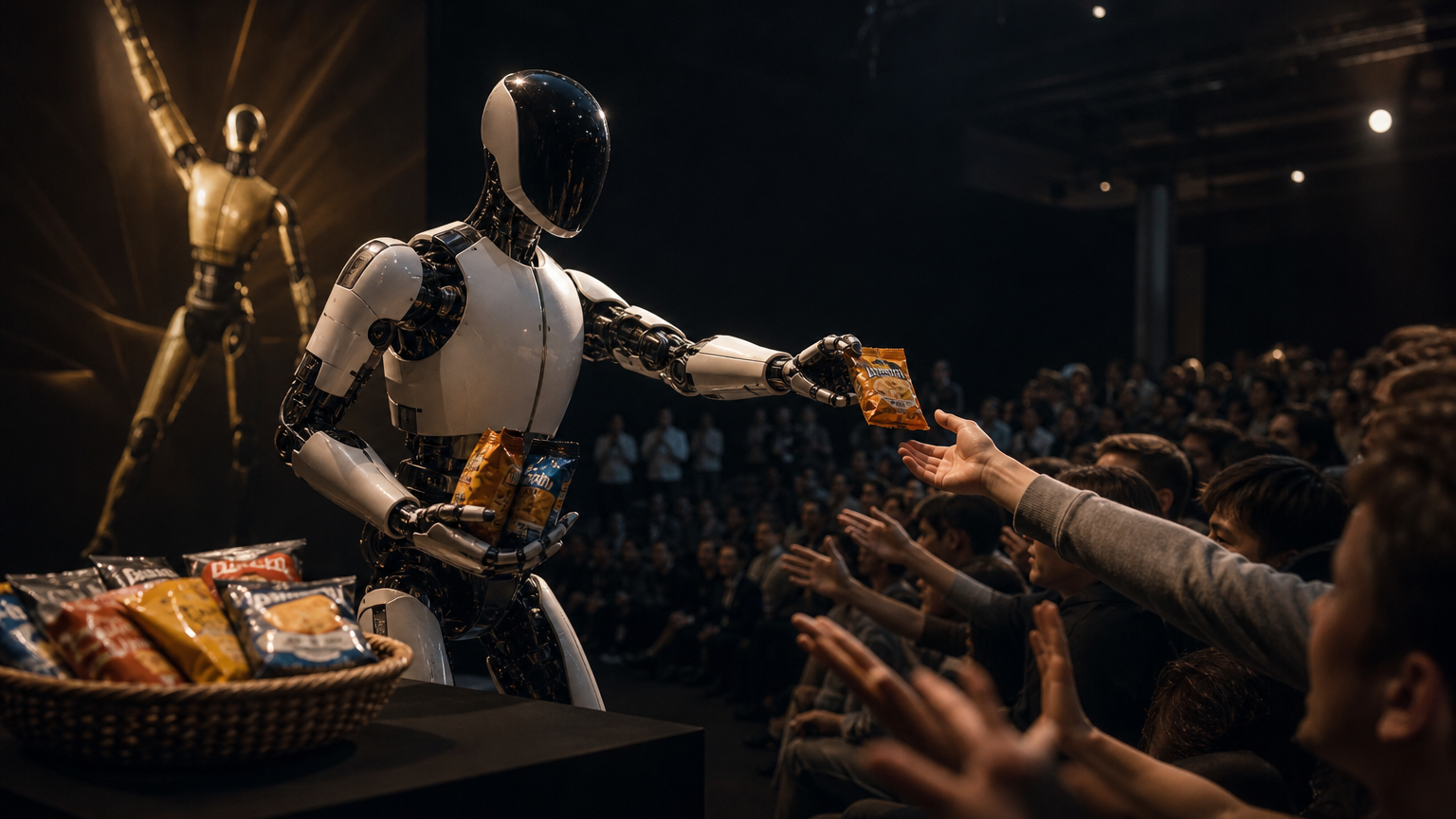
A small snack handoff, a big robotics signal
At the Conference on Robot Learning in Austin, Tesla put Optimus back in front of a public, technical audience with a deceptively simple task: handing snack packets to attendees. The robot shown was identified in fresh public reporting as Optimus 2.5, not as a formally unveiled Gen 3 unit, and the interaction was reported as teleoperated rather than fully autonomous . That distinction matters. It keeps the demo from being overread as a finished product launch, but it does not make the moment meaningless.
The reason this scene attracted attention is that a handoff is not just a party trick. For a humanoid robot, passing a light, deformable package to a person combines perception, arm reach, wrist alignment, finger pressure, timing, and balance. A snack packet is easier than industrial assembly in some ways, but harder than it looks in others: it bends, slips, crinkles, and changes shape under force. The CoRL appearance therefore turned a booth interaction into a compact test of what matters most for humanoid robots: whether hardware, control, and human interaction can work together in public space.
What was actually shown
The most conservative reading is also the most useful one. Optimus was stationed at Tesla’s CoRL booth and handed out snack packets. The demo was public-facing, close to people, and designed around a repeatable object-transfer task. The operator was still in the loop, according to the post that first circulated the clip, and Tesla engineers at the booth reportedly declined to share details while saying that “cool autonomous demonstrations” could be coming soon .
That makes the Austin demo a bridge, not a destination. It sits between earlier lab-style clips and the future Tesla wants observers to imagine: a humanoid robot that can respond to changing requests without a hidden human pilot. The handoff task is useful precisely because it is mundane. If humanoids are ever to work in offices, factories, retail counters, homes, or event spaces, they must handle ordinary objects in ordinary human geometry. No special bin. No fixed tabletop. No perfect lighting. Just a person waiting for the robot to pass something over.
Why the hands are the story
The subject line says “new hands,” and the hands are indeed the center of the discussion. Fresh reports around the CoRL demo do not confirm a full Gen 3 specification sheet, nor do they prove that the unit on the floor was the finished Gen 3 robot . But the visible emphasis on handoff behavior points directly to the part of Optimus that decides whether the robot is a useful worker or a walking display.
A humanoid hand must do two opposite things well. It must be strong enough to hold, pull, carry, and stabilize objects, while also being sensitive enough not to crush, tear, or drop them. In the snack-packet demo, the impressive element was not speed; it was the controlled sequence. The arm approached, the wrist oriented the package, the fingers maintained a grasp, and the body stayed composed while the object moved from robot to human. That is the kind of choreography that future autonomy will have to reproduce without teleoperation.
The better interpretation, then, is not “Tesla has fully revealed Gen 3.” It is “Tesla is showing the manipulation problem that Gen 3 must solve.” In robotics, that is a meaningful signal. Dexterous manipulation is the bottleneck between a humanoid that walks and a humanoid that works.
Design polish: closer to a product, still not a product launch
The CoRL appearance also sharpened attention on Optimus’s external design. Attendees and trackers described a more polished presentation, with Tesla placing the robot in a direct human-facing setting rather than hiding it in a controlled lab clip . That does not automatically confirm production specifications, but it does show how Tesla wants Optimus to be perceived: as a general-purpose machine meant to share environments with people.
This matters because humanoid robots are judged differently from industrial arms. A factory arm can live behind a cage and still be useful. A humanoid is supposed to move through spaces designed for humans. Its proportions, surfaces, balance, motion smoothness, and even head lighting become part of the product experience. A public booth handoff tests not only mechanics but also trust. Does the robot look predictable? Does it pause where a person expects? Does it keep the object at a comfortable height? Does the motion feel safe?
At CoRL, Tesla’s answer was still mediated by teleoperation. Yet the event setting raised the bar. The robot was not merely being watched; it was interacting.
The world-model clue from CoRL
The more technical signal came on the second day of CoRL, when Tesla’s Patrick Cho gave a talk titled “World Models for Optimus,” according to a clip posted by Michael Cho . The talk reportedly framed the goal as a model that is physically accurate, not merely visually convincing, and described learning the physics of the world from general real-world data while learning the physics of the robot by combining human data with robot data .
That is highly relevant to the snack handoff. Teleoperation can make a demo look smooth, but autonomy needs prediction. If Optimus is to hand an object to a person without live control, it must anticipate how its own hand will move, how the object will deform or slip, and how the human recipient may adjust. A useful world model would let the robot practice and plan inside an internal simulation of physical consequences before committing to motion.
The reported CoRL material also included references to scaling Optimus manufacturing, which connects the software story to Tesla’s broader ambition: not just building a clever robot, but building many copies of a robot that can learn and operate reliably .
What this means for autonomy
The Austin demo should be read as a checkpoint on the road to autonomy, not as autonomy itself. That is not a criticism; it is the reality of humanoid robotics in 2026. The hard part is not producing one impressive clip. The hard part is making the same robot succeed across many objects, many people, many lighting conditions, and many small surprises.
The engineer comment reported from the booth is therefore important but limited. “Soon” is not a date, and “autonomous demonstrations” could mean anything from a narrowly bounded task to a more flexible behavior sequence . Still, the direction is clear: Tesla is trying to move Optimus from remotely guided public interaction toward self-directed behavior in human spaces.
That is the real boss fight. Walking is necessary. A polished shell helps. But reliable manipulation, physical prediction, and safe interaction are what determine whether Optimus becomes a worker rather than a mascot.
Bottom line
Tesla’s CoRL appearance did not deliver a clean, official Gen 3 spec reveal. The freshest accounts identify the booth robot as Optimus 2.5, say the snack handoff was teleoperated, and note that Tesla has not posted a definitive product announcement around this demo . But the event still matters.
Optimus is leveling up in the areas that count: hands, handoffs, balance, public interaction, and the software stack needed to move from controlled demonstrations to autonomy. The snack packet was small. The test behind it was not. If Tesla can turn this kind of smooth teleoperated handoff into a robust autonomous behavior, CoRL may be remembered as one of the quieter moments when Optimus started looking less like a prototype and more like a platform.
Comments
Be the first to comment.