
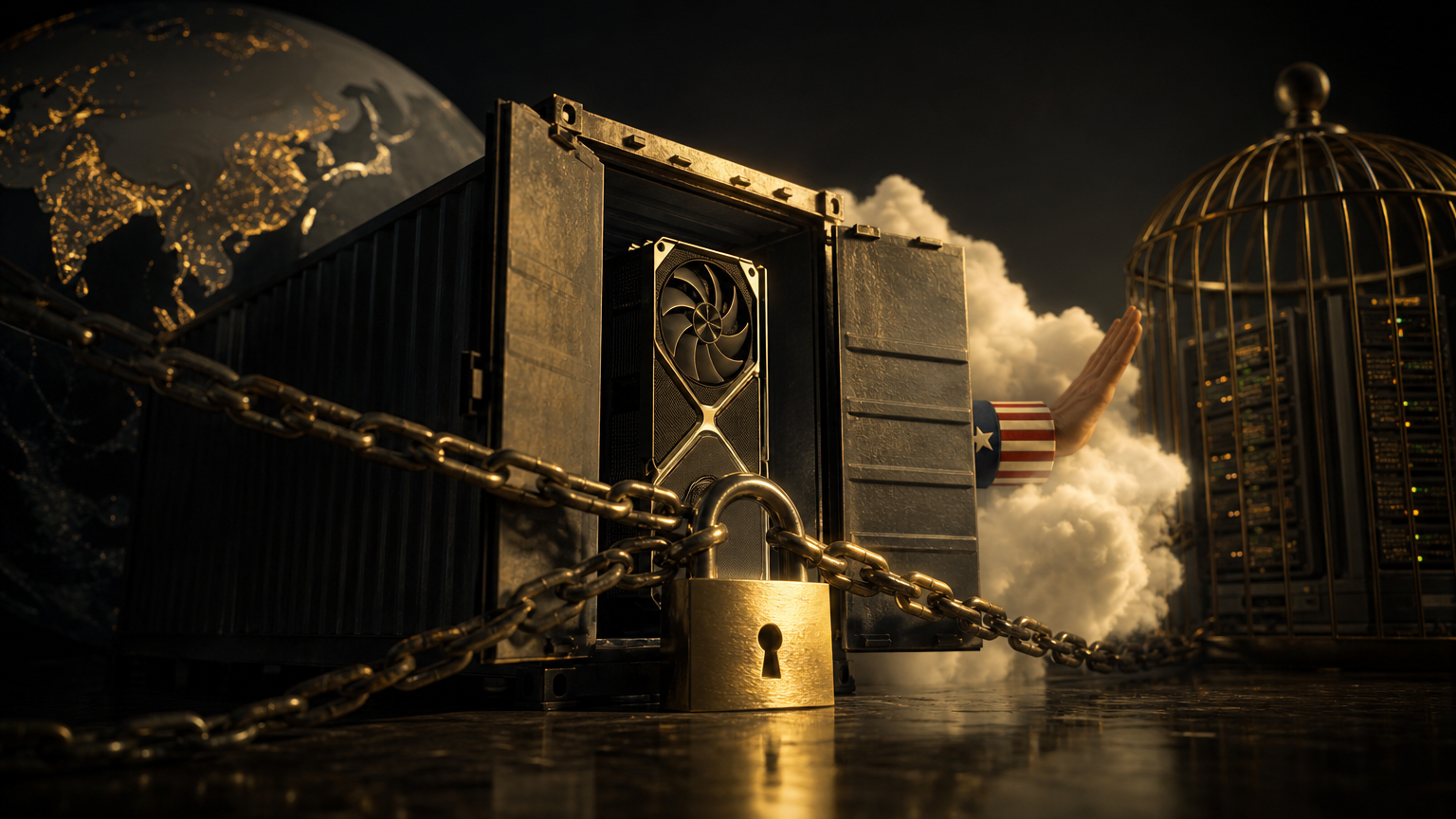
From chip boxes to cloud sessions
Washington’s AI-control strategy is moving from customs paperwork to cloud telemetry. The Commerce Department is preparing a rule that would block Chinese AI companies from remotely using advanced AI chips located in data centers outside China, according to reporting attributed to The Information and summarized by Investing.com . The point is straightforward: export controls that stop a server from being shipped to Shanghai lose force if the same customer can rent the server’s GPUs in Singapore, Malaysia or Thailand.
The draft approach would expand Bureau of Industry and Security controls to seven additional countries, including Malaysia, Singapore and Thailand, and could be announced this month . Chosunbiz reported a more detailed list: Singapore, Malaysia, Thailand, Indonesia, Brazil, Norway and South Africa, with recipients of Blackwell-class and more advanced AI chips needing Commerce approval and facing reporting obligations on users and use cases . That would mark a significant shift in how the United States defines access. The sensitive event would no longer be only the movement of hardware; it would also be the delivery of computation through a network.
The loophole is not theoretical. Reuters reported that Chinese AI companies are trying to rent Nvidia-powered computing capacity at overseas data centers because they fear Washington may tighten rules on remote access to advanced processors . A major Chinese cloud provider has discussed locking in overseas Nvidia capacity, while other companies have contacted data-center operators about reservations, according to Reuters’ sources . In other words, policy risk is already shaping procurement behavior: if compute may soon be controlled, customers rush to secure it before the gate closes.
Why remote access matters
The strategic problem is that AI chips are useful whether a customer owns them or merely schedules jobs on them. Training a frontier model, fine-tuning a specialized system or running large-scale inference can be done through cloud interfaces. If the law focuses only on physical export, a restricted actor can still receive the value of restricted hardware without receiving the hardware itself.
That is why the emerging rule targets data centers in third countries. Chosunbiz reported that the new framework would limit remote access by Chinese companies through Southeast Asian and other overseas facilities, while creating conditional exemptions for data centers run by U.S. companies if they meet reporting and access-control requirements . Operators would have to report customers’ countries and the scale of compute, and avoid remote access from U.S. arms-embargoed countries such as China and Russia .
For cloud providers, the compliance burden could be deeper than conventional sanctions screening. It may require knowing not just who opened an account, but who is ultimately using the compute, where the workload originates, whether a reseller is masking the real customer, and whether jobs are routed through affiliates. The practical compliance stack starts to look like a mix of identity verification, geolocation, customer-risk scoring, model-workload monitoring and audit trails. The firewall is being asked to inspect not only packets, but political geography.
The seven-country signal
The country list matters because it shows Washington is not only worried about direct U.S.-China transfers. It is worried about a dispersed infrastructure market in which hyperscalers, neoclouds, local partners and resellers can form chains of access. Singapore and Malaysia are especially prominent because of the role Southeast Asian data centers can play as neutral-looking compute hubs for Chinese customers.
Chosunbiz connected the planned expansion to scrutiny of Megaspeed, a Singapore-linked cloud company under joint U.S. and Singapore investigation on suspicion of smuggling Nvidia advanced AI chips to China . Reuters also reported that Megaspeed has faced scrutiny over suspicions that it helped Chinese customers gain access to advanced Nvidia chips subject to U.S. export controls, while the company has denied illegally diverting chips to China . The specifics remain contested, but the policy implication is clear: if regulators cannot reliably separate legitimate regional cloud growth from indirect Chinese access, they will push controls upstream into licensing, reporting and customer restrictions.
Axios reported a separate internal fight inside the Trump administration, saying President Donald Trump authorized crackdowns on companies suspected of diverting Nvidia advanced AI chips to China, while Commerce Secretary Howard Lutnick resisted some efforts, especially around Megaspeed . That friction is important because it shows the rule is not just a technical export-control update. It sits at the intersection of national security, commercial pressure, diplomatic management and the enormous financial weight of Nvidia-class infrastructure.
Legislation as a second track
The administrative rule is only one channel. Reuters noted that Chinese companies are watching the Remote Access Security Act, a U.S. bill that would give the Commerce Department authority to regulate remote, cloud-based access to restricted technology; the House passed it in January by a 369-22 vote, and it awaits Senate action . Even before becoming law, the bill has become part of the market’s risk model. If companies believe the Senate or regulators could close the remote-access gap, they adjust behavior now.
That legislative track matters because regulations can be revised by agencies, but statutes can define longer-lived boundaries. A remote-access law would clarify that the regulated event includes reaching controlled technology through a network. For AI infrastructure companies, that would reduce ambiguity: the question would no longer be whether cloud compute is “really” an export, but whether the remote use of controlled technology by a covered foreign person is itself controllable.
The domestic guardrail: Limits to AI Act
The second Washington signal is broader than China. The Limits to AI Act, introduced in a Resilience article by Kirsten Stade and originally published by CASSE, is framed as an answer to calls for a temporary moratorium by proposing permanent limits on AI development, deployment and infrastructure . The proposal would put boundaries around data centers, advanced AI systems, artificial general intelligence and private-sector deployment, making it a far more sweeping intervention than voluntary safety pledges .
According to the Resilience summary, the act comprises twelve sections, including definitions, federal roles for FERC and the FCC, restrictions on new or upgraded data centers, rightsizing and retrofitting of existing facilities, reporting requirements, and penalties for violations . The proposal would assign the FCC to define “limited AI” applications permitted to the private sector and “advanced AI” applications reserved for federal development and operation, while also determining which systems qualify as AGI or ASI . It would ban private development of all AI and private deployment of “advanced AI,” and it would ban the development or operation of AGI by private or public actors .
That is not the same kind of measure as an export-control rule. One is a national-security perimeter around adversarial access to compute; the other is a proposed domestic ceiling on the scale and character of AI systems. But both share the same premise: compute is not a passive commodity. It is an enabling resource that can produce strategic, environmental and social consequences.
A new perimeter around compute
Taken together, the two developments suggest a new phase in AI governance. The United States is no longer treating AI policy as a matter of model behavior alone, or chip policy as a matter of boxes crossing borders. It is beginning to regulate the chain that connects chips, data centers, cloud accounts, workloads and model capability.
For Nvidia-class infrastructure operators, the near-term lesson is operational. If the Commerce rule lands as reported, compliance will likely turn on customer identity, beneficial ownership, workload destination, affiliate relationships, country-of-use reporting and the ability to deny or terminate prohibited sessions. For policymakers, the lesson is conceptual: the most important transfer may be neither a file nor a server, but the ability to make a restricted machine think on someone else’s behalf.
The hard part will be enforcement. A rule that depends on cloud providers knowing the real user can be undermined by resellers, shell entities, VPNs, subcontractors and mixed-use workloads. A domestic AI-limit statute, meanwhile, would depend on definitions that can survive rapid technical change. What counts as “advanced AI”? What threshold separates ordinary automation from AGI-relevant development? Who audits a workload that may look harmless until it is combined with other compute?
Still, the direction is unmistakable. Washington is trying to close the AI compute loopholes from both sides: preventing Chinese organizations from renting controlled accelerators abroad, and testing legal ideas that would set permanent limits on the most powerful systems at home. The box is no longer enough. The cloud session is now part of the battlefield.
Comments
Be the first to comment.