
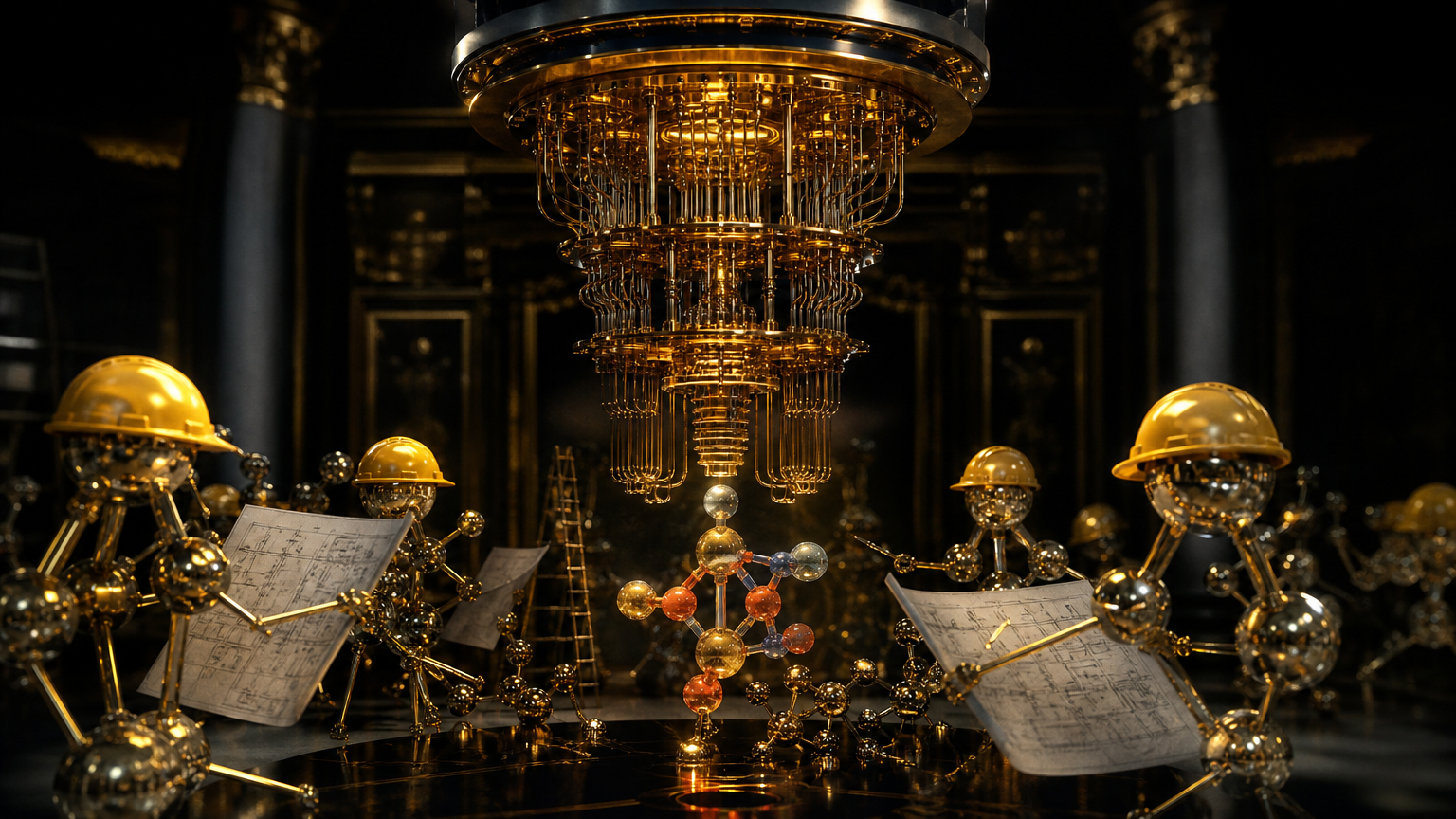
Chemistry enters co-op mode
The latest quantum-chemistry headlines point in the same direction: useful progress is coming from hybrid systems, not isolated quantum boxes. In one thread, Cleveland Clinic, RIKEN and IBM reported a heterogeneous quantum-classical electronic-structure calculation on solvated protein-ligand complexes exceeding 12,000 atoms, described as the largest such calculation to date . In another, Qunova Computing reported chemical accuracy for an 80-qubit simulation of a [4Fe-4S] iron-sulfur cubane cluster using an IBM Quantum System Two processor at RIKEN with the Fugaku supercomputer . Separately, PsiQuantum and AMD announced an expanded partnership to co-design the compute infrastructure for utility-scale, fault-tolerant quantum systems and hybrid applications combining quantum, high-performance and AI computing .
Taken together, the message is not that quantum computers have suddenly become stand-alone drug-discovery engines. It is subtler and more important. The practical path appears to run through tightly coupled quantum processors, GPUs, CPUs, workflow managers, supercomputers, error-correction logic and application-specific algorithms. Chemistry has not just entered the quantum era; it has entered co-op mode.
The 12,000-atom barrier is a systems milestone
The Cleveland Clinic-RIKEN-IBM result is striking because of scale and workflow. The reported campaign simulated full solvated protein-ligand complexes above 12,000 atoms, including trypsin-benzamidine at 12,635 atoms and T4-lysozyme-n-butyl-benzene at 11,608 atoms . Those are not toy molecules. They are the kind of large, water-surrounded biomolecular systems that make binding-energy prediction difficult in real pharmaceutical modeling.
The calculation combined two 156-qubit IBM Heron r2 quantum processors, identified as ibm_cleveland and ibm_kobe, with three leadership-class supercomputers: Fugaku, Miyabi-G and ROQUO . According to the report, the team executed 21,006 circuits using up to 94 active qubits, accumulated 3.0 billion measurement samples and consumed more than 239 quantum processing unit hours . The classical side was not a passive post-processing accessory; it supplied the fragment construction, distributed diagonalization and workflow automation that made the large biomolecular problem tractable .
The technical idea is to avoid asking a near-term quantum processor to swallow the whole protein-ligand complex at once. The workflow partitions the molecular system into fragments, samples electronic configurations on quantum hardware and then reconstructs fragment wavefunctions through optimized subspace diagonalization on supercomputers . The reported method used Embedded Wavefunction and TrimSQD techniques, with QCR noting a greater than 40-fold increase in molecular size and up to a 210-fold improvement in fragment-energy accuracy over prior quantum-embedding benchmarks .
The result also moved toward a more application-shaped deliverable: a protein-ligand binding-energy prediction. The report identifies a mixed-basis workflow that resolved T4-lysozyme binding affinity at −21.07 kcal/mol and describes it as the first heterogeneous quantum-classical protein-ligand binding-energy prediction . That does not mean a new drug has been designed. It means a hybrid stack has been demonstrated on a problem class that drug-discovery teams actually care about.
Qunova’s iron-sulfur result targets accuracy, not just size
Qunova’s result attacks the chemistry problem from a different angle: strongly correlated transition-metal systems. The company reported that its Handover Iterative Variational Quantum Eigensolver, or HI-VQE, achieved chemical accuracy in an 80-qubit electronic-structure simulation of a [4Fe-4S] iron-sulfur cubane cluster . The run used an IBM Quantum System Two processor at RIKEN together with Fugaku, again reinforcing the centrality of quantum-HPC coupling .
The benchmark matters because iron-sulfur clusters are important in catalytic biology and energy-related chemistry, while their correlated electrons are hard for standard approximations and early quantum algorithms . Qunova reported an extrapolated ground-state energy of −327.2482 ± 0.0007 Hartree, compared with a classical density-matrix renormalization group reference of −327.2471 Hartree, putting the result within the 1.6 millihartree, or roughly 1 kcal/mol, chemical-accuracy threshold .
Just as important, the report frames the gain as a resource story. Qunova’s workflow used 2,518 Fugaku node-hours and was described as cutting classical supercomputing costs by roughly 300 times compared with prior sample-based quantum diagonalization runs . In other words, the claim is not merely “more qubits.” It is that a particular hybrid algorithm can use a quantum processor and a supercomputer together to reach a chemically meaningful number with a smaller classical bill.
That point is worth stressing. Near-term quantum value in chemistry may arrive first as a reduction in the cost, wall time or complexity of a larger classical workflow. The quantum processor is a specialized accelerator, not the entire computer.
PsiQuantum and AMD show why the classical wrapper matters
The PsiQuantum-AMD announcement is not an IBM result, but it belongs in the same story because it addresses the infrastructure layer that all useful quantum systems will need. PsiQuantum and AMD said they will co-design computing infrastructure for utility-scale, fault-tolerant quantum computers and for hybrid applications that combine quantum, HPC and AI computing . AMD also plans to make an equity investment in PsiQuantum, though the companies did not disclose the size of the investment .
The partnership expands beyond prior work around AMD Versal FPGA technology into AMD Instinct GPUs, AMD EPYC CPUs and the ROCm software stack, combined with PsiQuantum’s silicon-photonics quantum platform . That portfolio is a reminder that future quantum machines will need serious classical control, data movement, scheduling, decoding and simulation capacity around the qubits.
Error correction is the clearest example. PsiQuantum said its researchers, working with AMD, optimized PRISM, a machine-learning decoder, for low-latency implementation on programmable hardware accelerators, aiming at real-time error correction for utility-scale photonic quantum computers . The companies also said their combined workflows and AMD GPU expertise have delivered initial simulation results for covalent inhibitors, a molecule class relevant to oncology drug discovery, and that they plan to focus initially on pharmaceutical research and drug discovery .
That framing mirrors the IBM-linked chemistry results. Whether the qubits are superconducting or photonic, the useful machine is not just a quantum processor. It is a full stack.
What this does and does not prove
The week’s developments do not prove that near-term quantum computers have broadly surpassed classical supercomputers in chemistry. The Cleveland Clinic-RIKEN-IBM result is a large heterogeneous workflow, Qunova’s result is a benchmarked hybrid calculation, and PsiQuantum-AMD is an infrastructure partnership with forward-looking goals . Each is impressive, but each depends on specialized algorithms, carefully chosen problems and heavyweight classical compute.
Still, the pattern is meaningful. The field is moving away from abstract demonstrations and toward chemistry-shaped workloads: protein-ligand binding, transition-metal clusters, covalent inhibitors and biological modeling . It is also moving away from the fantasy of a quantum computer as a self-contained miracle appliance. The emerging model looks more like a quantum-centric supercomputer: quantum processing units embedded inside a broader classical and AI compute fabric.
For investors, researchers and pharmaceutical technologists, the implication is practical. Watch the interfaces as closely as the qubits. The hard value may come from schedulers, decoders, fragment solvers, GPU kernels and software stacks that let quantum processors contribute to workflows already familiar to chemists. The milestones this week suggest the controller may matter as much as the character class.
Quantum chemistry’s near-term future, then, is not a duel between classical and quantum computing. It is a raid party: IBM systems, RIKEN supercomputers, Cleveland Clinic biomedical problems, Qunova algorithms, AMD accelerators and PsiQuantum photonics all pointing toward the same design principle. The qubits are powerful, but they are strongest when they bring friends.
Comments
Be the first to comment.