
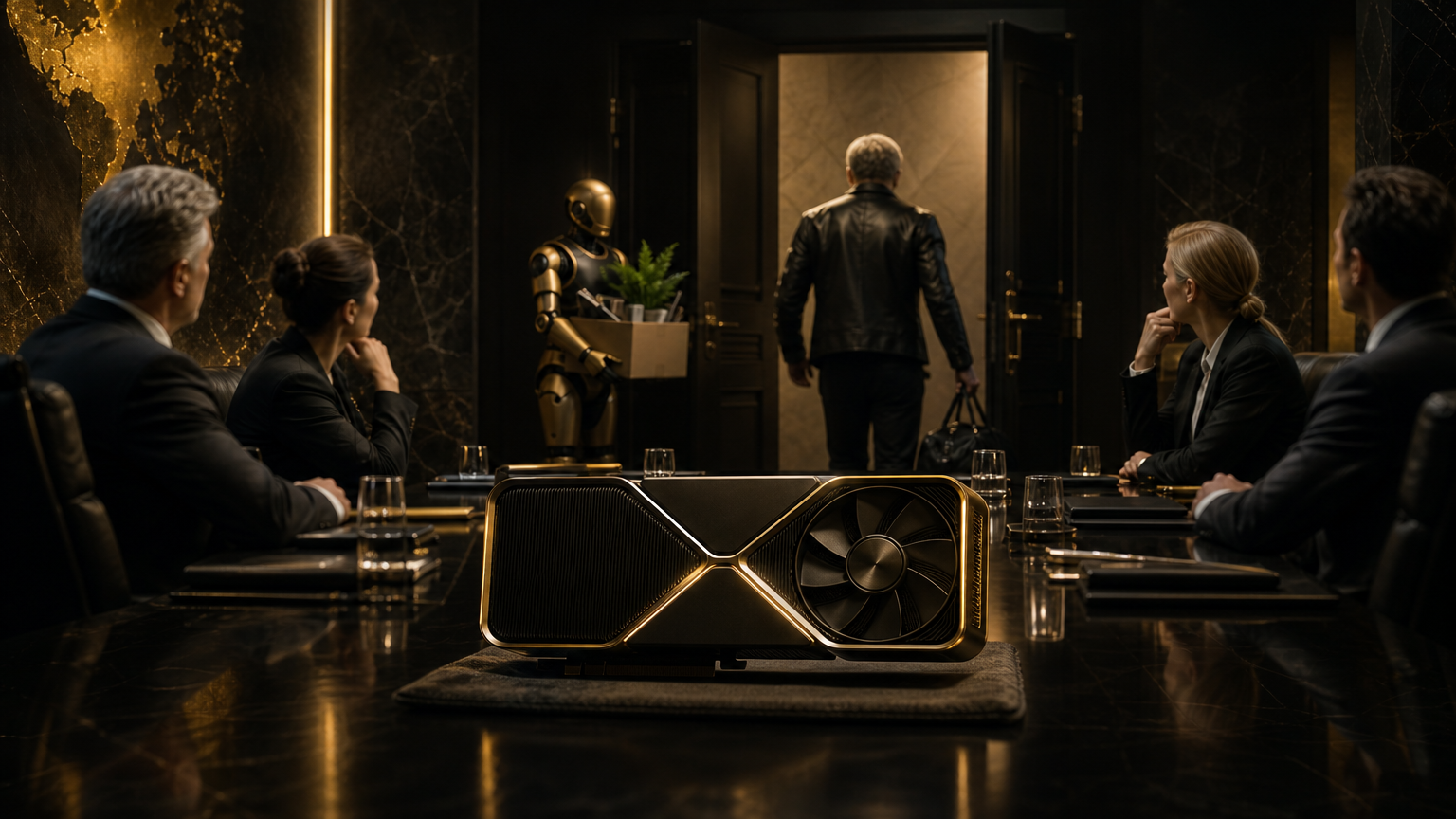
A founder-led company loses its founder-CEO
NVIDIA’s board has accepted Jensen Huang’s resignation as president, chief executive officer and board member, effective immediately, ending a 33-year run that began when he co-founded the company in 1993 . The company announced the transition on November 12, naming executive vice president and chief financial officer Colette M. Kress as interim CEO while she continues to hold the CFO role . The board also appointed Harvey C. Jones, a director since 1993, as its first-ever chair .
That last detail matters. NVIDIA has not simply swapped one executive for another; it has created a new governance center at the same time as it begins its first true CEO search. The company said the board will consider both internal and external candidates for the permanent role, but it did not name a successor or give a timeline . NVIDIA also said its third-quarter fiscal 2027 results remain scheduled for Tuesday, November 17, making the earnings call the first major public test of Kress’s authority .
The company’s formal announcement did not give a reason for Huang’s departure . Reporting over the past week has tied the crisis to allegations involving extramarital relationships, including one relationship that raised national-security concerns because U.S. intelligence suspected the woman involved of links to Chinese intelligence, which Beijing has denied . AP reported that NVIDIA had previously said it had no reason to believe national security or company secrets were compromised, while its internal review would examine available information .
Why the resignation is bigger than one executive
Huang was not a normal CEO in a normal sector. He was the public face, chief product evangelist, geopolitical negotiator and strategic risk-taker behind NVIDIA’s rise from graphics chips to the central hardware platform of the AI boom. AP described him as a key face of the AI race and noted that NVIDIA’s high-end chips have become leading building blocks for artificial intelligence . TechCrunch summarized the scale of that rise: after ChatGPT helped ignite the AI infrastructure rush, NVIDIA’s market value and revenue exploded as its GPUs became central to training and running large AI models .
That is why “what it means” starts with key-person risk. Founder-led companies can move fast because one person supplies conviction, taste and escalation power. They can also become fragile when too many relationships, bets and informal decision loops run through that same person. Huang’s exit forces NVIDIA to prove that the machine he built can now run without his personal command line.
Kress is the continuity choice. She has been NVIDIA’s CFO since 2013, knows the customer base, the capital markets and the supply chain, and is already familiar to Wall Street from years of earnings calls . Reuters reported that people familiar with the company view her as a pragmatic counterweight who pushed back on some of Huang’s larger and riskier AI financing ambitions . That profile is useful in a crisis: investors may want fewer surprises, customers want delivery, and governments want assurance that sensitive chip access is being controlled.
But the same profile creates the central uncertainty. NVIDIA’s edge came partly from aggressive technical and market bets that looked extravagant before they looked obvious. Reuters reported that some investors and industry sources questioned whether a finance executive could preserve the technological risk-taking that made NVIDIA an AI chip powerhouse . The board’s next decision, therefore, is not only who becomes CEO. It is whether NVIDIA wants a technical visionary, an operating stabilizer, a Washington-capable diplomat, or some combination of all three.
The policy problem: chips, China and trust
The national-security dimension is not a side plot. NVIDIA sits at the intersection of AI infrastructure, U.S. export controls and China policy. Washington Post reporting said lawmakers were pushing Huang to testify about his relationship with Alice Huang, a technology executive suspected of being a Chinese intelligence asset, and noted broader tensions over access by Chinese firms to advanced chips . The company now has to navigate that environment without the executive who had personally become one of its most visible advocates in Washington .
For NVIDIA, the immediate task is credibility. The board’s statement emphasized confidence in Kress and said it expects operations, customer commitments and the product roadmap to continue without interruption . That sentence is aimed at hyperscalers, cloud providers, governments, developers and suppliers who cannot easily pause AI infrastructure plans while a CEO search unfolds. It also tells regulators that NVIDIA wants to separate the company’s execution from the personal conduct allegations surrounding its former leader.
Yet the chip-access question will not vanish because Huang resigned. If the scandal reinforces doubts about how tightly advanced AI chips are monitored, U.S. officials could face more pressure for stricter export controls or tougher reporting obligations. AP reported that analysts see the episode as likely to strengthen calls in Washington for stricter China-related controls . A Kress-led NVIDIA may be less confrontational in policy style, but it still has to defend a business model that depends on global demand for scarce, highly strategic processors.
The market reaction: shock, then a search for the new map
The first market reaction was abrupt. AP reported that NVIDIA shares fell more than 4% by Thursday’s close after plunging earlier in the day . TechCrunch reported that shares were down nearly 12% in early Thursday trading, showing how quickly investors initially priced in the sudden loss of Huang’s leadership . Axios later reported that NVIDIA tumbled 4.3% on Thursday and that companies financially tied to NVIDIA were also caught in the selloff .
The deeper market issue is not just NVIDIA’s share price. Axios reported that investors were reassessing NVIDIA’s financial ties to heavily indebted AI infrastructure companies, including CoreWeave, where NVIDIA is a major shareholder and has committed to buying unused computing capacity through 2032 . If a new CEO slows, trims or rethinks ecosystem financing, the ripple effects could reach data-center developers, AI labs, cloud providers and suppliers whose expansion plans assumed NVIDIA would remain both chip supplier and strategic backer.
That does not mean the AI boom is suddenly over. It does mean one of its strongest assumptions has been patched in production. NVIDIA still has dominant hardware, deep software moats, a massive developer ecosystem and demand that competitors cannot instantly absorb. But the leadership premium attached to Huang has been removed overnight. The stock now has to trade on backlog, margins, supply, product execution and the board’s credibility rather than on the founder’s aura alone.
What to watch next
First, watch the November 17 earnings call. Kress must reassure investors on three fronts: demand, product timing and governance. The numbers matter, but the tone may matter just as much because this will be the first major moment when markets can judge whether interim leadership has command of the story .
Second, watch whether NVIDIA gives more detail on the internal review and any government inquiries. The official filings confirm the leadership change, but they do not explain the cause . If the board remains silent while outside reports continue to accumulate, uncertainty may migrate from personal scandal to governance risk.
Third, watch the CEO search. An internal technical leader would signal continuity of product culture. A permanent Kress appointment would signal discipline and stability. A high-profile outsider would signal a board willing to reset NVIDIA’s public identity after the Huang era. Each path solves one problem and creates another.
The bottom line: Huang’s resignation is not an automatic business breakage event, but it is a structural reset. NVIDIA’s “leadership patch” is Kress plus Jones plus a board-run search. The code can keep running; the question is whether the next maintainer can ship at Jensen speed without inheriting Jensen risk.
Comments
Be the first to comment.