
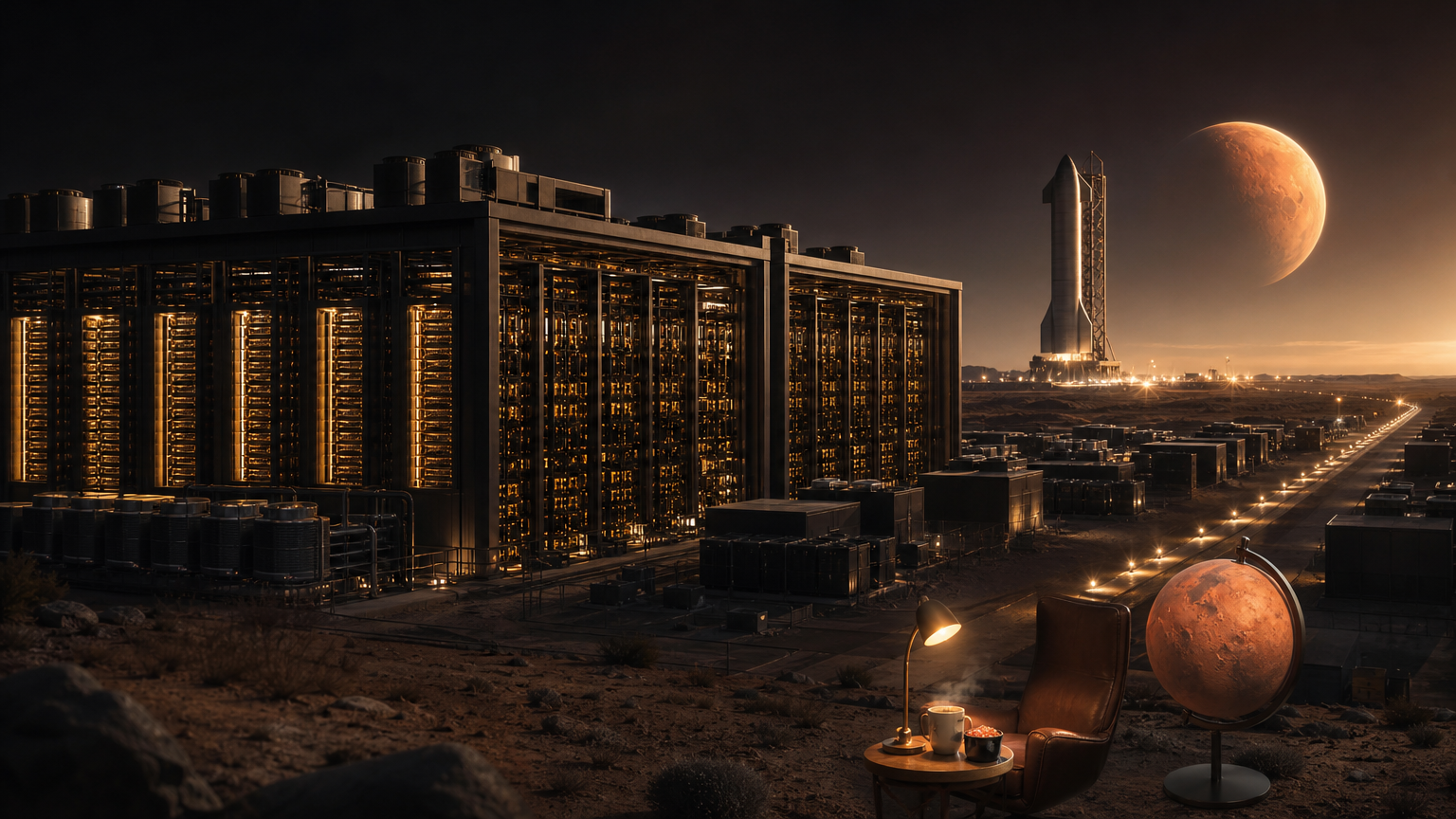
A rocket company moves deeper into compute
SpaceX has laid out plans to invest more than $74 billion in two U.S. supercomputing campuses, one at its Starbase site in South Texas and another in Cochise County, Arizona . The headline number is striking even by the standards of the current AI infrastructure race: roughly $24 billion is tied to the Texas facility, while about $50 billion is attached to the Arizona campus .
The plan marks a sharp expansion of SpaceX’s identity. The company is still anchored by launch services, Starship development and Starlink, but the newly announced campuses place compute infrastructure much closer to the core of the business . Reuters reported that SpaceX’s AI segment generated more than half of the company’s third-quarter revenue, underscoring how far the company has moved beyond rockets and satellite internet alone .
The immediate business logic is simple: advanced AI workloads require enormous, reliable computing capacity, and the most valuable capacity is the kind a company can schedule, power and optimize for its own roadmap. The strategic logic is broader. If SpaceX can control more of the compute stack, it can support AI model training, inference, engineering workloads and future space-related computing ambitions without relying entirely on third-party data-center operators.
Texas: Starbase gets its own power-heavy campus
The Texas portion of the plan is centered near Starbase, close to SpaceX’s South Texas launch and industrial operations . The company expects to spend more than $24 billion there, and the facility is planned on about 444 acres near the Port of Brownsville . The site is not being positioned as a conventional grid customer: SpaceX says the Starbase facility will generate its own electricity rather than draw power from the public grid .
That detail matters. AI campuses are increasingly judged not only by their GPU inventory, but by their ability to secure power without overwhelming local grids. At Starbase, SpaceX is choosing a self-generation model, and reporting cited a city notice showing plans for a gas-fired power plant paired with the supercomputing site . The Starbase City Commission is expected to consider a property tax abatement for the project on December 9, 2026 .
SpaceX says the Texas project has already generated more than 3,000 construction jobs and would support more than 500 permanent jobs once operational . The company has also committed $220 million to Brownsville-area water and wastewater infrastructure, including $40 million already provided, with identified projects expected to add about 20 million gallons of daily water capacity .
The Texas campus therefore has two layers of local politics. One is economic: jobs, tax treatment and infrastructure investment. The other is environmental and operational: a gas-fired power station may reduce pressure on the public grid, but it also places the project inside a broader debate over the energy footprint of AI.
Arizona: bigger campus, tougher approval path
The Arizona side is larger and more politically exposed. SpaceX expects to spend roughly $50 billion on a campus in Cochise County . The project still requires county approval, and the public record around it suggests a much longer checklist than simply buying land and servers.
The Arizona campus is expected to create about 5,500 construction jobs and 1,000 permanent positions, according to the company’s plan . It is also tied to local power negotiations: SpaceX says it is working with electric cooperatives and that the project could cut electricity bills for cooperative members by as much as 20 percent . Quiver reported the same planned benefits while noting that the Arizona project is still seeking approval and remains linked to cooperative power arrangements .
Water is the most sensitive issue in Arizona. SpaceX says the campus would use dry cooling and has no planned industrial groundwater use . That commitment is crucial in a rural desert county where large data-center projects immediately raise fears about aquifers, agriculture and long-term resource stress. UPI reported that the project includes a proposed $3.6 billion investment in electrical infrastructure and a 24-gigawatt-hour battery storage system .
Opposition is already organized. Reuters reported that a petition with about 2,400 signatures has asked officials to deny the permit, and a public hearing is set for December . The Next Web also noted that local residents have raised concerns over water, power bills and wildlife, including at a recent community meeting . In other words, the Arizona campus may be the larger economic prize, but it is also the part of the buildout most visibly dependent on public acceptance.
Why the number matters
The $74 billion commitment sits at the intersection of three bottlenecks: chips, power and permitting. Money alone does not solve any of them. The most advanced AI chips remain globally constrained, major substations and transmission projects can take years, and local approvals are becoming harder as communities see data centers as industrial-scale neighbors rather than invisible cloud infrastructure.
That is why SpaceX’s announcement should be read less as a single capital expenditure and more as a vertical-integration move. The company wants compute capacity close to its own operations, but it also wants more command over the infrastructure that makes compute possible. In Texas, that means private generation. In Arizona, it means a cooperative power strategy, battery storage, dry cooling and a promise of lower local bills .
The plan also shows how AI infrastructure is becoming inseparable from industrial policy. SpaceX’s October lobbying disclosures listed permitting reform, AI regulation and onshoring advanced manufacturing among its policy priorities, according to Quiver . That fits the pattern: companies building frontier-scale AI systems increasingly need not just GPUs and engineers, but favorable energy rules, faster permitting and predictable local tax frameworks.
The execution risk
The biggest risk is not that SpaceX lacks ambition. It is that every piece of the project has to arrive in sequence. The Texas site needs the power plant, the abatement process, construction delivery and local infrastructure work to align. The Arizona site needs county approval, cooperative electricity agreements, transmission capacity, community buy-in and environmental assurances that withstand scrutiny.
There is also a market question. If SpaceX succeeds, it could become a larger force in the U.S. data-center market and add pressure to the supply chain for chips, power equipment, transformers and construction labor. The Next Web reported that SpaceX now sells computing power to AI customers including Anthropic and Google, which suggests that the campuses are not only internal engineering infrastructure but also part of a commercial compute strategy .
For SpaceX, the move is consistent with the Musk playbook: pull a difficult dependency inside the company, scale it aggressively and accept the operational mess that follows. For communities in Texas and Arizona, the issue is more practical: whether the promised jobs, tax revenue and infrastructure upgrades outweigh the power, water and land-use concerns.
The $74 billion figure gets the attention. The real story is whether SpaceX can turn that figure into powered, permitted and socially durable compute capacity. Mars may not literally require a massive GPU inventory, but SpaceX is acting as if future space systems, AI models and industrial automation will all depend on one.
Comments
Be the first to comment.