
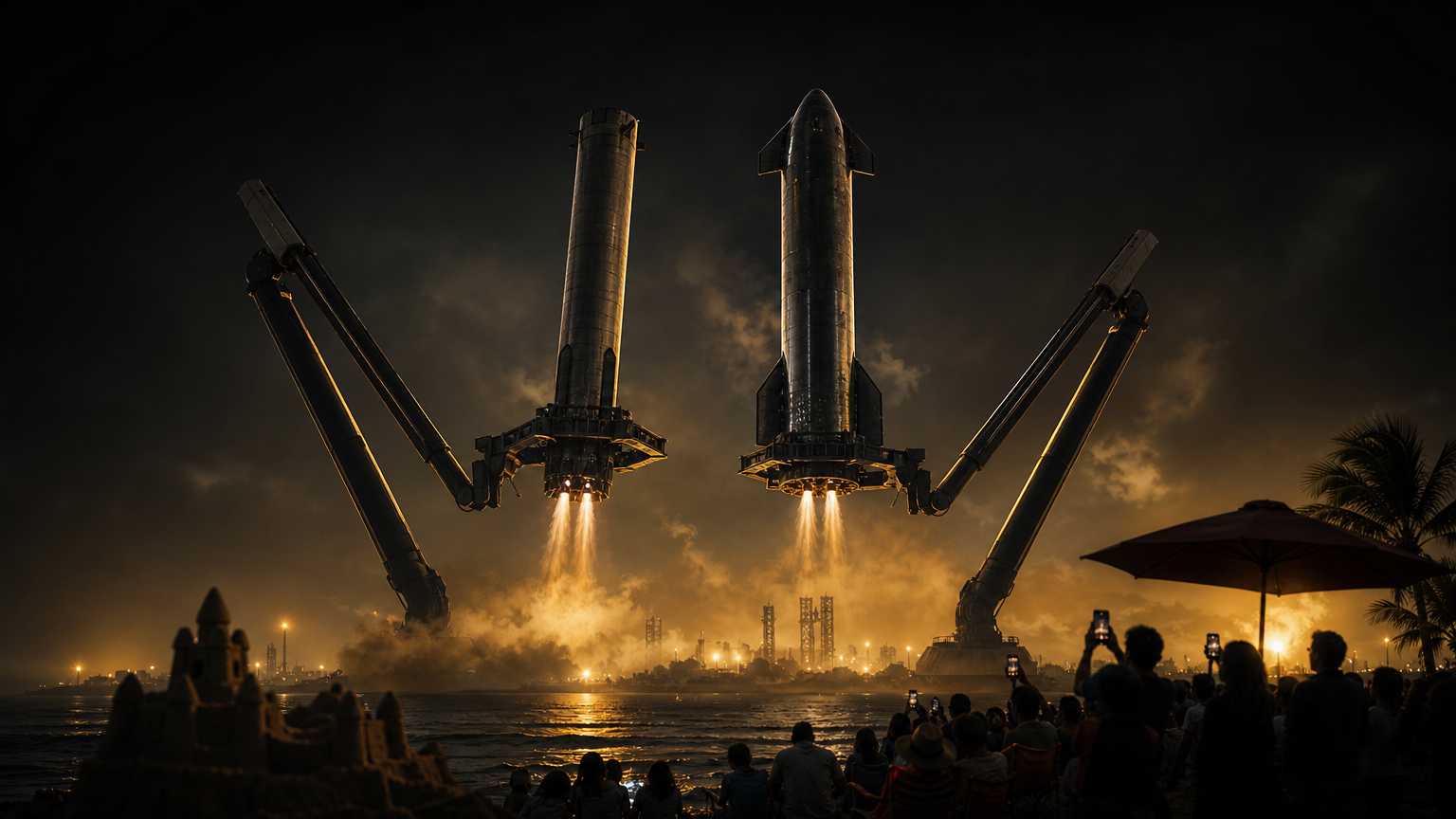
The target: one launch, two catches
SpaceX’s next Starship test is built around a simple but unforgiving idea: launch the full stack from Starbase, send the ship to orbit, then bring both stages back to the Texas launch site for tower catches. The flight is scheduled no earlier than Friday, November 13, with a 75-minute window opening at 4:45 p.m. CST, or 5:45 p.m. EST . The FAA’s current operations plan also lists “SPACEX STARSHIP FLT-15” from Starbase with a primary launch period of 22:45-00:40 UTC and a separate Starship reentry period on November 14 .
That split between launch and reentry is the story. Super Heavy would return first, about six and a half minutes after liftoff, aiming for the tower’s mechanical arms near the pad. Starship itself would continue onward, target roughly 14 orbits over more than 22 hours, and only then attempt its own return to the same launch site . SpaceX has caught boosters before; Flight 15 is meant to add the far harder half of the puzzle, the ship.
The current mission profile calls for Starship to deploy 26 Starlink V3 satellites during the orbital phase, making the flight both a payload demonstration and a recovery test . Reporting by Florida Today and the Palm Beach Post says Ship 42 is expected to circle Earth 14 times over roughly 22 hours before returning, while the booster comes back to Starbase roughly six and a half minutes after launch . That makes the test less a single dramatic catch than a two-day choreography of ascent, payload deployment, orbital health checks, deorbit, reentry and final tower approach.
Why the “double catch” matters
The catch attempt is not a stunt added to the end of a test flight; it is the business model in hardware form. Falcon 9 reuse lowered the cost of access to orbit by recovering only the first stage, but Starship’s promise is deeper: reuse the booster and the spacecraft, fly often, inspect quickly and relaunch with minimal refurbishment. If both stages can return to the tower, SpaceX avoids ocean recovery hardware, saltwater exposure and long transport cycles.
That is why the first full-stack catch is central to Elon Musk’s Mars architecture. A Mars transport system needs frequent launches, in-orbit refueling and a vehicle that can be treated more like aircraft infrastructure than disposable launch hardware. The company’s near-term Starlink capacity goals also benefit from the same capability: larger batches of next-generation satellites only matter if the launch vehicle can fly often enough to deploy and replenish them.
Flight 15 is therefore a cost-and-cadence test as much as a landing test. Recovering the booster alone would be useful, but catching both stages would attack the two biggest turnaround bottlenecks at once. In that sense, the tower arms are trying a real-life Tetris clear: align the booster, align the ship, and remove two expensive recovery problems from the board.
The timeline: minutes for the booster, a day for the ship
The booster sequence is the more familiar part. After liftoff, hot staging and separation, Super Heavy is expected to perform its boostback and landing burns before reaching the tower catch point around T+6 minutes 35 seconds . The FAA’s airspace planning reinforces that this is treated as a launch-and-reentry operation, with the Starship flight and Starship reentry listed as separate planned activities .
The ship’s path is longer and more conditional. Space.com’s published mission timeline lists orbital insertion, payload deployment, multiple return checks, a deorbit burn after more than 21 hours, atmospheric entry after about 22 hours and a final catch sequence around T+22 hours 32 minutes . Edit USA similarly reports that, if liftoff occurs at the opening of the window, the ship catch would fall around 3:17 p.m. CST on Saturday, November 14 .
The key word is “if.” SpaceX is expected to return Starship to the launch site only if flight controllers are satisfied that the systems needed for reentry, the landing burn and tower approach are healthy . If not, the mission design includes precleared ocean options rather than forcing a catch attempt. That conservative branch matters: a failed ship catch at the tower would threaten launch infrastructure as well as the vehicle.
Local impact in South Texas
For Brownsville, South Padre Island, Port Isabel and nearby communities, Flight 15 is not just a webcast. It is a local operations event with road closures, restricted areas and potential sonic booms. Starbase Watch reported that Mayor’s Order No. 2026-25 closes Boca Chica Beach, State Highway 4 from FM 1419/Oklahoma Avenue to the beach entrance, and FAA hazard areas from 11 a.m. to 11:30 p.m. CT on both Friday and Saturday .
The same local update notes that the booster is due back minutes after launch and the ship is planned to return the following afternoon, creating two periods when residents may notice operations around Starbase . It also says residents of Cameron County and nearby areas may hear one or more sonic booms when the ship comes back, while SpaceX characterizes sonic booms as brief thunder-like sounds whose audibility depends on weather and other conditions .
The practical result is that South Texas gets two tests at once: the aerospace test at the tower and the community-management test around it. Flight 15 will show not only whether Starship can approach the arms, but also how cleanly SpaceX, Starbase and federal airspace managers can run a launch-and-return campaign that spans two days.
Regulatory posture: planned, but still dynamic
As of the fresh public materials reviewed for this article, the target remains conditional. SpaceX’s public schedule and multiple trackers describe the November 13 attempt as pending regulatory approval . The FAA’s operations advisory, however, already reflects Starship Flight 15 in planned launch and reentry windows, with a primary launch slot on November 13 and a primary reentry slot on November 14 . Those two facts can coexist: airspace planning can appear before the final public signal that every launch requirement is cleared.
The backup planning also reflects the usual Starship uncertainty. The FAA operations plan lists a backup launch period on November 14 and a backup Starship reentry period on November 15 . That matters for spectators and residents: a scrub would not simply erase the local impact, but shift the launch and return sequence by a day.
What would count as success?
A clean Flight 15 has several separate success gates. The first is getting off the pad and through staging. The second is catching Super Heavy. The third is orbital insertion, deployment of the 26 Starlink V3 satellites and healthy cruise. The fourth is clearing the ship for return. The fifth is surviving reentry, executing the flip and landing burn, and arriving precisely enough for the tower arms to catch the ship .
A partial success would still generate valuable data. A booster catch with a ship wave-off, a successful satellite deployment with an ocean disposal, or a safe ship reentry without a tower catch would each answer important engineering questions. But the headline objective is unmistakable: Flight 15 is the first serious attempt to recover the whole Starship launch system in one mission.
If SpaceX pulls it off, the symbolic line will move. Full-stack reuse would no longer be a distant Mars-slide aspiration; it would be a demonstrated, inspectable, repeatable engineering target. If it does not, the data may still move the program closer. Either way, the chopsticks are no longer just catching boosters. They are being asked to catch the business case.
Comments
Be the first to comment.