
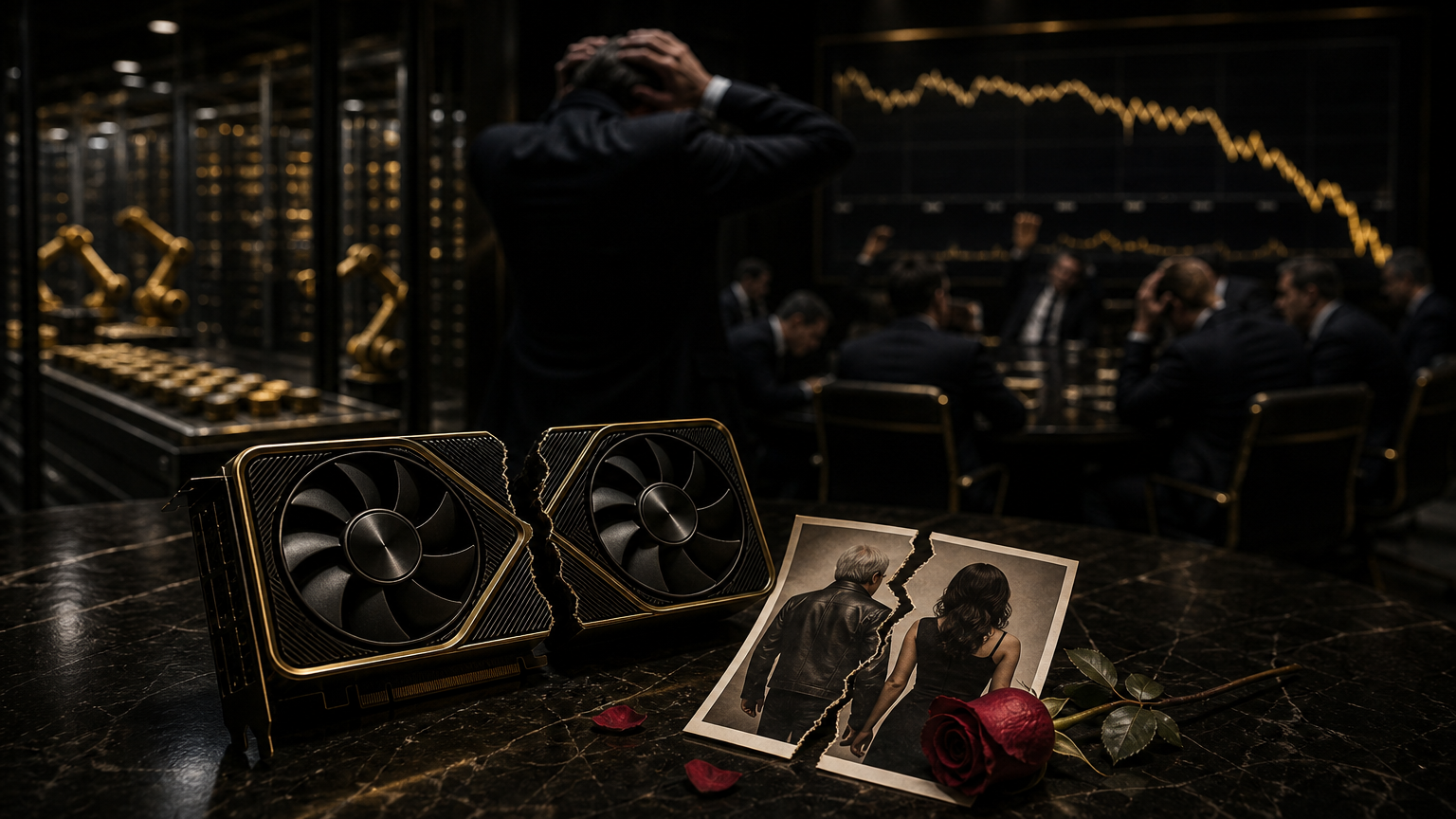
A week that broke the AI rhythm
The headline still reads like a market rumor that escaped containment: Jensen Huang is out at Nvidia. On November 12, Nvidia said Huang had resigned as president, CEO and board member, effective immediately, and that longtime finance chief Colette Kress would serve as interim CEO while Harvey C. Jones became the company’s first-ever board chair . That would be a major corporate transition in any year. In this year’s AI economy, it is closer to a stress test of the whole machine.
Huang was not just another tech CEO. He was the industry’s most visible supplier, cheerleader, diplomat and bottleneck manager. Nvidia’s accelerators power the training and inference pipelines behind much of the generative AI market, and the company’s chips sit under the ambitions of labs, cloud providers, neoclouds, enterprise software vendors and governments. AP described Nvidia’s high-end chips as leading building blocks for artificial intelligence, and noted that Huang had become a key figure both in the industry and in Washington .
That is why the resignation landed with unusual force. This was not only about succession planning. It collided with reports of extramarital relationships, questions about whether Huang had been targeted by a foreign intelligence effort, and renewed scrutiny of chip flows to China-linked companies .
The Nvidia shock: leadership, trust and leverage
Nvidia’s formal announcement was careful, sparse and corporate. The board said Huang resigned immediately; Kress, Nvidia’s CFO and executive vice president, would take over on an interim basis; and the company would begin a permanent CEO search considering internal and external candidates . But the surrounding context was anything but routine.
AP reported that one relationship raised national-security concerns after The New York Times said Huang had an affair with a businesswoman U.S. intelligence suspected of being a Chinese spy, allegations Beijing denies . AP also reported that Nvidia had earlier said it was investigating whether Huang had been “the target of a foreign intelligence effort,” while the company had said it had no reason to believe national security or Nvidia secrets were compromised . That distinction matters: the current public record contains allegations, investigations and denials, not a proven finding that Huang transferred secrets or that Nvidia’s core technology was compromised.
The chip-transfer angle is what made the scandal systemically important. AP reported that Megaspeed International, a Singapore-based company tied to Alice Huang, had previously been accused of illicitly shipping advanced Nvidia chips into China, while Megaspeed said there was “no evidence” of such exports and later said it takes U.S. export-control obligations seriously . Malaysia was investigating whether chips brought into the country by Megaspeed or its affiliate Speedmatrix had been reexported, according to AP .
On November 13, the political dimension widened. AP reported that Treasury Secretary Scott Bessent publicly blamed the Commerce Department’s delay in placing restrictions on Nvidia chip exports to Megaspeed, saying Treasury, State, Defense and USTR had favored adding the company to an export-control list for months . AP also reported that Chinese firms have accessed Nvidia chips through companies like Megaspeed, which had reportedly purchased more than 4 billion dollars worth of Nvidia advanced semiconductors .
The result is a story that touches governance, marriage, espionage, export controls, AI infrastructure and U.S.-China policy at once. That is why it felt less like a CEO scandal and more like a pressure leak in the AI supply chain.
The market reaction: Nvidia as the AI trade’s nervous system
The market did not treat Huang’s departure as a normal executive handoff. Axios reported on November 13 that Nvidia shares lost 12.7% during the week and continued sliding after the Huang fallout . Another Axios newsletter framed the concern as “contagion” for the AI trade, noting that Anthropic’s IPO preparations were suddenly trying to dodge the Nvidia fallout .
The anxiety is easy to understand. Nvidia is not merely a vendor to the AI industry. It is also a financier, partner and strategic accelerant. Axios reported that Nvidia had agreed to buy roughly 10 billion dollars of Anthropic shares through a private placement tied to Anthropic’s IPO, in addition to a previously announced 10 billion dollar funding commitment to Anthropic . The same report said Anthropic had committed hundreds of billions of dollars to cloud-computing deals for Nvidia GPUs, including through partners such as SpaceX, Microsoft, Nscale and Lambda .
That web of commitments makes Kress’s interim leadership important. A CFO stepping into the top job may reassure investors on operational discipline, but it also raises a question: will Nvidia keep financing the demand that keeps its own GPU flywheel spinning? Axios reported that Kress had sometimes pushed back on deals Huang championed, including large backstop-style commitments . If that posture carries into the CEO transition, the AI financing loop could become less aggressive.
Meanwhile, the models kept coming
The strangest part of the week was that the product cycle barely slowed. While Nvidia’s governance crisis dominated headlines, Anthropic and Google pushed forward with models and agentic workflows that show where AI is heading: away from isolated chatbots and toward systems that plan, switch tools, invoke other agents and sit inside daily work.
Google introduced Gemini 4 Hydrogen for agentic workflows and said it was bringing Gemini 4 to Google AI Studio, the Gemini API, Gemini for business, the Gemini app, Google Search and paid Google AI Pro and Ultra users in Google Antigravity . Google also introduced Orchestrator in Antigravity, a system that can dynamically switch between Gemini 4 Carbon and Hydrogen inside the same session, claiming near-Carbon task success on Terminal-Bench 4.0 while using 24% less quota and finishing 19% faster on average .
Anthropic’s platform notes show a similar direction. Claude Fable 5.2 and Mythos 5.2 are described as models for demanding reasoning and long-horizon agentic work, with a 1-million-token context window, 128,000-token maximum output and always-on adaptive thinking . Anthropic also said Claude Fable 5.2 is available through the Claude API, Amazon Bedrock, Claude Platform on AWS, Google Cloud versions of Claude Models and Microsoft Foundry . Just as importantly, Anthropic’s November 12 platform update announced self-hosted Claude Managed Agents, allowing customers to run the managed-agent service on their own infrastructure while choosing a model provider .
Google Cloud’s November 13 updates pointed in the same workflow-first direction: AI gateways, guardrails, model streaming across Gemini, Claude and OpenAI gpt-oss models, and controls for AI delegation through privileged access management [9]. The message across the product news is clear: the frontier is no longer only “which chatbot answers best?” It is “which model can be trusted to operate inside the work system?”
The bigger context: AI’s human and institutional risk
This week exposed a contradiction at the center of AI. The industry sells automation, reliability and scale. Yet the sector remains dependent on very human structures: founder judgment, executive relationships, government permits, board decisions, personal credibility and fragile financial alliances.
The Nvidia scandal matters because it sits at the intersection of all those dependencies. If the allegations remain unproven, the company still has a governance crisis and a succession challenge. If export-control investigations intensify, customers and partners must plan around tighter scrutiny. If Nvidia becomes more cautious with financing, AI infrastructure deals may face tougher math. If the scandal pulls Washington further into chip policy, the next GPU shipment could carry more political weight than technical meaning.
At the same time, the model labs are not waiting. Google is routing tasks between models. Anthropic is pushing longer-context, agentic systems and self-hosted managed agents. Cloud platforms are building guardrails, gateways and permission layers around AI delegation. The week’s irony is that AI products looked more capable just as the industry’s human foundations looked more fragile.
So yes, this may be the craziest AI week of the year. Not because one executive fell, or one model launched, or one stock dropped. It was crazy because all of those things happened together, revealing the same truth from different angles: AI is not just software anymore. It is capital markets, geopolitics, personal conduct, export law, cloud architecture and workplace automation compressed into one volatile stack.
Comments
Be the first to comment.