
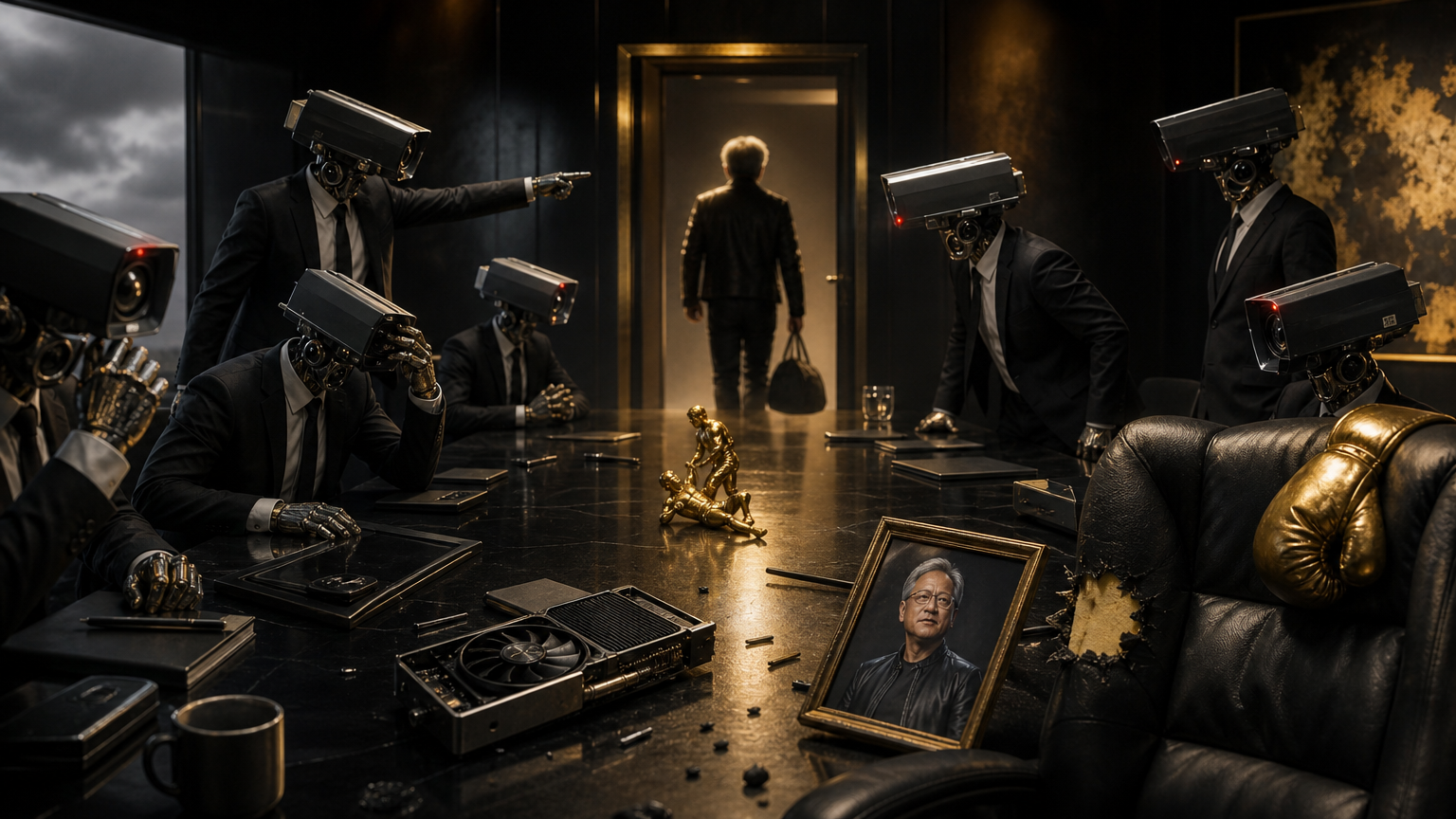
A founder exits, but the system keeps running
The working headline is the story: “The After” begins after Jensen Huang. Nvidia’s own announcement now makes the leadership break official: Huang has resigned as president, CEO and board member, effective immediately; CFO Colette Kress is interim CEO; Harvey C. Jones has become the company’s first-ever board chair; and a search for a permanent successor is under way . The company also says its third-quarter fiscal 2027 results will still be released on November 17, a detail that matters because investors will be listening less for sales guidance than for evidence that the Nvidia machine can function without its defining personality .
That is the paradox. Officially, this is a resignation. In market language, political language and Silicon Valley language, it reads like an ouster. The Associated Press described Huang’s departure as coming after two reported personal relationships put Nvidia under national-security and workplace-governance pressure: one involving Alice Huang, a former Megaspeed executive whom U.S. intelligence reportedly suspected of being linked to Chinese intelligence, and another involving an Nvidia executive who reportedly reported to him directly; AP said it could not independently confirm the second report . Nvidia’s official text avoids scandal detail and instead stresses continuity: Kress has been CFO since 2013, the board says operations and the product roadmap should continue without interruption, and the company thanks Huang for 33 years of work .
Why this is bigger than a CEO scandal
A normal tech CEO scandal hurts a stock. This one touches export controls, China policy, AI infrastructure, and the psychology of the entire boom. Nvidia is not simply another supplier; it is the company whose GPUs sit underneath much of the frontier-AI economy. AP framed the resignation as “the most tumultuous chapter yet” for a company whose high-end chips have become core building blocks for artificial intelligence .
The federal layer is now visible. On November 12, Senator Ron Wyden and Representative Richard Neal asked Commerce Secretary Howard Lutnick to preserve records tied to Nvidia export licenses, semiconductor tariff actions, communications involving Nvidia and Huang, and reports about Chinese intelligence links . Their letter says the inquiry follows reports of potential Chinese intelligence ties to the former Nvidia CEO and questions how advanced Nvidia AI chips were approved for Chinese buyers . That does not prove wrongdoing by Huang, Nvidia or the administration. It does show that the story has crossed from boardroom crisis into formal political oversight.
The White House is trying to narrow the diplomatic blast radius. AP reported on November 14 that President Donald Trump plans to bring Elon Musk on an Asia trip to the Philippines and China but does not plan to confront Chinese leader Xi Jinping over the Nvidia scandal . That same report said administration officials did not expect Chinese retaliation over follow-up actions to prevent smuggling or use of advanced chips . In other words: Washington wants to be seen as alert to chip leakage, but not eager to let the Huang affair derail a broader China agenda.
The market’s first verdict: nervous, not broken
Markets have not treated the transition as trivial. AP’s Friday market wrap said technology shares weighed on the market and Nvidia shares fell again one day after the AI industry was rocked by Huang’s resignation . The S&P 500 fell 0.4%, the Nasdaq dropped 0.9%, and the Dow rose slightly, illustrating that the shock was concentrated in the technology trade rather than a full-market panic .
That distinction is important. Nvidia is damaged, not disabled. Kress inherits a company with customers, chips, software, contracts, and an ecosystem that cannot be rebuilt overnight by AMD, Broadcom, Google, Amazon, or China’s domestic accelerators. But Huang was not a replaceable spokesperson. He was the salesman, strategist, product narrator, geopolitical lobbyist and AI-era mythmaker in one leather jacket. Removing him changes how every partner reads Nvidia’s promises.
The next pressure point is the November 17 earnings call. If Kress can answer questions on customer commitments, export exposure, internal controls, and capital allocation with discipline, Nvidia may convert a personality crisis into a governance reset. If she sounds boxed in by investigations and politics, the stock will become a referendum on whether Nvidia’s moat belonged to the company or to Huang.
Anthropic’s “overpowered” moment becomes more complicated
Anthropic enters this drama from the opposite direction: not a leadership collapse, but an acceleration story colliding with market skepticism. The current reporting says Anthropic’s IPO is roughly a week away and is now trying to dodge Nvidia fallout because of the financial and strategic links between the two companies . Axios reported that Nvidia had recently agreed to buy around $10 billion of Anthropic shares through a private placement connected to the IPO, separate from an earlier $10 billion funding commitment, while Anthropic has committed huge sums to cloud-computing deals involving Nvidia GPUs .
This is why “Anthropic overpowered” is not only about model capability. It is about capital intensity. MoneyWeek reported that Anthropic is expected to begin trading on Nasdaq on November 19 under the ticker ANT, with a price range of $70 to $78 per share . The same report said the company’s prospectus showed roughly $900 billion of purchase commitments payable by 2045, with about $70 billion due within 12 months of September 2026 . That is an astonishing number even by AI standards, and it reframes the Claude story: faster, stronger models are only half the pitch; the other half is whether investors believe the compute bill can generate durable returns.
The fresh media framing of the subject captures that tension. The Silicon Carne episode published November 13 described Anthropic as unveiling its most powerful model ahead of a colossal IPO and explicitly asked whether Dario Amodei’s scientific promises were a revolution or an argument for Wall Street . That is the right question. Anthropic’s advantage is that it can present itself as the serious, safety-conscious, enterprise-grade alternative in a moment when Nvidia looks politically exposed. Its weakness is that it is still dependent on the same infrastructure economy whose stability is being questioned.
Musk, Breton and the symbolic war over AI power
Elon Musk’s role is partly real and partly theatrical. AP reported that Musk wrote on X that it would be an “honor” to hire Huang . AP separately reported that Trump plans to take Musk on the upcoming Asia trip, placing him physically close to the geopolitical conversation around chips, China and AI, even as Trump avoids making Nvidia the agenda item .
The “Musk vs. Breton” frame is less about a single new regulatory act than about a continuing clash of models. Musk represents the American founder-sovereign: move fast, accumulate compute, ignore polite institutional constraints, and turn personal brands into geopolitical assets. Thierry Breton, in the French tech-media shorthand, represents the European counter-impulse: regulate platforms, discipline tech power, and insist that the AI future cannot be left to billionaires and their algorithms. The November 13 Silicon Carne episode explicitly framed one segment as “Breton vs Musk: Europe humiliated,” placing the Huang and Anthropic stories inside a broader argument over European weakness in the AI stack .
That framing is provocative, but it lands because Europe is mostly absent from the hard-power parts of this story. The chips are Nvidia’s. The cloud contracts are American. Anthropic’s IPO is on Nasdaq. Musk travels with the U.S. president. China is the strategic antagonist. Europe appears as regulator, critic, and worried spectator.
The aftershock
The lesson of this week is not that AI slowed down. It is that AI power is becoming less separable from personal conduct, national security, capital markets and statecraft. Nvidia now has to prove that its operating system is institutional, not merely Jensen Huang. Anthropic has to prove that “overpowered” models can justify overpowering obligations. Musk and Breton, meanwhile, personify the argument over whether AI should be governed by founders, markets, states or rules.
The real bug was never only in the code. It was in the leadership layer, the financing layer and the geopolitical layer. And this week, all three threw errors at once.
Comments
Be the first to comment.