
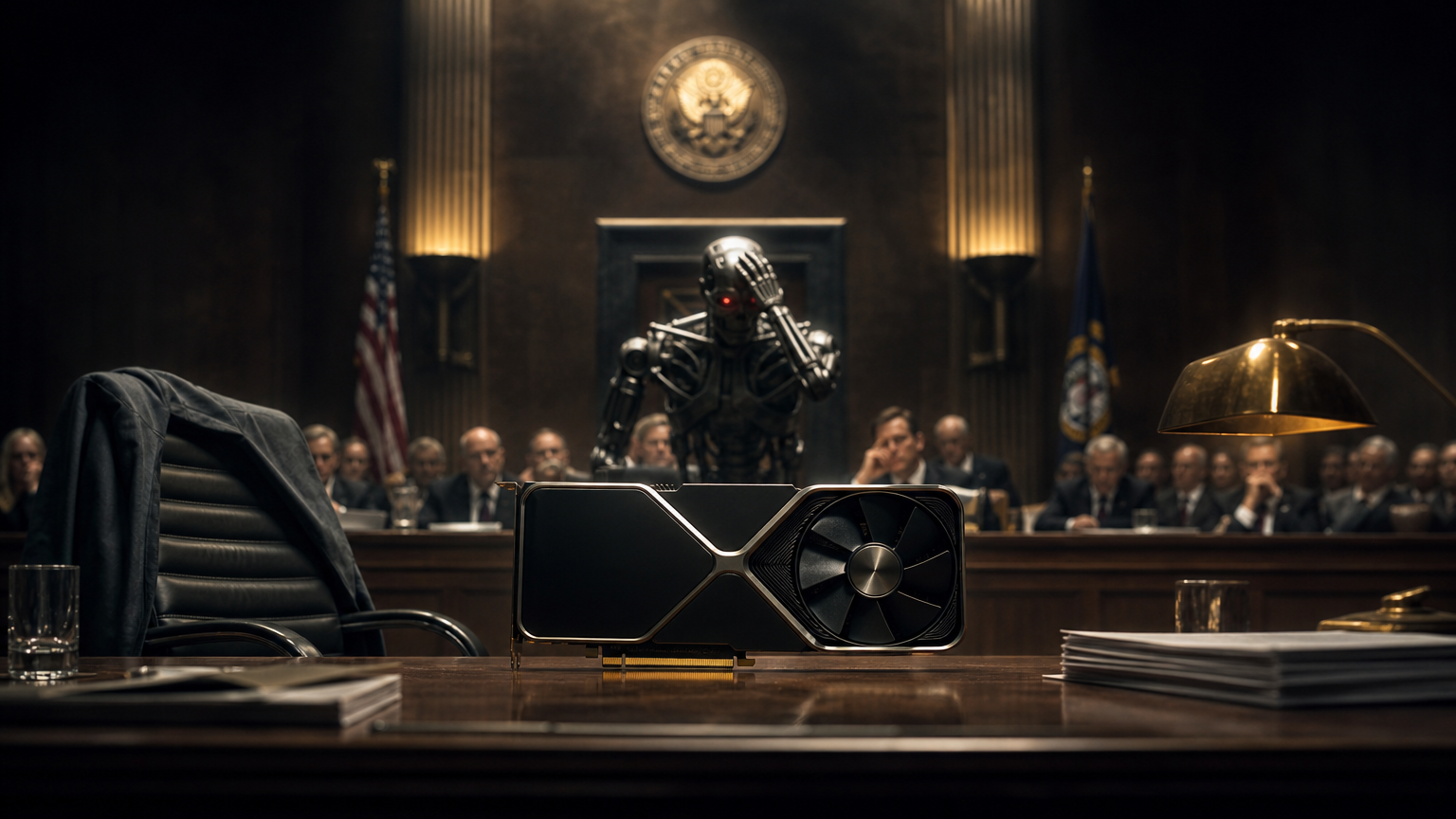
A sudden break at the center of the AI boom
Jensen Huang’s resignation from Nvidia lands as more than a change in the corner office. It removes the co-founder, public face and chief political advocate of the company most associated with the modern AI boom. Nvidia said Huang stepped down as chief executive with immediate effect, and Colette Kress, its long-serving chief financial officer, became interim CEO while remaining CFO . AP also reported that Nvidia is weighing both internal and external candidates for a permanent successor, ending an era in which Huang had led the company since its 1993 founding .
The timing is what makes the rupture so destabilizing. Huang’s departure followed reports about personal relationships, including one with Alice Huang, a former Megaspeed International executive whom U.S. authorities suspect of spying for China; Beijing has denied that allegation . CBS reported that the FBI was investigating romantic and business ties involving Jensen Huang and Alice Huang, while Nvidia’s board had been preparing to oust him before the resignation became public . That means Nvidia’s leadership transition is not simply a governance issue. It is now inseparable from questions about export controls, foreign intelligence risk and the chain of custody for high-end AI chips.
Nvidia tried to project operational continuity. Kress has been CFO since 2013, and Harvey Jones was named the company’s first board chair as the board began the CEO search . Yet the market reaction showed how personal Nvidia’s valuation story had become. CBS reported that Nvidia’s stock closed down 4.3 percent on Thursday, at $166.19, as the turmoil spread through investors’ expectations for the company . For a company whose chips sit underneath frontier AI labs, cloud data centers and government technology strategy, the loss of its defining executive is a systemic event, not a normal succession.
Why Washington is treating the scandal as a security event
The core concern in Washington is not only who Huang knew, but what access, influence or commercial decisions may have followed. CBS reported that Alice Huang was connected to Megaspeed, a Singapore-based data center company that had access to restricted Nvidia AI chips, and that Megaspeed is under investigation in the United States and Singapore over alleged chip smuggling into China . AP reported on Sunday that Megaspeed said Alice Huang left the company effective August 30, 2025, currently has no role there, and that Megaspeed retained outside counsel for an internal investigation . Megaspeed also told AP that it runs a legitimate business and said media claims about its operations were unsupported by verifiable evidence .
That distinction matters. The public record now contains allegations from U.S. officials, denials or distancing statements from companies and governments, and parallel investigations or inquiries. But the practical effect is already clear: Nvidia’s China exposure is no longer being assessed mainly through sales forecasts. It is being assessed through counterintelligence, export-control enforcement and congressional oversight.
Republicans on Capitol Hill moved quickly after the resignation. CBS reported that the chairs of the House Foreign Affairs Committee, House Select Committee on China and House Intelligence Committee asked Huang to appear for a closed-door interview on December 1 and warned that a subpoena could follow if he did not accept by Friday evening . The same report said Senate Banking Committee Chair Tim Scott asked Huang to testify voluntarily in early December and warned the committee was ready to use subpoena power if necessary . Huang’s resignation, in other words, did not close the file. It may have made him a less protected witness.
Democrats opened a separate line of attack focused on the Trump administration’s approval of Nvidia chip sales to China. TechCrunch reported that Democratic lawmakers launched an inquiry into how the administration handled Nvidia’s China sales, including a request for Commerce Secretary Howard Lutnick to preserve records tied to export licenses and communications involving Nvidia or Huang . The same report said the inquiry questioned why Commerce allegedly continued allowing certain sales after intelligence concerns had been raised . The scandal has therefore expanded from Nvidia’s boardroom into the machinery of U.S. export licensing.
Succession risk meets regulatory risk
Nvidia’s immediate challenge is to convince customers, developers and investors that its roadmap can survive the loss of Huang’s personal leadership. Kress brings deep institutional knowledge and financial credibility, but she inherits a company whose strategic relationships were often personified by Huang: with cloud providers, sovereign AI buyers, Washington policymakers and manufacturing partners. AP described the episode as a test not only for Nvidia but for the AI boom, because Nvidia remains the dominant supplier of the accelerators that underpin advanced AI systems .
The succession problem is complicated by timing. Nvidia is navigating export controls, possible subpoenas, a Megaspeed-linked probe, and bipartisan legislative pressure at the same moment that customers are planning multiyear infrastructure investments. Buyers of AI clusters care about supply continuity, compliance assurances and access to future architectures. Any uncertainty over who can speak for Nvidia, negotiate with governments or commit to long-term allocation decisions could ripple through the AI infrastructure stack.
The regulatory overhang may be even harder to contain. The questions now being asked in Congress go beyond whether Nvidia complied with existing rules. Lawmakers are asking whether the rules themselves are too weak, whether chip diversion through third countries is being adequately policed, and whether Chinese firms can still obtain Nvidia compute indirectly through overseas data centers . That broadens the issue from one executive’s conduct to the architecture of AI export control.
The China chip-control debate is accelerating
The political center of gravity has shifted toward tougher controls. IBTimes reported Sunday that lawmakers from both parties are moving to accelerate legislation aimed at preventing China from acquiring advanced AI chips after Huang’s resignation . The proposals gaining attention include the AI Overwatch Act, the Chip Security Act, the MATCH Act and the Remote Access Security Act, which together would expand congressional review, chip tracking, allied coordination and restrictions on remote access to AI compute . Reuters, republished by AsiaOne, similarly reported that lawmakers from both parties are calling for stricter limits on China’s access to advanced chips after the scandal .
For Nvidia, the danger is that its past lobbying position may no longer carry the same weight. Huang had long argued for preserving some access to the Chinese market, and CBS reported that the Trump administration had allowed certain H200 chip sales to approved Chinese customers under a revenue-sharing arrangement, while excluding more advanced Blackwell and Rubin systems . But AsiaOne’s Reuters report said lawmakers are now looking at measures that could treat chip exports more like strategic transfers, require tracking of advanced processors and restrict Chinese firms from renting overseas data-center capacity to reach Nvidia chips .
The market consequences are already visible beyond Nvidia. AsiaOne reported that Chinese AI model stocks and hardware suppliers fell on November 13 as investors feared Huang’s departure would lead to deeper restrictions on access to U.S. chips . That reaction shows how tightly AI valuations are tied to assumptions about compute availability. If the United States narrows access to high-end Nvidia hardware, the effects will reach cloud providers, model developers, data-center builders and semiconductor equipment suppliers.
What happens next
Three questions now define the story. First, can Nvidia stabilize leadership quickly enough to reassure customers that shipments, support and the product roadmap will continue without disruption? Second, will congressional testimony produce evidence of compliance failures, intelligence compromise or policy favoritism? Third, will the scandal become the catalyst for a durable tightening of U.S. controls on AI chips, cloud access and third-country intermediaries?
The safest conclusion is that Huang’s resignation is not an endpoint. It is the beginning of a more formal phase: board succession, congressional testimony, record preservation, internal reviews and export-control legislation. Nvidia remains essential to the AI economy, but its political immunity has weakened. The company that made accelerated computing the foundation of the industry must now prove that its governance and compliance systems can move just as fast.
Comments
Be the first to comment.