
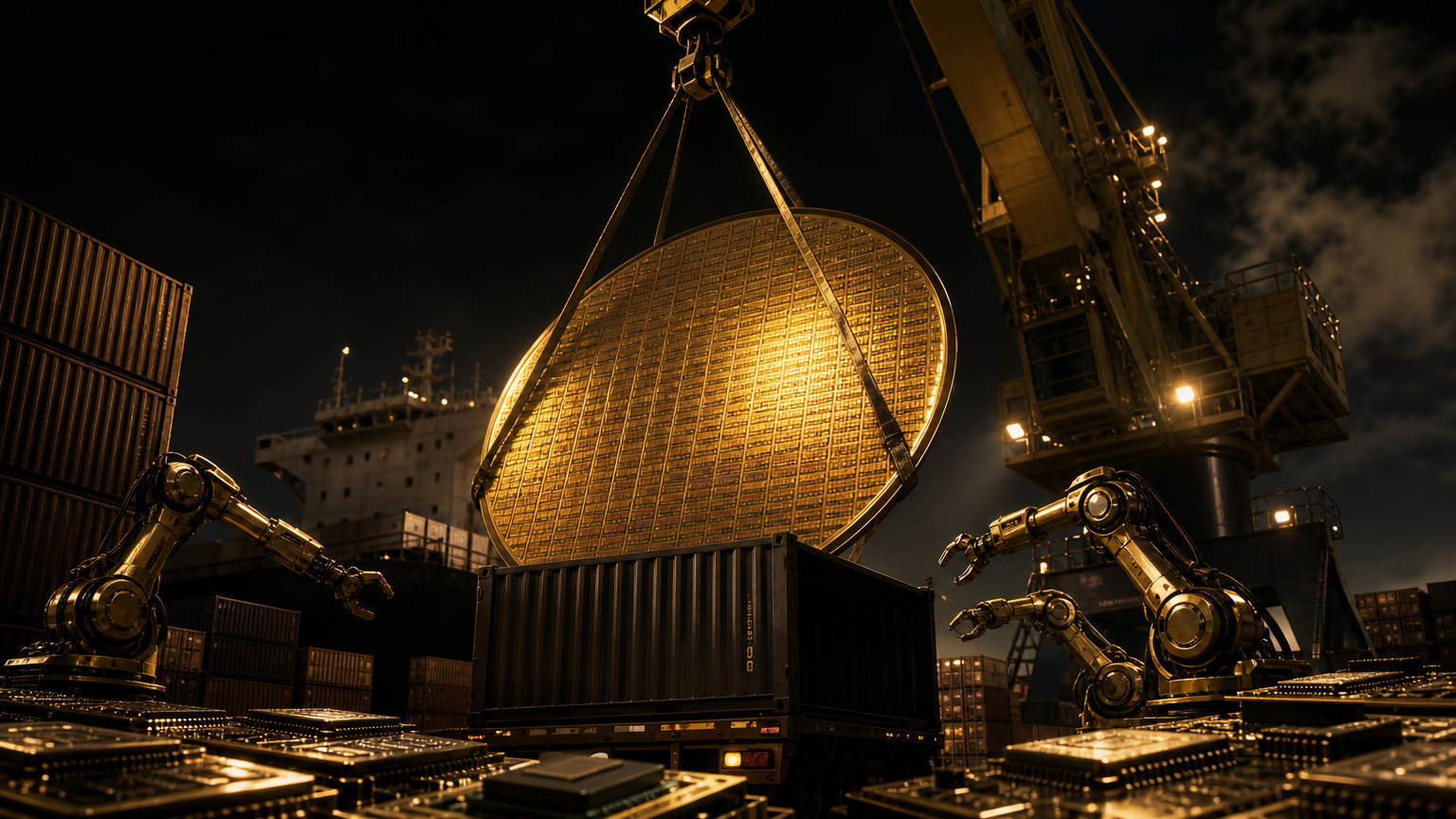
The headline number: $70.35 billion
South Korea’s information and communication technology exports reached $70.35 billion in October 2026, up 202.0% from $23.29 billion a year earlier, according to figures released by the Ministry of Science and ICT and the industry ministry on November 15 . That makes the month one of the clearest snapshots yet of how the artificial-intelligence infrastructure cycle is moving from corporate capital expenditure into national trade accounts.
The October figure was not the absolute monthly peak: September’s ICT exports were slightly higher at about $75.1 billion, according to Yonhap’s English-language report . But October still mattered because it kept Korea above the $70 billion level for a second consecutive month and represented the strongest year-on-year growth rate on record for ICT exports . In other words, September showed the scale of the boom; October showed that it was not a one-month spike.
ICT exports also accounted for 61.0% of Korea’s total outbound shipments of $115.28 billion in October, keeping the sector above 60% of national exports for a third straight month . That is the strategic point behind the numbers: Korea’s trade engine is increasingly being driven by the hardware layer of AI, especially memory, semiconductors and data-center storage.
Semiconductors carried the month
The core of the story is semiconductors. Chip exports jumped 259.4% year on year to $56.47 billion in October, representing 80.3% of all ICT exports . That concentration is both impressive and uncomfortable. It shows Korea’s exceptional leverage in the AI supply chain, but it also confirms that the export boom is heavily dependent on one sector and a narrow group of large players.
The demand driver is familiar but still powerful: AI infrastructure. Reports citing the government data pointed to strong demand for high-performance memory, tight supply in DRAM and firm memory prices as the main reasons for the semiconductor surge . In Korean reporting, DRAM exports were described as especially strong, while broader memory exports were presented as the main growth engine inside the chip category .
This is why the October data reads less like a traditional electronics recovery and more like a data-center investment report. Training and serving large AI models require accelerators, high-bandwidth memory, advanced DRAM, NAND storage and server-class SSDs. Korea’s export mix sits directly inside that stack. When hyperscalers and AI firms expand computing capacity, the effect can appear downstream as Korean customs data.
SSDs show the data-center channel
The second major signal came from computers and peripherals. Exports in that category reached $5.99 billion in October, up 439.3% from a year earlier, according to Korean coverage of the official data . The reason was not a consumer PC revival. It was the surge in high-capacity server SSDs used in AI data centers.
Yonhap reported that computer and accessory exports grew more than fivefold, led by high-capacity SSDs for servers . Korean-language coverage put SSD exports at $5.64 billion, up 584.3% year on year, and said U.S.-bound SSD exports rose especially sharply . That matters because it confirms that Korea’s AI exposure is not limited to headline chip shipments. Storage is also becoming a major AI trade channel.
The U.S. market illustrates the pattern. Korea’s ICT exports to the United States rose more than sixfold to $15.56 billion in October, while shipments to China and Hong Kong reached about $27.2 billion, supported by semiconductors and computers . Other Korean reporting cited strong increases across Taiwan, Vietnam, the European Union, India and Japan, suggesting that the boom is geographically broad rather than confined to one customer market .
A trade surplus built on silicon
The import side also expanded. ICT imports rose 52.7% to $19.8 billion in October, with semiconductor imports up 73.6% and computer and peripheral imports up 60.7%, according to Newspim’s report on the government release . But exports grew much faster, leaving an ICT trade surplus of $50.55 billion .
That surplus is the macroeconomic significance of the story. For Korea, the AI chip cycle is not just boosting corporate earnings expectations for memory leaders; it is strengthening the external account. In a global economy where many countries are trying to capture AI value through software, cloud services or sovereign models, Korea is capturing it through the physical bottlenecks of compute: memory, storage and advanced electronics.
The October data also reveals the asymmetry of the boom. Korean reporting noted that small and midsized companies’ ICT exports rose only 10.3% to $5.61 billion, while their semiconductor exports actually fell 6.2% . That contrast suggests the export upside is concentrated in large manufacturers with capacity, process technology and relationships with global cloud and AI infrastructure buyers.
Strategic upside, strategic risk
The upside is obvious. Korea has a stronger claim than almost any country to being indispensable to the AI hardware chain. When global accelerator demand rises, the supporting memory and storage ecosystem matters. Korea’s leading chipmakers have decades of experience in DRAM and NAND, and October’s figures show that this specialization can translate into national export power.
The risk is equally clear. If more than four-fifths of ICT exports are semiconductors, Korea’s trade performance becomes highly sensitive to memory prices, capacity timing and changes in AI capital spending. A pause in data-center investment, a pricing correction in DRAM or NAND, or a shift in procurement caused by U.S.-China technology controls could quickly alter the picture.
Export controls are part of the strategic background. Korean suppliers sell into a world where AI chips, advanced memory and manufacturing equipment are no longer treated as ordinary commercial goods. The United States, China, Taiwan and Korea are all positioned differently in the chain: the U.S. dominates accelerator design and cloud demand, Taiwan dominates advanced foundry production, China is pushing substitution, and Korea is central to memory and storage. October’s export figures show why Seoul’s policy choices on capacity, technology protection and market access are becoming more sensitive.
Why this month matters
October 2026 will likely be remembered less for the dollar figure alone than for what the figure represents. Korea’s ICT export structure is being re-priced around AI infrastructure. Semiconductors supplied $56.47 billion of the $70.35 billion total . Computers and peripherals surged because server SSD demand is growing with data-center buildouts . ICT made up 61.0% of all national exports for the month .
That is a powerful position, but not a relaxed one. Korea is winning because it sits close to the hardest hardware constraints in AI. The next challenge is whether the country can turn this boom into durable industrial strength: enough capacity without oversupply, enough diversification beyond the largest conglomerates, and enough policy agility to navigate export controls and strategic competition.
For now, the October data sends a simple message. In the AI economy, code may get the attention, but silicon is writing the trade balance.
Comments
Be the first to comment.