
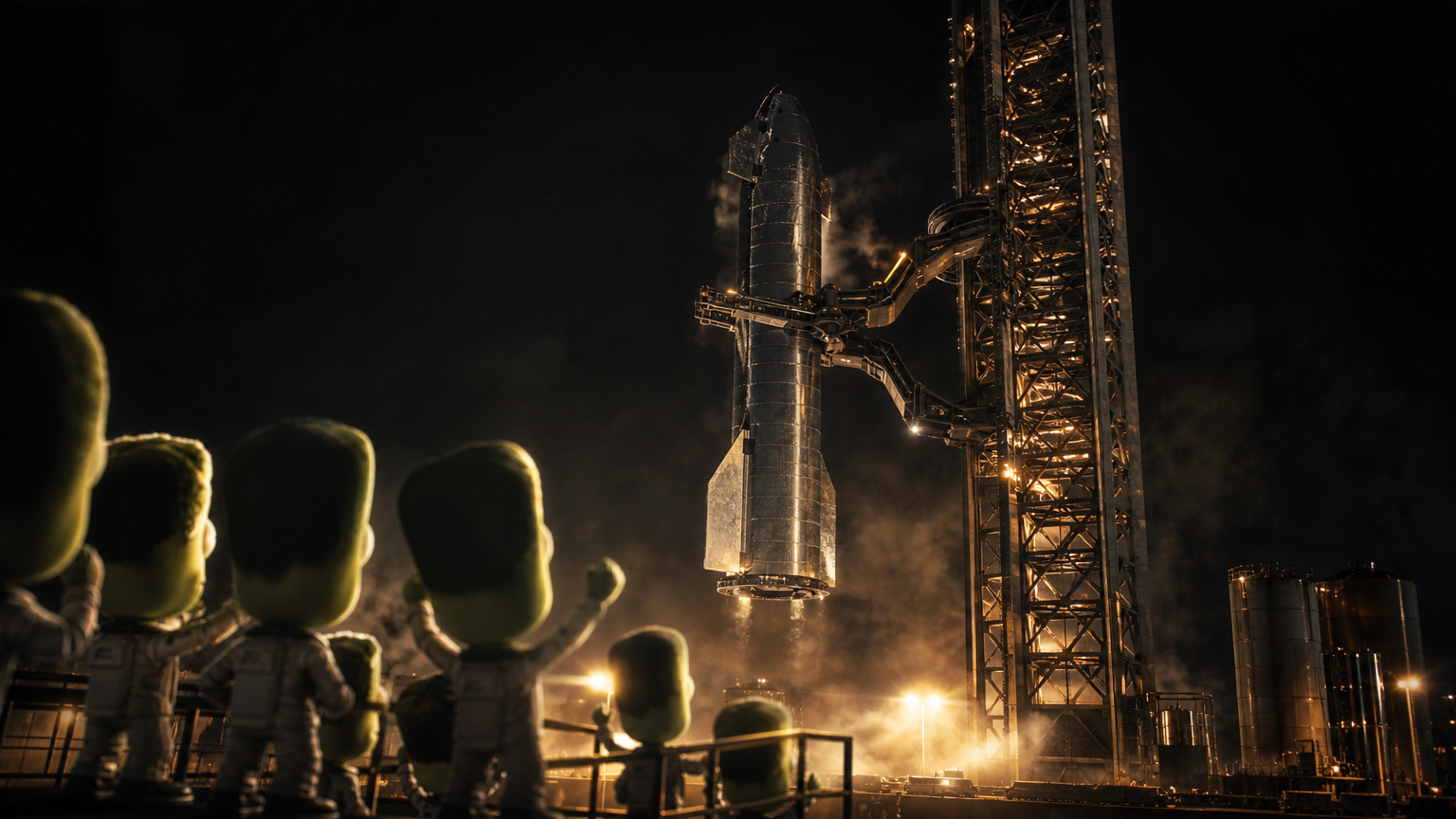
The headline matches the milestone: SpaceX catches orbital Starship
SpaceX has done the thing that made even veteran rocket-watchers sound briefly out of vocabulary: it brought the Starship upper stage back from an orbital mission and caught it at the Texas launch tower. On Saturday, November 14, 2026, the spacecraft returned to the same Starbase complex from which it had launched the previous evening and was captured in midair by the tower’s giant mechanical arms, the “chopsticks” often nicknamed Mechazilla .
The catch ended Starship Flight 15, a mission that lifted off from Starbase at 5:47 p.m. ET on Friday, November 13, deployed payloads, completed 14 circuits of Earth, and brought Ship 42 home after more than 22 hours aloft . Payload Space reported the catch at 4:20 p.m. ET, while other mission timelines placed the final capture around 3:29 p.m. Central time; the important point is not the minute on the clock, but the location and method: the spacecraft returned from orbit to the launch site and was supported by the tower arms rather than splashing into the ocean .
That is why this mission is more than another spectacular landing video. SpaceX had already caught Super Heavy boosters on earlier tests, but catching the upper stage is the harder half of the reusable-rocket equation. Unlike the booster, Ship goes all the way to orbital velocity, spends hours in space, survives atmospheric reentry heating, performs a final flip and landing burn, and must then align with a fixed tower beside the pad .
What actually happened during Flight 15
Flight 15 was designed as the first attempt to recover both major elements of the Starship system at the launch site: the Super Heavy booster shortly after liftoff, and the Starship upper stage after an orbital mission . The full double catch did not happen. Super Heavy Booster 22 aborted its planned return to the tower after indications that its boostback ended early because of a low fuel mass alarm; SpaceX said the guidance system then correctly detected that the vehicle was not in the right position and diverted it to an offshore splashdown path instead .
That booster miss matters, because SpaceX wanted a full-system demonstration. But it also matters that the abort protected the pad. Aerospace America quoted SpaceX’s Kate Tice saying early indications pointed to a low-fuel-mass alarm and that the booster autonomously followed safety protocols rather than forcing a risky tower approach . In reusable launch operations, a smart abort is part of the system, not merely a blemish on the scorecard.
The upper stage then became the mission’s main event. Ship 42 reached orbit, deployed 26 Starlink V3 satellites, and coasted for hours while SpaceX assessed its systems . Space.com’s live coverage reported that the vehicle performed a planned 10-second, single-engine deorbit burn on November 14 before aiming back toward South Texas . As it returned, the stainless-steel spacecraft endured the thermal and aerodynamic stress that makes an upper-stage catch radically different from a booster recovery.
Interesting Engineering described the vehicle as returning from orbital speeds of about 17,000 mph before atmospheric drag slowed it for the final phase . Near the end, Ship 42 reignited three Raptor engines, flipped vertical, descended toward the Starbase tower, and settled into the mechanical arms . SpaceX commentator Dan Huot summed up the moment on the company livestream: “We caught a Starship,” adding that “everything changes,” according to Payload Space .
Why catching the upper stage is the bigger deal
A booster catch is dramatic, but an orbital Ship catch attacks a deeper cost problem. Traditional upper stages are usually discarded after delivering payloads. Even partly reusable rockets such as Falcon 9 recover the first stage while expending the second. Starship’s promise is different: if both stages can be recovered, inspected, refilled, and reflown quickly, the economics of access to orbit change.
That “if” remains large. Saturday’s mission did not prove aircraft-like turnaround, and it did not prove reuse of Ship 42. It proved that a Starship upper stage can survive an orbital mission, come back to its launch site, and be captured intact by ground infrastructure . That is the missing physical demonstration on which faster refurbishment and repeated flights can now build.
The heat shield is central to that next phase. Aerospace America reported that Starship’s windward side is protected by about 18,000 hexagonal ceramic tiles and that SpaceX has been modifying them with the long-term aim of avoiding replacement between flights . That is the difference between a heroic test article and a transportation system: not whether it lands once, but whether the same hardware can be turned around reliably.
Starship also carried a practical payload, not just instrumentation. The flight deployed 26 Starlink V3 satellites, with coverage noting that these next-generation satellites are part of SpaceX’s plan to increase network capacity . That payload component matters because reusable systems become economically powerful only when they can combine testing with useful delivery work.
The unfinished business: no double catch yet
SpaceX did not complete the full headline it originally wanted. The booster’s offshore diversion prevented Flight 15 from becoming the first full recovery of both stages on the same mission . The company must still diagnose why Booster 22 lacked the conditions needed to continue to the tower, and it must repeat the upper-stage feat enough times to show that the process is controllable rather than merely possible.
That caveat should not be used to shrink the upper-stage achievement. SpacePolicyOnline noted that SpaceX had previously caught three Super Heavy boosters, but Flight 15 was the first attempt to catch the second stage after an orbital mission . In other words, the mission moved the unsolved problem from “Can the orbital ship be caught?” to “How fast and reliably can the whole system be caught, refurbished, and relaunched?”
NASA is watching closely. AP reported that the agency welcomed the news because Starship is tied to NASA’s Artemis lunar plans, with the vehicle intended to help land astronauts on the Moon later this decade . The same architecture is also central to Elon Musk’s Mars ambitions, because high-mass, high-frequency transport is the logistical backbone of any sustained off-Earth settlement plan .
Why this could reshape launch economics
The business logic is straightforward: recovery at the launch pad removes the need to send ships, cranes, barges, and recovery crews to distant landing zones or splashdown areas. A tower catch also places the vehicle near the systems that can inspect, service, restack, and refuel it. If SpaceX can make that routine, it reduces both direct recovery costs and the time lost between flights.
That is why this looks bigger than a stunt. Starship is a heavy-lift vehicle designed around reuse from the beginning. If upper-stage recovery becomes normal, SpaceX can treat the most expensive hardware as recurring capital rather than expendable inventory. Satellite deployment, space-station cargo, lunar hardware, propellant-transfer experiments, and eventually Mars logistics all become less constrained by the need to throw away a major stage each flight.
There is still a gap between a successful catch and an airline-style launch cadence. SpaceX must prove post-flight inspection, tile durability, engine relight reliability, pad safety, booster recovery, and regulatory repeatability. But Flight 15 has changed the baseline. Before November 14, an orbital Starship tower catch was an animation, a goal, and a wager on guidance, heat shielding, propulsion, and infrastructure. After November 14, it is a demonstrated event.
Even Kerbal Space Program would call that landing overpowered. The real-world significance is less meme and more manufacturing: SpaceX has shown that the orbital ship can come home to the place where another flight begins. The next revolution will be measured not by applause at the catch, but by how quickly the same kind of ship can fly again.
Comments
Be the first to comment.