
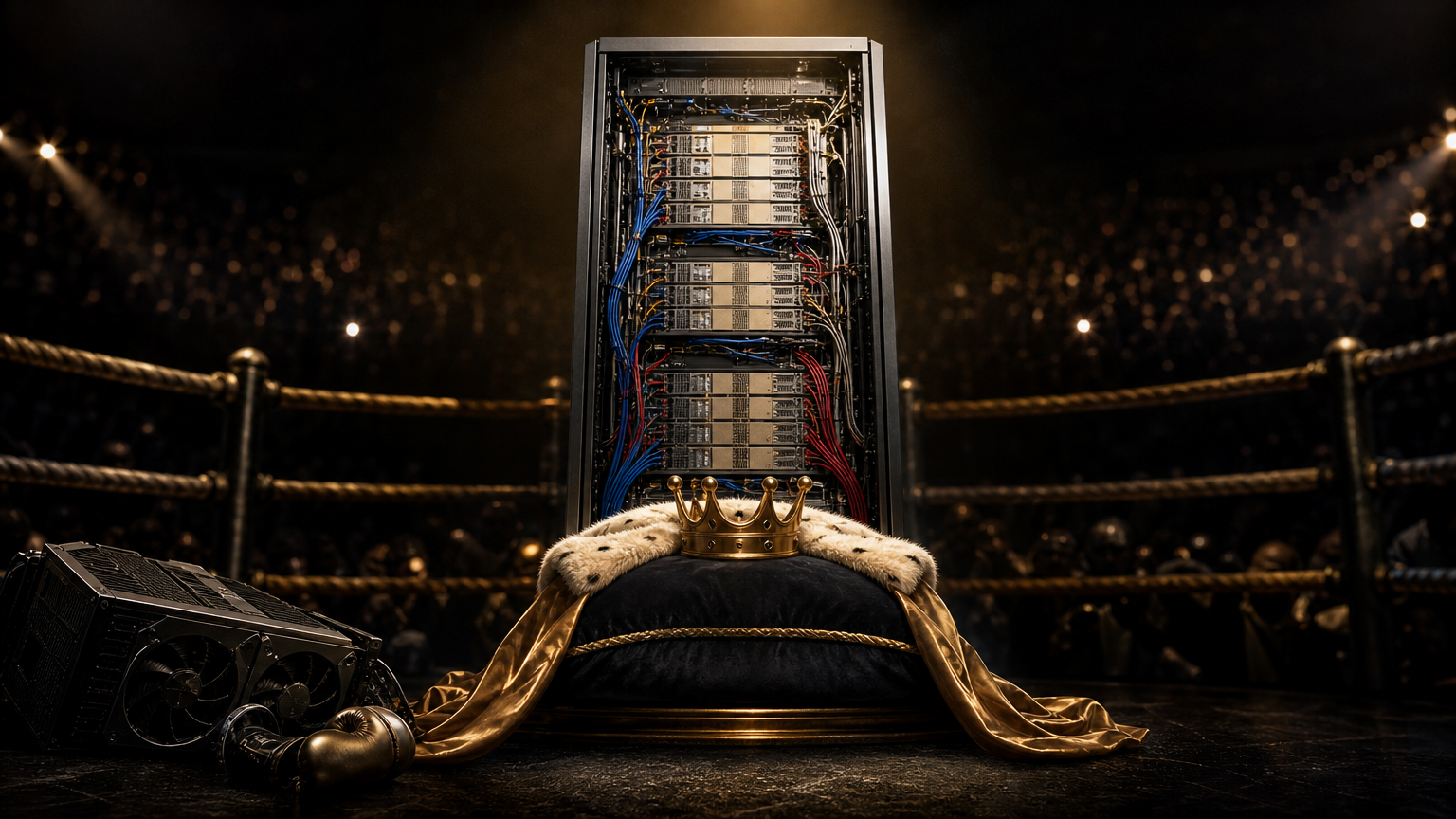
A TPU strategy that now looks like a hardware offensive
Google’s latest TPU move is not just another chip announcement. The report at the center of this story says Google has begun selling complete TPU systems to external customers, a break from its older model of keeping TPU hardware largely inside Google-managed cloud infrastructure . That matters because the customer is no longer merely renting accelerator time through Google Cloud; in the new model, selected customers can receive a vertically integrated TPU system that includes compute, storage, networking hardware, software, and services tied to training and inference .
The headline claim is direct and intentionally comparative: the full-rack TPU offering is said to deliver inference performance per dollar 50% ahead of Nvidia’s GB200 . Whether every customer workload will see that advantage is a separate benchmarking question, but the commercial signal is clear: Google is positioning TPUs as a substitute for Nvidia rack-scale systems, not just as a cloud-only option for teams already inside the Google ecosystem .
The timing also matters. The report says Google has expanded its eighth-generation TPU line to four configurations in one year, with two new chips aimed at confidential inference and long-context workloads, adding to two TPU systems released earlier in the year . That portfolio language suggests Google is no longer pitching a single accelerator as a universal answer. It is instead leaning into specialization, separating training, real-time inference, confidential computing, and long-context requirements into different system configurations .
From internal silicon to external systems
For most of its history, the TPU was a Google infrastructure story. The article notes that the TPU began in 2013 as a custom accelerator meant to lower the compute cost of Google’s own AI workloads, and that Google opened TPU compute rental on Google Cloud in 2018 . Under that older model, Google operated the hardware, managed the infrastructure, and offered external users access through the cloud .
The new development is the sale of complete TPU systems outside that closed operating model. According to the report, Google started delivering full TPU systems to customers in the second quarter of 2026 . The same report frames this as an internal strategic change: external orders help share the huge capital burden of AI data centers, while scaled demand can push the cost curve of Google’s self-developed hardware lower .
That is the part Nvidia should care about. Nvidia has dominated by selling not only chips but rack-scale systems, networking, software, and an ecosystem that makes GPUs the default procurement choice for AI infrastructure. Google’s shift copies the system-level logic: if buyers increasingly purchase AI compute by the rack, then Google has to compete by the rack, not by the chip or by the cloud instance alone .
Why inference economics are the real battleground
The phrase “performance per dollar” is the most important part of the story. Training grabs headlines because frontier model runs are spectacularly expensive, but inference is the cost that repeats every day once a model is deployed. As AI products move from experiments to production, the operator’s problem becomes less about one giant training bill and more about the marginal cost of every generated token, every user query, and every long-context session.
That is why a reported 50% inference performance-per-dollar advantage over GB200, if it holds across enough production workloads, would be strategically meaningful . A hyperscaler, AI lab, financial platform, or enterprise software provider does not only ask which rack is fastest. It asks which rack can serve the most tokens for the least money while meeting latency, reliability, software, and deployment constraints.
The article also says Alphabet has already tied TPU system sales to Google Cloud’s financial trajectory: Google Cloud revenue reached 30.7 billion dollars in the third quarter, up 103% year over year, and operating profit rose from 3.594 billion dollars to 11.121 billion dollars . It further says Alphabet has listed “product sales, primarily the sale of TPU systems” as part of Google Cloud revenue, and that management expects TPU system sales to continue expanding in the fourth quarter .
That does not mean TPU sales have already transformed Alphabet’s income statement. The same reporting says most contract revenue from TPU system sales is expected to be recognized in 2027, not immediately . But it does mean the business is now visible enough to be discussed as part of Google Cloud’s growth story, rather than hidden inside internal infrastructure accounting .
The software moat problem: CUDA versus TorchTPU
Google’s hardware challenge to Nvidia cannot succeed on hardware alone. Nvidia’s most durable advantage is not just silicon; it is CUDA, the developer tooling, libraries, integrations, and habits built over many years around GPU computing. The 36Kr report makes this point explicitly, noting that PyTorch support around CUDA has long made Nvidia GPUs the mainstream path for AI development .
This is where TorchTPU becomes important. The report says Google began working with Meta’s PyTorch team in mid-2025 to develop TorchTPU, with the goal of letting PyTorch models run on TPUs with only limited code changes . It also says the collaboration was open-sourced late last month, lowering the migration barrier that previously came from TPUs being strongly associated with TensorFlow and JAX .
That software move is not a footnote. If customers have to rewrite large parts of their codebase, revalidate kernels, retrain teams, and rebuild deployment pipelines, cheaper hardware may still lose. If TorchTPU makes the switch more incremental, Google’s rack-scale pitch becomes more credible . In other words, Google is not merely selling a rack; it is trying to sell an escape route from a GPU-only software habit.
Nvidia still has answers
The story is not that Nvidia has suddenly lost the AI infrastructure market. The same report cites SemiAnalysis testing in which Google’s TPUv7 Ironwood showed stronger token output per dollar than Nvidia GPUs in some agent inference tests, but it also says Nvidia responded with engineering optimization and eventually made GB300 outperform TPU by 1.5 to 2.6 times on one model after four rounds of optimization .
That detail is important because it shows the race is dynamic. Benchmarks are not fixed laws of nature. Kernel work, quantization, batching, memory management, interconnect tuning, and model-specific serving stacks can change the result. A TPU rack may be compelling for one inference profile, while Nvidia’s platform may win after optimization on another .
Still, Google’s attack changes the negotiating environment. Until recently, many large buyers could complain about GPU pricing and supply constraints, but they had limited alternatives at comparable scale. A full-rack TPU system gives them another vertically integrated option, and even customers that remain with Nvidia may gain leverage if Google can credibly supply capacity .
What this unlocks for large AI operators
The most likely early adopters are not small startups buying a few accelerators. Full-rack TPU systems make the most sense for companies with sustained AI demand, engineering teams capable of validating a new accelerator stack, and enough inference volume to care deeply about cents per million tokens. The article says Google has seen strong TPU demand from AI labs, capital-market firms, and high-performance computing applications .
For those customers, the question is no longer simply “GPU or TPU?” It is “which workloads should stay on GPUs, which can move to TPUs, and how much bargaining power does a multi-accelerator strategy create?” Training, latency-sensitive inference, long-context serving, confidential inference, and batch agent workloads may not all land on the same silicon.
Google’s full-rack TPU sales therefore represent more than a product launch. They mark a structural shift in AI infrastructure procurement: custom silicon is moving from a hyperscaler’s internal advantage to an external product competing against Nvidia’s rack-scale systems . If Google can prove the economics, strengthen the software stack, and deliver systems reliably, the GPU boss battle has indeed entered a new phase — one where the challenger is not another GPU, but a TPU-shaped rack.
Comments
Be the first to comment.