
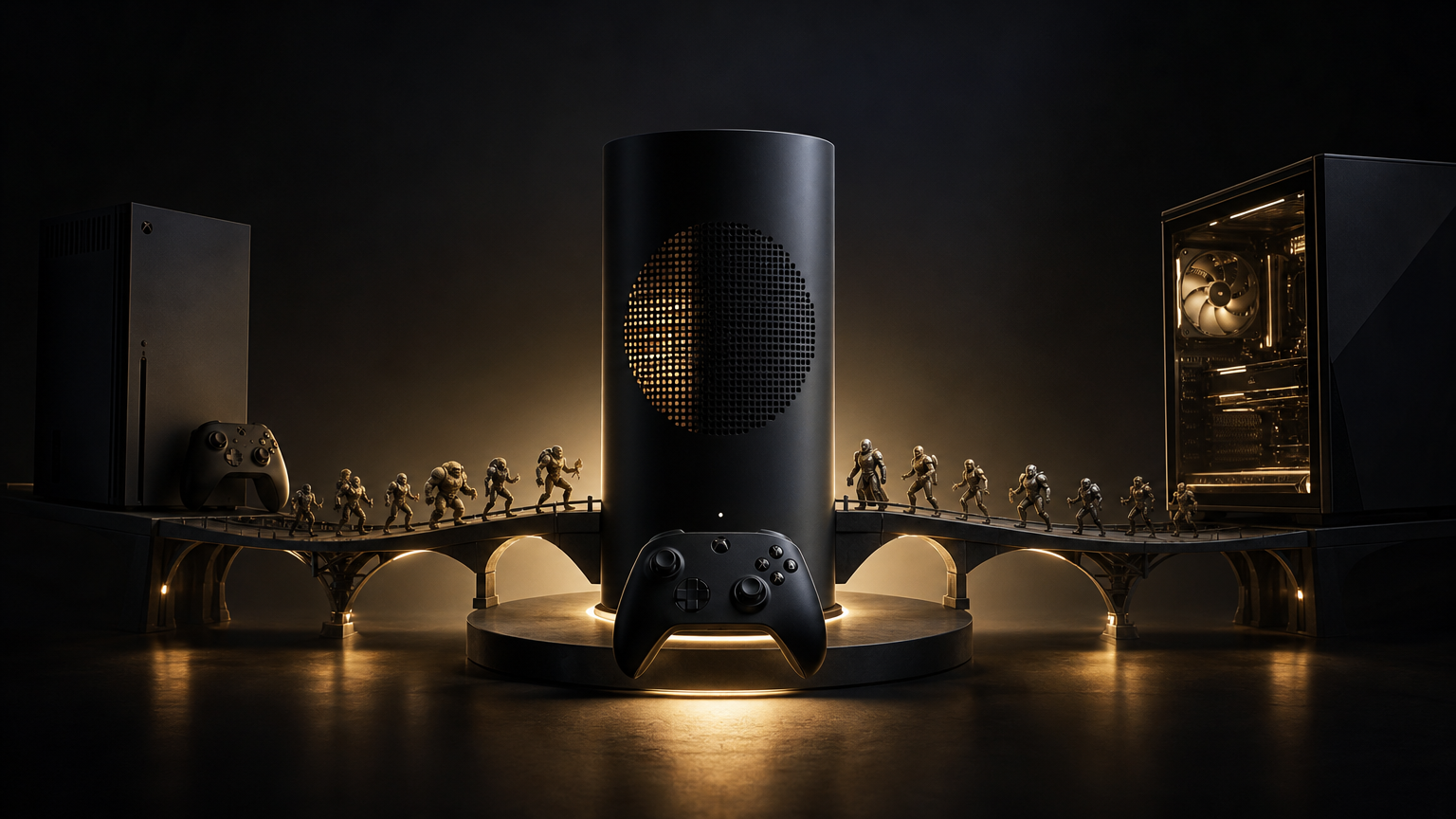
A console, not a disguised desktop
Microsoft’s newest clarification on Project Helix is less about a spec sheet and more about identity. The company used its 25th anniversary Xbox magazine to frame the next Xbox as a dedicated console experience that happens to blur the wall between console and PC games, not as a Windows gaming PC repackaged for the living room . That distinction matters because Xbox has spent years pushing a broad “play anywhere” message across console, PC, cloud, handhelds and Game Pass, sometimes at the cost of making the dedicated console feel central.
Jason Ronald, Microsoft’s vice president of next generation, supplied the key line: Helix is designed as “a console that is also capable of playing games from your PC,” not “a PC that can also play console games” . The formulation is carefully ordered. Microsoft wants the comfort of the console model — turn it on, find the game, play — while borrowing enough of PC gaming’s openness to make the next Xbox feel less isolated than previous generations.
That is why this is not just a semantic correction. If Helix were perceived as a PC with an Xbox interface, buyers would judge it against gaming desktops, Steam Machines, handheld PCs and storefront politics. If it is understood as a console with PC reach, Microsoft can preserve the emotional contract of Xbox hardware: simple setup, predictable performance, a living-room interface and a library that follows the player.
The real promise is continuity
The most important part of the Helix pitch may be the library promise. Ronald described a future in which a player can bring four generations of Xbox library and progression into the new hardware “instantly” . Kotaku also reported the same core idea: Helix is being positioned to carry games and progress from every previous Xbox generation while removing constraints between console and PC games .
That is an ambitious expansion of backward compatibility. Xbox already made preservation a brand pillar during the Xbox One and Series X|S eras, but Helix reframes compatibility as a platform design principle rather than a bonus feature. The practical message to players is simple: upgrading hardware should not mean abandoning purchases, saves or identity.
This is also where Microsoft has an advantage over a pure PC strategy. PC libraries are powerful but fragmented across launchers, stores, settings menus and hardware assumptions. Console libraries are cleaner but more limited. Helix is being described as an attempt to keep the console side’s clarity while widening the usable library to include PC games.
PC games without PC chores
The challenge is that “PC games on a console” can mean many things. Does it mean Xbox app purchases only? Battle.net? Steam? Epic Games Store? Cloud streaming from a home PC? Native installs? Microsoft has not fully answered those questions in this round of messaging.
GamesRadar noted that the central quote does not make Helix sound like a Steam Machine, and it identified storefront breadth as the obvious unanswered question . TechSpot likewise reported that rumors and hints have pointed toward possible rival storefront access, but that the confirmed message is more cautious: a console-focused experience, deeper performance controls for power users, and a front end shaped by lessons from the ROG Xbox Ally and Xbox mode on Windows .
That gives us the clearest current read: Microsoft wants the default experience to feel like a console, while allowing enthusiasts to adjust settings more like they would on PC. Ronald’s comments suggest a two-layer model. Most players get the “instant access” layer. Power users get more control over performance and graphics options . The unresolved question is how far Microsoft will let third-party PC ecosystems into that console layer.
Neural rendering is the cost story
The other major Helix theme is affordability. Ronald tied the next Xbox’s design to a tough component environment and said the team needs to invent new technology while keeping hardware accessible and affordable . He pointed specifically to neural rendering as a way to generate frames without simply adding more computational horsepower or memory .
That is the strategic pivot. In previous console generations, the story often revolved around more teraflops, higher resolution targets and obvious leaps in raw power. With Helix, Microsoft appears to be preparing players for a different kind of generational argument: not “8K or 240Hz,” but smarter rendering, better frame generation, stronger visual fidelity per watt and per dollar .
This is not merely technical marketing. If memory and components remain expensive, brute-force hardware could push console pricing into territory that undermines the mass-market appeal of dedicated boxes. Neural rendering gives Microsoft a way to claim forward motion without promising an unaffordable tower-class machine under the TV.
Why the clarification was necessary
The clarification arrives because Xbox’s identity has become complicated. The company sells consoles, publishes games on rival platforms, runs a major PC storefront, operates Game Pass, supports cloud play, and has experimented with handheld PC hardware through the ROG Xbox Ally line. In that context, players had a fair question: is the next Xbox still a console?
Microsoft’s answer is yes, but with qualifications. Helix is meant to be the bridge: a device that keeps console simplicity but acknowledges that modern players own libraries across devices and expect progress to move with them. Digital Trends framed the same point as Microsoft trying to blur the line between console and PC while preserving the simplicity of a traditional Xbox .
That is the correct strategic target. Xbox cannot win the next generation by pretending PC gaming is separate from its ecosystem; Microsoft is one of the biggest forces in PC gaming. But it also cannot abandon the console buyer who wants dedicated hardware precisely because it is not a maintenance project.
The open questions
For all the clarification, Helix is still more philosophy than product. Microsoft has not shown the box, named the final hardware, confirmed the price, announced the release date, or explained exactly which PC games and storefronts will work . Kotaku noted that there is still no word on when Microsoft will show Project Helix in more detail, and the timing debate remains open between 2027, 2028 or later .
The strongest reading is that Microsoft is trying to reset expectations before revealing hardware. Helix is not being sold as a hobbyist PC. It is being sold as Xbox’s attempt to make a player’s console history, PC library and future progress feel like one continuous account-based ecosystem. If Microsoft can make that feel effortless, Helix could solve a long-standing split inside Xbox. If it cannot, players may see only another layer of launcher confusion.
For now, the achievement is conceptual but significant: backward compatibility is no longer just about old discs or old downloads. In Microsoft’s Helix pitch, it becomes a multigenerational, cross-device identity system — the connective tissue between console and PC.
Comments
Be the first to comment.