
The catch that changes the Starship argument
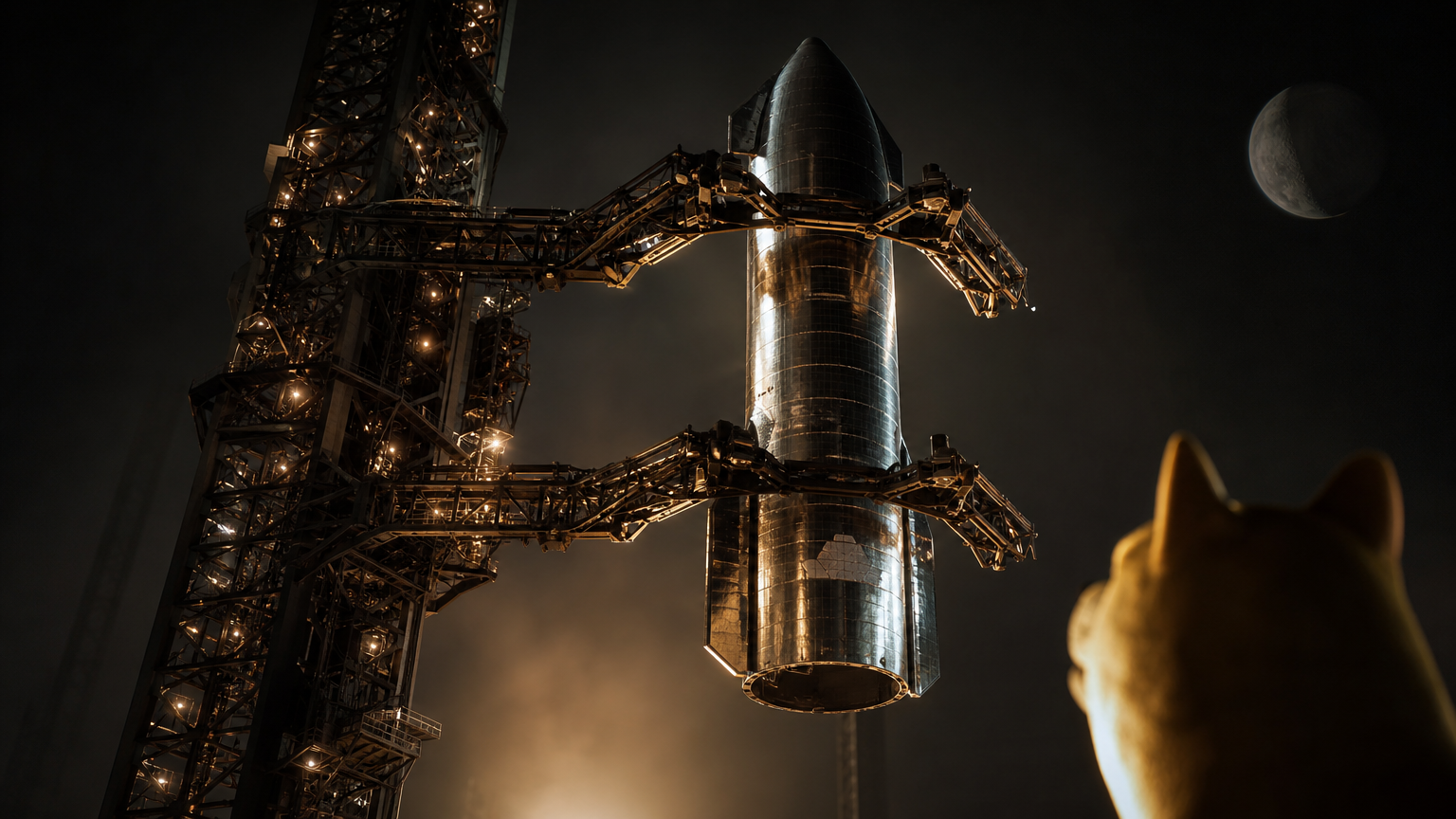
SpaceX’s Flight 15 ended with the image the company has been building toward for years: a Starship upper stage descending through cloud, flipping upright, and settling into the mechanical arms of the Starbase launch tower after returning from orbit . The catch took place on November 14, 2026, after the vehicle had left Texas the previous day, completed 14 laps around Earth, and spent roughly 22.5 hours in flight .
This was not simply another landing stunt. SpaceX had previously caught Super Heavy boosters, but the upper stage is the part of Starship that actually reaches orbital velocity, endures reentry heating, performs the late flip maneuver, and must still arrive precisely enough for the tower arms to close around it . Until Flight 15, Starship upper stages had been treated as test articles to be expended or sent to ocean recovery paths. Now, for the first time, SpaceX has brought the ship back to the launch site and caught it in the same infrastructure meant to turn it around for another mission .
The immediate result is a mixed success. The upper stage delivered the headline milestone, while the Super Heavy booster did not complete the planned double catch . Still, the balance of the mission has shifted the program’s center of gravity: Starship is no longer just demonstrating ascent, payload deployment, or controlled reentry. It has demonstrated the hardest visible piece of orbital-stage recovery.
What Flight 15 actually did
Flight 15 launched from Starbase, Texas, on November 13, 2026, with SpaceX targeting the first return of both major Starship elements to the launch site . The upper stage reached orbit, deployed 26 advanced Starlink satellites, and streamed live views through Starlink while circling Earth at about 165 miles, or 265 kilometers, in altitude .
After roughly 14 orbits, the ship performed its return sequence, reentered the atmosphere, transitioned from high-speed flight to subsonic descent, and executed the landing flip that brought it vertical over the pad . It then slid into the tower’s “chopstick” arms at Starbase, where the vehicle was left suspended above the launch mount .
The mission’s commercial subtext matters. Starship is meant to move beyond the Falcon 9 model, where the booster is reused but the upper stage is discarded. A fully reusable Starship system would preserve both stages, reduce the need for ocean recovery, and make the expensive upper stage part of a fly-inspect-refly loop rather than a one-and-done machine . That is why the catch is more than spectacle: it attacks the cost and cadence bottleneck at the top of the launch stack.
The booster failure kept this from being the full prize
The planned double catch did not happen. Super Heavy’s return was aborted, and the booster diverted to a Gulf of Mexico splashdown, where it exploded after the catch attempt was waved off . SpaceX commentators initially discussed a guidance, navigation and control trigger, but later clarified that guidance was doing its job by detecting that the booster was not in the right place to proceed with a tower catch .
According to Space.com’s reporting from the SpaceX broadcast, the company was still investigating the root cause, with the automated abort sending the booster away from the pad and toward the offshore contingency zone . The important safety point is that the tower and pad were protected; the important engineering point is that a fully recovered orbital launch system was not achieved on this flight .
That distinction matters for how to read the milestone. Flight 15 did not prove complete Starship reuse. It proved something narrower but arguably more difficult: that an orbital Starship upper stage can survive the mission profile, return to the launch site, and be caught by ground infrastructure . The remaining task is to make both halves of the vehicle do that on the same mission, then repeat it on a schedule that looks less like experimental flight test and more like transport operations.
Why the ship catch is commercially decisive
The Starship business case depends on eliminating the expensive habits of spaceflight. Ocean splashdowns expose hardware to saltwater, delay inspections, and complicate refurbishment. Traditional expendable upper stages remove reuse from the most energy-demanding part of the system. A tower catch, if it becomes routine, changes the economics by keeping the ship close to the factory, the pad, the fueling systems, and the technicians who must certify it for the next flight.
That is especially important for Starlink. Flight 15 deployed 26 next-generation Starlink satellites, and SpaceX has tied Starship’s future cadence to larger satellite deployments and much higher constellation capacity . If Starship can launch, return, and fly again quickly, SpaceX can put far more payload mass into orbit without scaling launch costs in the old linear way.
There is also a strategic difference between recovering a booster and recovering a ship. Boosters return after a short suborbital arc. Ships must operate in orbit, preserve cryogenic systems, survive entry heating, manage crossrange and final approach, and land with little room for error . By catching Ship 42 from orbit, SpaceX has taken a visible step toward the kind of reuse that would make Starship not merely large, but operationally disruptive.
Artemis, Mars, and the work still ahead
NASA also has a stake in this milestone because Starship is part of the Artemis lunar architecture. AP reported that NASA welcomed the result, with the agency paying SpaceX billions of dollars for Starship-derived lunar lander capability later this decade . The catch does not by itself solve the lunar version of Starship, but it strengthens confidence in one essential layer: recovery and reuse of the core vehicle family.
The hardest remaining items are not small. SpaceX still has to demonstrate rapid reflight, ship reuse after inspection, reliable booster catch on the newer vehicle configuration, and orbital propellant transfer for deep-space missions . Space.com noted that Starship has not yet reused a ship, and that off-Earth refueling remains a key hurdle for lunar and deep-space operations .
That means Flight 15 should be read neither as mission accomplished nor as mere theatrics. It was a proof point. The ship came home. The tower caught it. The booster did not. The next era of Starship will be judged by whether SpaceX can turn this spectacular recovery into routine operations: catch, inspect, reload, relaunch.
For now, Mechazilla has done something no launch tower had done before. It caught a Starship after orbit, and that single act moved the program from “can it return?” to “how fast can it fly again?” .
Comments
Be the first to comment.