
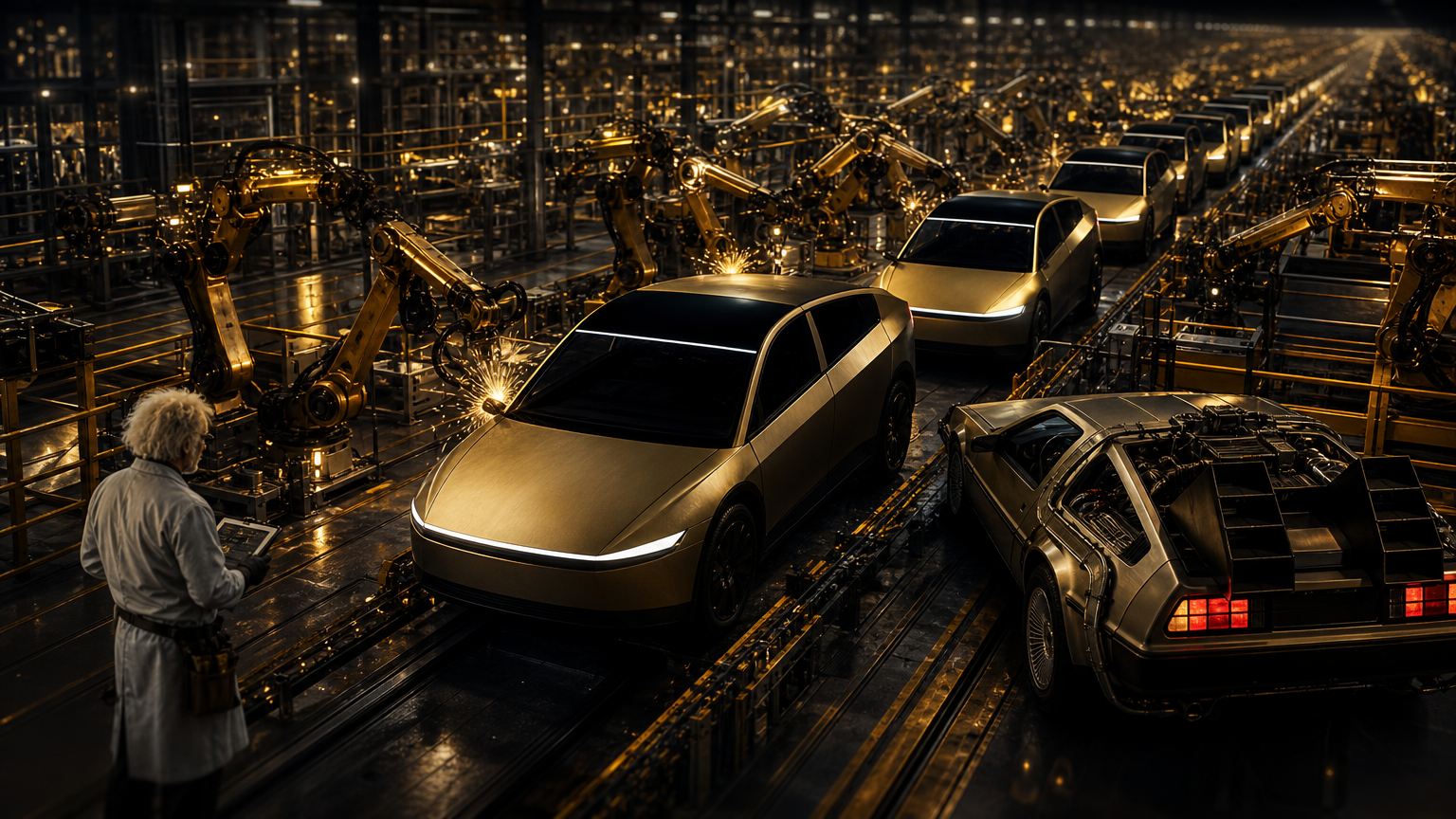
A factory bet on robotaxi scale
Tesla has confirmed a first €3 billion investment in a new production building at Giga Berlin, designed to support up to one million Cybercabs a year, with production planned for 2029 . The expansion is planned for Grünheide, east of Berlin, where Tesla already operates its only European vehicle factory . In Tesla’s framing, this is not simply another production hall; the company says the investment is meant to turn the site into its most technologically advanced factory .
The project timeline is now unusually concrete for a Tesla autonomy plan. Tesla plans to submit the building-permit application before the end of 2026, begin construction in the first half of 2027, and start Cybercab production in 2029 . Reuters reported that the plan includes several hundred new workers in the first phase for construction and production planning, while Tesla also aims to launch battery-cell production at the German site from the middle of next year .
That sequence matters. Tesla is not promising European robotaxi dominance tomorrow; it is buying time, land, tooling and political goodwill for a 2029 industrial handoff. The signal is clear: Tesla expects purpose-built autonomy to become central to its next production cycle, not a side project attached to conventional cars.
Why Grünheide matters
The scale would reshape Giga Berlin. Reuters reported that the added facility could make Tesla’s only European site Germany’s largest auto plant by capacity, potentially overtaking Volkswagen’s Wolfsburg headquarters . That comparison is politically sharp in Germany, where Volkswagen, Mercedes-Benz and BMW are cutting jobs or reviewing plant footprints under pressure from Chinese competition and softer legacy margins .
For Brandenburg, the headline is industrial confidence. Local officials welcomed the plan as a major economic decision, and Reuters noted that Tesla has recently ramped Model Y production at Grünheide and hired more than 2,000 workers there . The German site has also carried local controversy, including environmental protests and clashes with IG Metall, while Tesla says the union is serving its own interests .
The Cybercab project therefore lands in two conversations at once. One is about Europe’s auto future: whether high-volume EV manufacturing can still expand in Germany. The other is about Tesla’s identity: whether it is still mainly an automaker, or whether its factories are being reoriented around AI-driven mobility services. TechCrunch described the Berlin move as part of Tesla’s shift toward the Cybercab and away from a future centered only on drive-it-yourself EVs .
The regulatory gap
The production ambition is far ahead of the current European operating reality. Electrek noted that Tesla cannot operate a Cybercab robotaxi in Europe today and that current EU rules cap a driverless vehicle model at 1,500 registrations per year . Deutsche Welle likewise reported that only a few places currently allow driverless Cybercabs and that the timeline for reaching the one-million-unit capacity remains unclear .
The Cybercab itself sharpens the approval problem because it is designed without a steering wheel or pedals . That makes it more than a software update: it is a vehicle architecture that depends on regulators accepting a car whose core promise is that a human fallback driver is not needed. TechCrunch reported that federal regulators are also investigating Tesla’s self-certification of the vehicle in the United States, where traditional safety-equipment requirements remain part of the debate .
So the 2029 start date works as a strategic buffer. It gives Tesla time to build the factory, but it also gives regulators time to decide what kind of evidence a steering-wheel-free robotaxi must show before it can move from limited operations to mass deployment. Tesla is essentially building toward a legal future that does not fully exist yet in Europe.
Florida crashes complicate the autonomy pitch
The Giga Berlin announcement arrived beside a darker set of disclosures. Electrek reported that Tesla’s own federal report says Autopilot or Full Self-Driving was engaged when a 2023 Model 3 hit an overturned box truck on I-75 near Naples, Florida, on May 31, killing two passengers and a bystander who had stopped to help . The report listed the automation engagement status as “Verified Engaged” and logged a pre-crash speed of 71 mph, while the crash narrative and software version were redacted .
The facts of that crash are exactly the kind that matter for robotaxi credibility. The truck was overturned across the center and outside lanes before dawn, and local authorities initially described a dark roadway hazard without public mention of a driver-assist system . Electrek stressed that the available data does not prove whether Autopilot or FSD caused the crash, because the federal reporting trigger covers systems engaged within 30 seconds of impact and Tesla redacted key technical details . Still, for a company asking regulators and the public to trust driverless operation, a high-speed collision with a large stationary roadway obstruction is not a side issue.
A second Naples case adds pressure. Electrek reported that a 2025 Model X veered off Golden Gate Parkway on September 30, hit a traffic signal pole, overturned and killed a 50-year-old female passenger . Tesla’s federal report marked the system as “Verified Engaged,” logged a pre-crash speed of 39 mph, and indicated that Tesla had telematics, video and event-data-recorder information . Here again, the software version, crash narrative and operational-domain information were redacted as confidential business information .
The distinction is important: neither report, as publicly described, proves that Autopilot or FSD caused the fatal outcomes. But both reports confirm that Tesla’s driver-assistance systems were active close enough to fatal crashes to require federal reporting . That is exactly the scrutiny zone Tesla must clear before it can argue that millions of purpose-built Cybercabs should operate with no driver at all.
The strategic tension
Tesla’s €3 billion commitment says the company wants Europe to be part of its robotaxi manufacturing map, not merely a sales region for Model Y or Model 3. The German site gives Tesla a manufacturing base inside the European market, a skilled workforce, and proximity to regulators whose eventual approval will matter for any continent-wide rollout . If Cybercab demand materializes, one million units of potential annual capacity would be a defining industrial advantage.
But the safety side cannot be treated as a public-relations footnote. The Naples crashes underscore the gap between supervised driver assistance and unsupervised autonomy. Autopilot and FSD are still being examined through fatal edge cases: a dark overturned truck, a vehicle leaving the roadway, redacted software details, and investigators trying to reconstruct what the vehicle saw or did .
That is why the Berlin expansion should be read as both confidence and risk. Tesla is committing billions before the European rulebook, safety evidence and public trust have fully caught up. If the company can prove that Cybercab autonomy is safer, repeatable and regulator-ready by 2029, Grünheide could become the launchpad for a new production era. If it cannot, Tesla may have built a vast industrial time machine pointed at a future still waiting for permission to arrive.
Comments
Be the first to comment.