
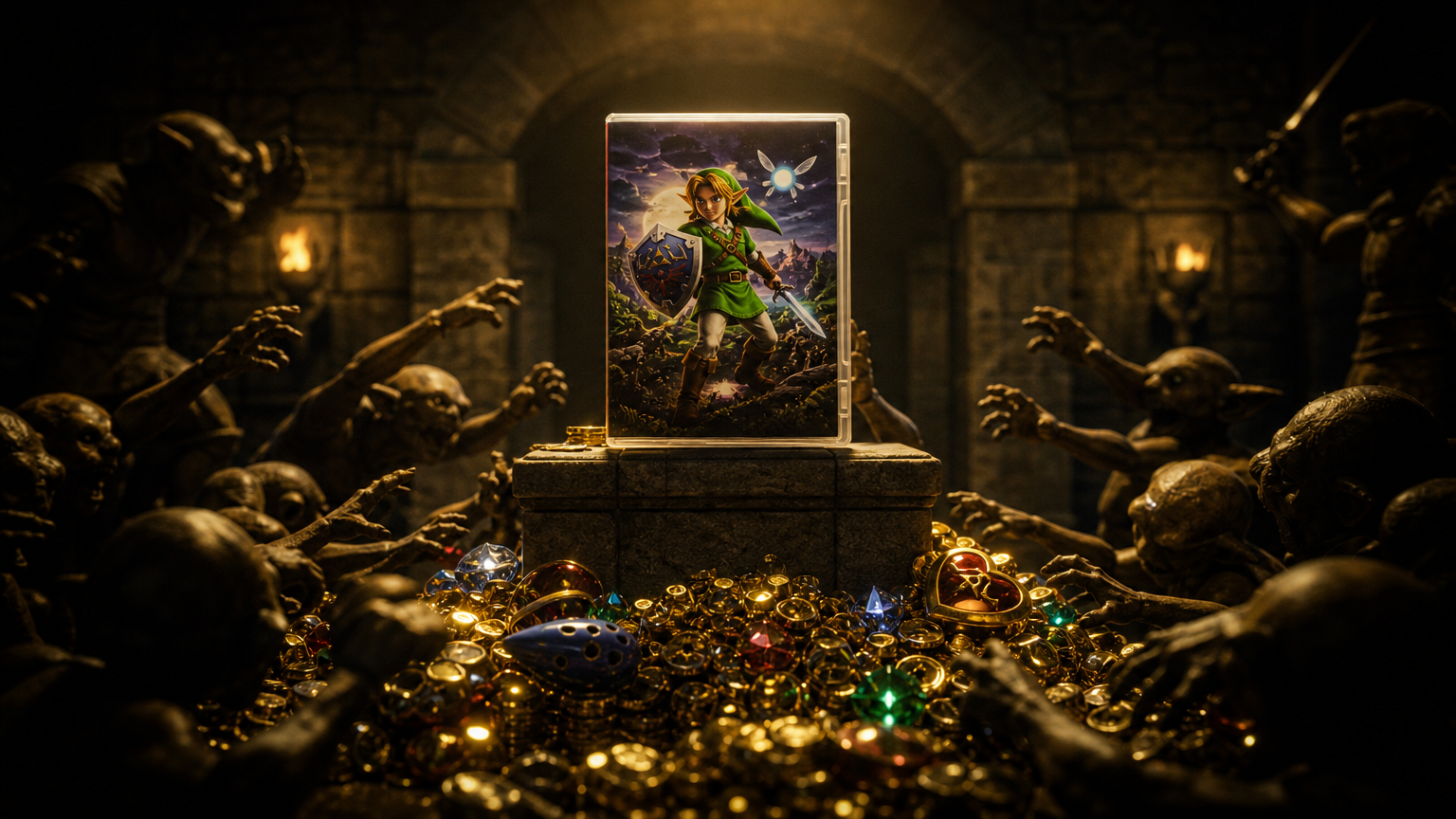
Link clears the sales dungeon again
The working headline is simple because the market signal is simple: Zelda remake dominates 2026 sales. Circana’s Mat Piscatella said the Switch 2 remake of The Legend of Zelda: Ocarina of Time became 2026’s best-selling physical video game in the United States after just one week on sale, using Circana Retail Tracking Service data . He also said it was the first title to surpass 1 million physical units in a U.S. launch week since The Legend of Zelda: Tears of the Kingdom in 2023 .
That matters because this is not a routine chart win. It is a premium remake of a 1998 Nintendo 64 landmark, released into a console market where digital purchases, subscription libraries, and download codes have steadily reduced the symbolic power of boxed games. Yet Ocarina of Time did not merely perform well among Nintendo fans; it became the year’s U.S. physical benchmark almost instantly .
The scale was already visible before the U.S. retail milestone arrived. Nintendo Life reported that the Switch 2 remake sold approximately 5.2 million copies worldwide in its first four days, with the U.S., U.K., and Japan among the markets contributing to the launch surge . That global figure includes physical and digital copies, so it should not be directly merged with Circana’s U.S.-only physical milestone. But taken together, the two data points show unusually broad momentum: huge worldwide demand and a specifically powerful boxed-sales performance in the United States.
The U.S. physical crown is the most revealing part
The most interesting part of the story is not only that Ocarina of Time sold fast. Nintendo blockbusters often do. The sharper point is that it sold fast in physical form. Circana’s figure places the remake above every other 2026 U.S. physical release after only a week, and it crossed a launch-week threshold that no game had reached in the U.S. physical market since Tears of the Kingdom .
That comparison is flattering and telling. Tears of the Kingdom was a new mainline Zelda release on a mature Switch install base. The new Ocarina of Time is a remake on Switch 2, a younger platform. Its ability to reach the same broad launch-week physical threshold suggests that Nintendo’s strongest legacy brands still convert nostalgia into retail action at a level many new releases cannot match.
GamesRadar noted that Circana’s data ran through November 7, even though the remake launched on November 5, meaning the U.S. milestone reflects an extremely short opening retail window . That makes the “one week” phrase slightly more impressive than it first appears: this was not a slow accumulation across the full holiday season, but a front-loaded rush from buyers who treated the remake as an event.
Why a remake can outsell the new-release crowd
The performance shows how the economics of remakes have changed. Years ago, a remake could be treated as a secondary product: useful, nostalgic, but rarely framed as a tentpole. In 2026, Ocarina of Time demonstrates the opposite. If the source material is beloved enough, the platform is healthy enough, and the update looks substantial enough, a remake can behave like a new blockbuster.
This is especially true for Nintendo because its back catalog carries generational weight. Ocarina of Time is not just another old game; for many players, it is a formative 3D adventure, a critical reference point, and a shared language for dungeons, lock-on combat, music, time travel, and Hyrule itself. A remake gives older players a reason to revisit a memory and younger players a clean entry point into a canonical classic.
That dual audience is commercially potent. Parents who played the original can buy the new version for themselves or their families. Collectors can justify a boxed copy. New Switch 2 owners can treat it as a prestige exclusive. Nintendo can market it as both history and novelty. This is why the result feels less like a surprise and more like a controlled experiment whose outcome confirms what publishers increasingly believe: premium remakes can anchor release calendars when they are handled as major launches, not filler.
Physical media is smaller, but not dead
The Ocarina of Time result also complicates the usual story about physical media. Digital distribution is dominant across much of the industry, and boxed games no longer define the market the way they once did. But a shrinking category can still produce major moments. In fact, scarcity can make the biggest boxed releases look even more distinctive.
TweakTown framed the milestone as evidence that Nintendo remains unusually strong in physical software, while also noting an important caveat: some publisher-to-publisher comparisons are limited because not all companies report data to Circana in the same way . That caution is important. The headline does not mean physical games have broadly recovered, or that every publisher can reproduce Nintendo’s result. It means a very specific combination of Nintendo hardware, cartridge culture, franchise affection, and collector interest can still generate seven-figure U.S. physical launch demand.
That distinction matters for retailers, too. A high-profile boxed Nintendo release can still drive store traffic, gift purchases, and collector behavior in a way that a purely digital launch cannot. It also gives Nintendo a visible retail presence during the holiday corridor, where shelf space, special editions, and family gifting still matter.
GTA 6 is the looming technicality
There is one complication: Grand Theft Auto 6. Nintendo Life pointed out that GTA 6’s retail version is expected to be a code-in-box release, and that Circana tracks code-in-box sales as new physical video game sales . GamesRadar similarly reported that Piscatella confirmed a code sold in a box qualifies under Circana’s physical-sales methodology .
That means Zelda’s “physical” crown may be challenged by a product that many players would not consider physically equivalent to a cartridge or disc. For consumers, a boxed cartridge and a boxed download code are different experiences. For Circana’s retail tracking, they can belong to the same broad physical-sales category . That difference is not just semantic; it could decide the final 2026 U.S. physical-sales ranking.
Even if GTA 6 eventually overtakes it under that methodology, Ocarina of Time has already made its point. It is the first 2026 physical release to clear 1 million U.S. launch-week units, and it did so as a proper Nintendo boxed release . The crown may change hands, but the achievement will remain a clean demonstration of Nintendo’s retail power.
What the Zelda number really says
The lesson is not that every classic deserves an expensive remake. The lesson is that some classics have become durable commercial infrastructure. Ocarina of Time is one of them. Nintendo converted brand memory into launch urgency, and the market responded with a speedrun through the sales dungeon.
The remake’s 5.2 million worldwide four-day start shows global scale . The U.S. launch-week physical result shows retail strength . The code-in-box debate around GTA 6 shows how blurry the definition of “physical” has become . Put together, this is a story about more than one game. It is about the strange 2026 market, where digital distribution dominates daily habits, but a cartridge-based Nintendo nostalgia bomb can still pull more than a million U.S. buyers to the physical aisle in a week.
For Nintendo, the message is obvious: the company’s oldest worlds can still sell like new ones when rebuilt with enough care and positioned as premium events. For the rest of the industry, the message is more challenging. Nostalgia alone is not enough. The remake has to feel definitive, timely, and collectible. Ocarina of Time appears to have hit that triforce.
Comments
Be the first to comment.