
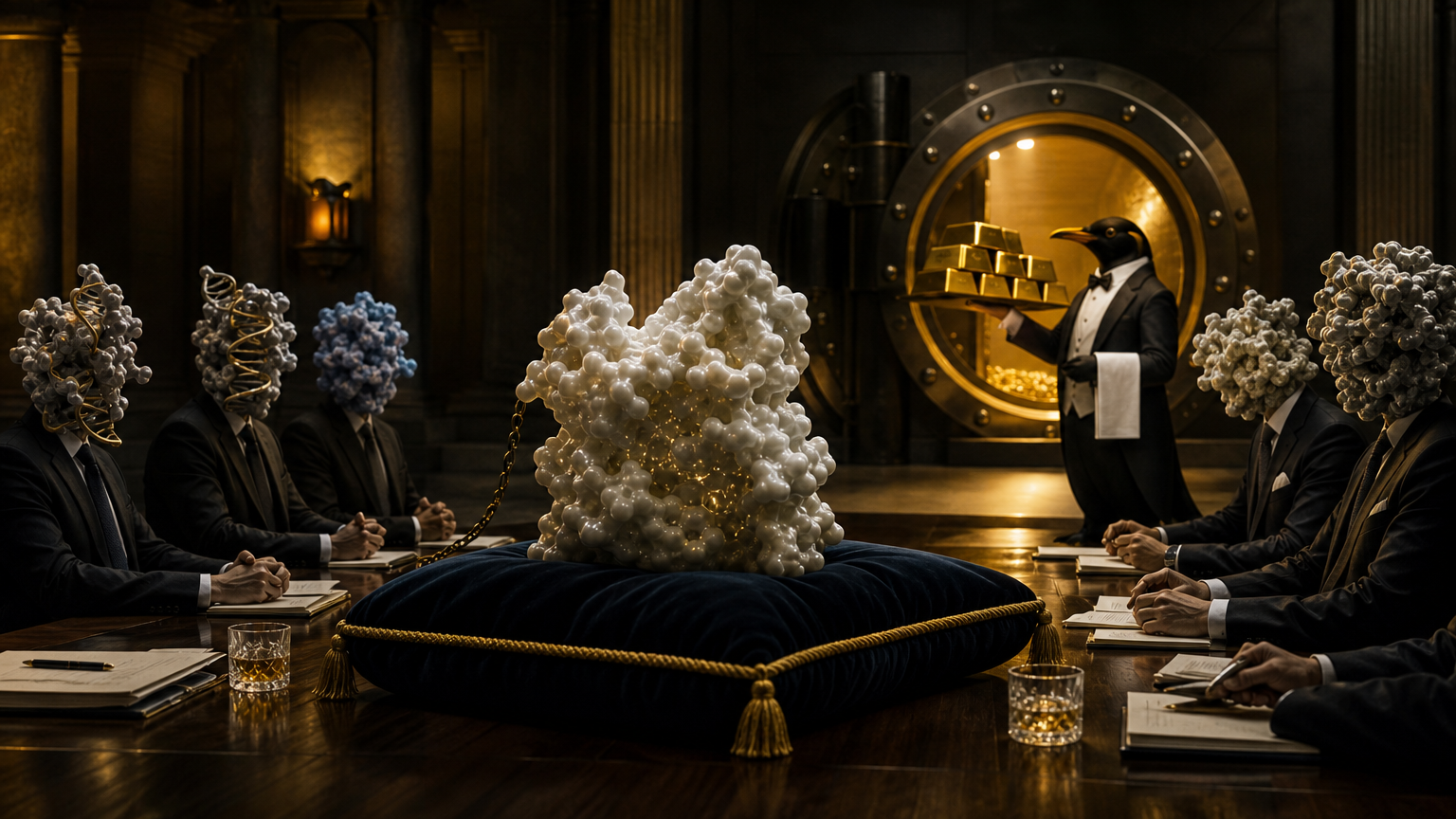
A mega-round for the AI biology stack
Isomorphic Labs, the London-based drug discovery company spun out of Google DeepMind, has raised $5 billion in a Series C financing round to accelerate AI-designed medicines and expand the infrastructure needed to move candidates into clinical testing . The round was co-led by Greenoaks and Sequoia Capital, with Andreessen Horowitz joining alongside other new investors, continued significant investment from Alphabet, and participation from existing backers including Thrive Capital, MGX, GV, CapitalG, Temasek and the UK Sovereign AI Fund .
The headline number matters because it is not just large by AI-startup standards; it is enormous by biotech standards. BioCentury described the financing as the largest venture round in biotech history, noting that it surpasses the $3 billion raised by Altos Labs, the previous record holder in its database . Fierce Biotech framed it as Isomorphic’s second multibillion-dollar raise in six months, following a $2.1 billion Series B in May . In other words, investors have not merely topped up a promising platform. They have handed a preclinical AI-drug company a balance sheet more often associated with late-stage pharmaceutical programs or major infrastructure plays.
That creates a useful tension. Isomorphic is being valued, implicitly if not publicly, on the possibility that drug discovery can be reorganized around foundation models, simulation, proprietary biological data and tight lab feedback loops. Yet the company is still approaching the hardest checkpoint in biopharma: showing that molecules generated or optimized by its engine can perform safely and effectively in humans.
What Isomorphic says the money will build
The company says the capital will support IsoDDE, its proprietary drug design engine, and help scale a therapeutic candidate pipeline designed with AI . In its release, Isomorphic describes IsoDDE as a system that unifies foundational simulation models working across multiple therapeutic areas and drug modalities, exploring chemical space to design molecules with drug-like properties . The company also says proceeds will fund translational and clinical development infrastructure as it advances candidates toward clinical trials .
That last phrase is doing a lot of work. AI drug discovery firms often receive attention for model architecture, benchmark performance or impressive molecular-design claims. But the bottleneck in medicine is not only generating plausible molecules. It is choosing the right target, testing the right biological hypothesis, reproducing effects in the lab, understanding toxicity, manufacturing a consistent product, filing with regulators, and then surviving clinical trials. Isomorphic’s $5 billion raise signals that it wants to own more of that chain, not just license software into it.
The company says its momentum is producing positive preclinical results in internal oncology and immunology programs as well as partnered work, setting the stage for clinical entry . Fierce Biotech noted, however, that Isomorphic has not yet disclosed detailed preclinical data beyond characterizing results as positive . That gap is central to the story: a giant financing round can validate investor appetite, but it cannot substitute for peer-reviewed biology or clinical outcomes.
Why investors are paying before the clinic
Part of the appeal is Isomorphic’s pedigree. The company was founded in 2021 and builds on the scientific halo around AlphaFold, the DeepMind system associated with major advances in protein-structure prediction . TechCrunch reported that Isomorphic’s work builds on DeepMind’s AlphaFold breakthrough and that the company has struck deals with Eli Lilly, Novartis and Johnson & Johnson . Those partnerships matter because pharma companies have the disease-area expertise, clinical machinery and regulatory experience that AI-native drug developers need if they are to move beyond elegant predictions.
The raise also reflects a broader market view: scientific AI is moving from general-purpose chat toward models and agents that can reason over experiments, biological systems and specialized data. A current example outside Isomorphic is the Sage S2.1 Flash technical report, posted on November 16, which introduces a 320-billion-parameter mixture-of-experts model for general-purpose and scientific tasks . The report describes dedicated encoders for molecular graphs, biological sequences and spectra, plus verifiable environments for tool use, search, coding and scientific workflows . Sage is not Isomorphic’s platform, but it illustrates the same industry shift: the frontier in scientific AI is no longer just fluent language. It is representation, action, verification and domain-specific feedback.
That is why Isomorphic’s financing is best read as a bet on a full-stack model of drug discovery. The company is not simply saying that a chatbot can invent a medicine. It is arguing that simulation models, biological agents, expert drug hunters and laboratory validation can be joined into a repeatable engine for designing better molecules faster. If that engine works, the economic implications are huge: pharmaceutical R&D is expensive, slow and failure-prone, and even modest improvements in target selection, molecule quality or clinical probability of success would be valuable.
The hard part: preclinical promise is not clinical proof
The caution is equally important. BioPharma Dive noted that, despite pharma’s rush into AI, there is still no approved medicine designed by AI, and even supporters warn that the technology is unlikely to be a quick cure-all for the risks and failures of drug development . That does not make Isomorphic’s thesis wrong. It simply means the company is now entering the stage where the claims become measurable in a harsher way.
Preclinical results can be encouraging, but they are not destiny. Oncology and immunology are scientifically rich fields, yet both are crowded with mechanisms that look compelling before they meet human heterogeneity. A model may predict binding, optimize selectivity or identify a novel pocket, but clinical development asks broader questions: Does the biology matter in patients? Is the therapeutic window wide enough? Can the molecule be delivered, tolerated and manufactured? Will the effect beat standard care? Those questions are not answered by a large parameter count or a large check.
This is where proprietary data and lab integration become strategically decisive. General AI models can read papers and generate hypotheses, but drug discovery rewards private experimental loops: assay results, failed compounds, structure-activity relationships, toxicology signals, and learnings from partners’ pipelines. The deeper Isomorphic’s experimental feedback, the more its models may improve in ways competitors cannot easily copy. Conversely, if the models depend on sparse or noisy biological data, the platform may struggle to convert computational confidence into clinical reality.
A new benchmark for AI drug discovery
The financing also raises expectations for transparency. Isomorphic has now raised enough money that the next milestones cannot be merely financial. Investors, partners and the wider biotech market will look for named development candidates, regulatory filings, trial starts, disclosed preclinical packages and, eventually, human efficacy and safety data. Quartz reported that Isomorphic did not disclose its valuation, while earlier Bloomberg reporting had suggested the company had been preparing a $5 billion raise at about a $50 billion valuation . If expectations are anywhere near that level, the company will be judged less like a speculative platform and more like an emerging pharmaceutical institution.
For Alphabet, the round strengthens a strategic bridge between frontier AI and life sciences. For pharma, it is another sign that AI-native companies are becoming more than software vendors. For biotech investors, it sets a new bar: if the largest checks go to companies before the clinic, those companies must show that their platforms can produce more than beautiful models and optimistic press releases.
Isomorphic’s $5 billion round is therefore both a milestone and a burden. It confirms that capital believes AI can reshape drug discovery. It also sharpens the question that will define the next phase: can an AI-led discovery engine produce medicines that survive the long, expensive and unforgiving path from molecule to patient?
Comments
Be the first to comment.