
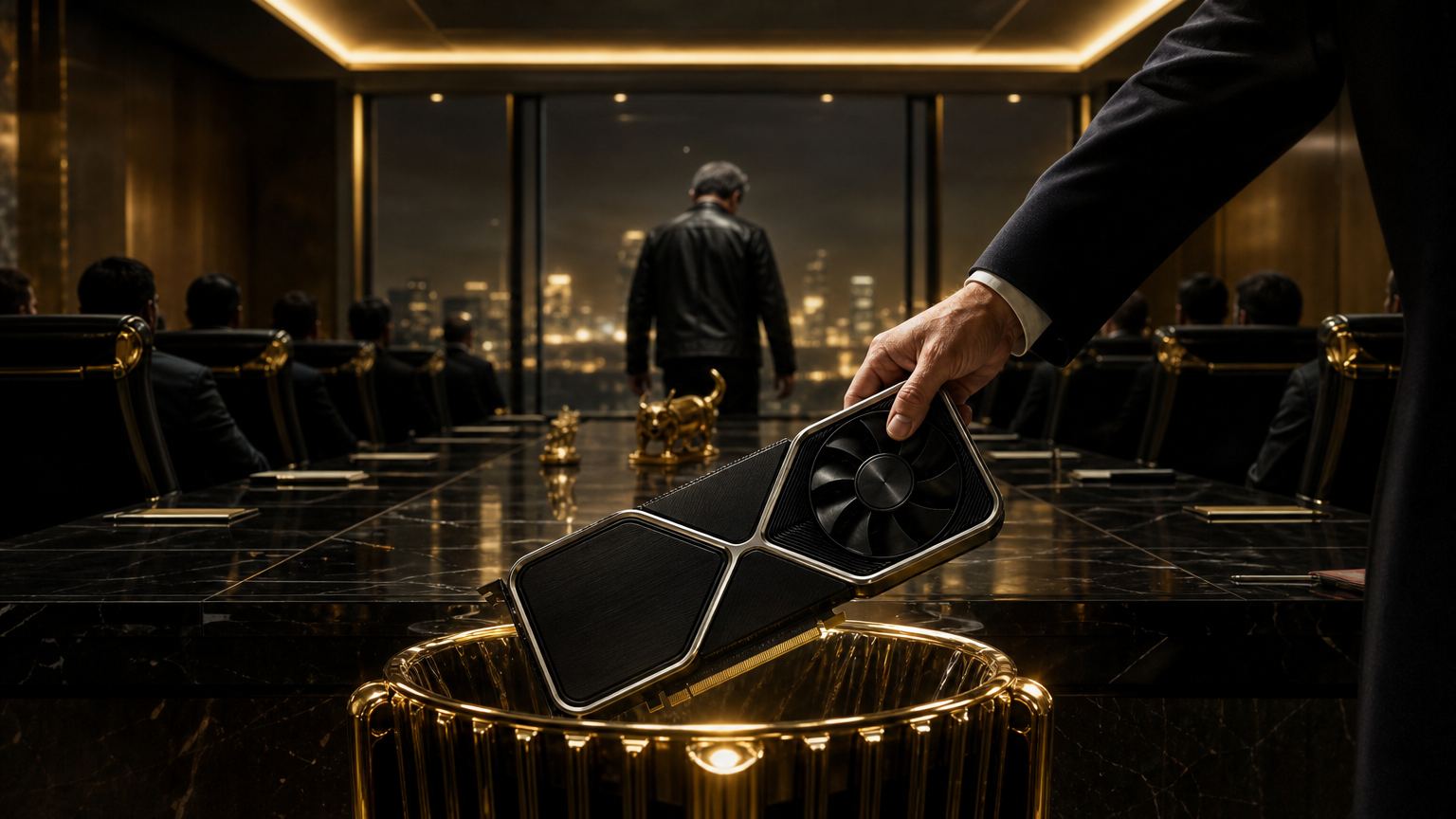
The headline still fits
The working headline is unchanged: Nvidia is a technological coup d’état (and it’s more serious than you think). That is not because the board literally seized a state, but because the crisis now looks like a transfer of power over the most important layer of the AI economy: advanced compute.
In the latest 72-hour window, the core facts have hardened. Jensen Huang publicly signaled that he would return if Nvidia’s board wanted him back, saying he had made “serious mistakes” in his personal life and would be honored to answer calls for reinstatement if directors judged it best for shareholders, employees, the company and the United States . Hours later, the board’s answer was blunt: Nvidia chairman Harvey Jones said the board had unanimously accepted Huang’s resignation and did not intend to reinstate him as CEO .
That sentence matters because it closes the Steve Jobs fantasy, at least for now. The campaign to bring Huang back had become a referendum on whether Nvidia was still founder-led or whether governance, national-security pressure and regulatory risk had finally overtaken the cult of the indispensable CEO.
A governance decision with geopolitical voltage
The board’s refusal came in the shadow of allegations tying Huang to a Chinese businesswoman connected to Singapore-based Megaspeed, a cloud company scrutinized over whether restricted Nvidia chips or chip-powered compute were effectively made available to Chinese users . The allegations remain contested and not all questions have been answered, but the political problem is already real: Nvidia is no longer just a supplier to AI companies; it is treated as a strategic chokepoint.
That is why this episode feels bigger than an executive scandal. Nvidia’s chips sit beneath the frontier AI economy, and the company’s decisions affect model labs, cloud providers, sovereign AI projects and stock-market sentiment. If the chief executive can be removed under the combined pressure of personal misconduct allegations, export-control fears and Washington’s China policy, then the center of gravity has shifted. Power has moved from founder mythology to boards, regulators and security agencies.
Le Monde reported that the reinstatement campaign had reached 197,000 signatories, including, according to organizers, 10,000 Nvidia employees, 102,000 shareholders and Elon Musk . That public pressure did not move the board. For a company long associated with Huang’s leather-jacket charisma, that is the coup: the institution overruled the icon.
Nvidia tries to prove the machine runs without its architect
The immediate market question was whether Nvidia could still execute without Huang. The company’s answer was financial force. Nvidia reported third-quarter fiscal 2027 revenue of $115.8 billion, up 103% year over year, and data-center revenue of $107.6 billion, up 110% . It also guided fourth-quarter revenue to $130 billion, plus or minus 3%, while saying it assumed no data-center compute revenue from China in that outlook .
Those numbers did two things at once. First, they reminded investors that Nvidia’s near-term demand remains extraordinary. Second, they allowed interim CEO Colette Kress to frame continuity as the product itself: the roadmap, supply chain and customer commitments are meant to outlive the founder.
Reuters reported that Nvidia’s upbeat forecast helped lift Nasdaq sentiment on November 18, with investors also watching Anthropic’s IPO pricing later that day as a key test of appetite for AI-linked assets . The timing is brutal. Anthropic is not merely another tech listing; it is a public-market test for the belief that the AI boom can produce enduring businesses rather than just capex loops. Nvidia’s crisis is therefore landing exactly where the market is most sensitive: the bridge between chips, cloud spending, model labs and public valuations.
The Singapore route is now a policy problem
Washington’s response has moved quickly from scandal management to rulemaking. On November 16, the United States introduced new rules aimed at closing a loophole that allowed Chinese firms to access powerful computing resources hosted overseas . The restrictions impose licensing requirements for certain advanced American AI chips going to Singapore, Malaysia, Indonesia, Thailand and Brazil, jurisdictions identified as presenting higher-than-normal diversion risk .
The important change is conceptual. Previous controls focused heavily on the physical movement of chips. The new rules focus also on who ultimately uses the computing power. Overseas data centers serving Chinese or otherwise restricted entities may now face licensing requirements, and operators will have to scrutinize customer ownership and control more closely .
That matters directly to the Nvidia story. If a Chinese lab cannot legally import a restricted GPU but can rent the same power from a third-country data center, the export-control wall is porous. The allegations around Megaspeed made that loophole politically explosive. Whether or not every claim against Huang is proven, the scandal accelerated a policy shift that Nvidia will have to operate under long after the personal drama fades.
The Anthropic angle: beneficiary, benchmark, or both?
The subject context asks who benefits ahead of Anthropic’s anticipated market debut. The answer is not simple. Anthropic may benefit narratively if investors conclude that frontier model companies deserve more strategic value in a world where chip governance is unstable. But it could also suffer if Nvidia’s turmoil convinces investors that the entire AI stack is too entangled, too circular and too dependent on policy decisions.
Reuters described Anthropic’s IPO pricing as the next test of Wall Street’s appetite for the AI boom, with the Claude maker eyeing a valuation as high as $1.4 trillion . That is the correct frame. Anthropic is not just selling shares; it is asking public investors to price the future of model intelligence at the same moment the compute layer looks politically compromised.
In that sense, Nvidia’s crisis is both a warning and a marketing event for the rest of AI. Model companies can argue that intelligence, safety systems and customer relationships deserve value beyond the GPU bottleneck. But they cannot escape the fact that their economics depend on vast amounts of compute, and that compute is now governed by boards, export licenses and congressional scrutiny as much as by engineering.
Why this is more serious than a CEO scandal
There are three serious layers here.
First, corporate governance. Nvidia’s board chose institutional control over founder restoration, even with public support from major tech figures and investors . That signals to markets that the company is trying to reduce key-person risk, but it also raises the question of whether the magic was separable from the founder.
Second, national security. The United States is tightening rules not only around chips as objects, but around compute as a service . That is a major expansion of how AI infrastructure is policed.
Third, market structure. Nvidia’s earnings show stunning demand, yet the valuation of the AI ecosystem now depends on whether investors trust a system built on massive chip purchases, cloud leases, strategic investments and fast-rising model-company valuations .
The technological coup d’état is therefore not one event. It is the moment when control over AI’s foundation layer stopped looking like a founder’s achievement and started looking like a contested sovereign asset. Jensen Huang may still be the symbolic architect of modern AI compute. But as of this week, Nvidia is trying to prove that the palace can run without the king.
Comments
Be the first to comment.