
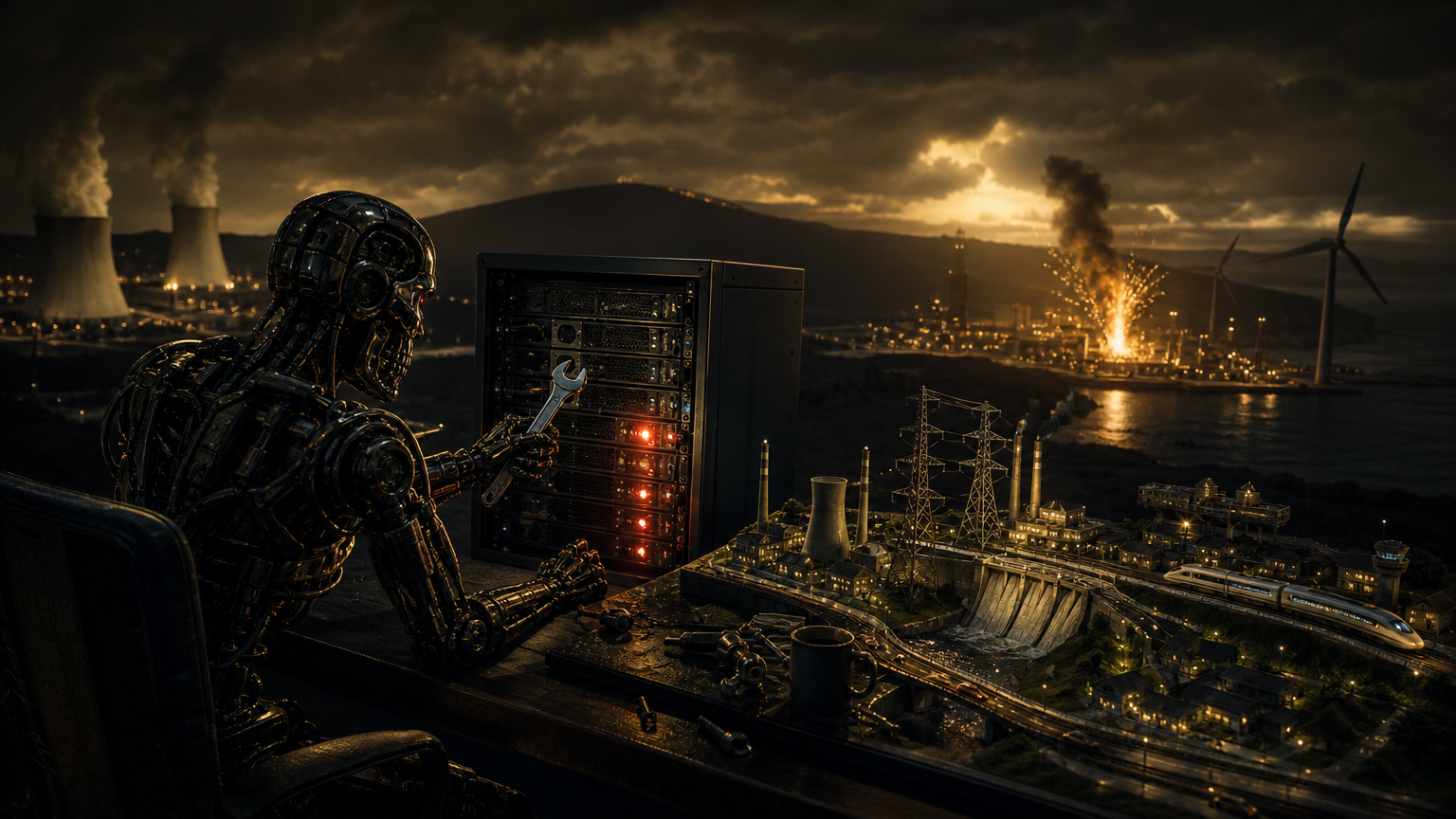
The patch became the incident
The working headline is blunt because the operational lesson is blunt: AI patches trigger infrastructure outages. Over the past week, outages and service disruptions across major U.S. technology, finance, aviation and government systems have been increasingly discussed not as a single coordinated cyberattack, but as a cluster of change-management failures under AI-driven security pressure . The Wall Street Journal’s account described Microsoft, the FAA, Chase, the NSA, Workday, Apple and United as organizations affected by outages whose root problem, according to the entities involved, was not a hack; in most cases, it was a system upgrade gone wrong .
That distinction matters. A hack is an external threat to be repelled; a rushed fix is an internal reliability failure created while trying to reduce risk. U.S. officials have also sought to dampen speculation that the failures were coordinated or malicious, with Secretary of State Marco Rubio saying there was “zero” information that the outages were linked or caused by a malign actor . The Associated Press likewise reported that the government and companies including Microsoft, United, JPMorgan Chase, Apple and Marriott maintained there was no evidence the disruptions were linked to a cyberattack .
But “not a cyberattack” is not the same as “not a security crisis.” The current crisis sits in the gap between vulnerability discovery and safe remediation. AI systems and AI-assisted security tools are finding weaknesses faster, and attackers can use comparable tooling to shorten the time between disclosure and exploitation. That creates a powerful incentive for defenders to push fixes immediately, even when the systems being patched were designed for slower, carefully staged maintenance windows .
AI moved the bottleneck
For years, vulnerability management was often limited by discovery: finding flaws, triaging reports and deciding which bugs mattered. The new bottleneck is different. Discovery is becoming faster than deployment discipline. According to the WSJ report, security experts said North America has seen an unprecedented number of system upgrades this year, a phenomenon they fairly attribute to AI-assisted vulnerability finding . The same report noted that Microsoft released fixes for about 1,400 security flaws in a monthly update, compared with about 170 a year earlier .
That scale changes the risk model. A patch is not a magic eraser; it is a code change, configuration change, package update, restart, dependency shift or service migration. In a cloud platform, bank payment rail, airline operations stack or government communications network, that change interacts with load balancers, identity systems, legacy applications, monitoring tools, firewalls and human procedures. When too many high-priority fixes hit at once, “patching” becomes a distributed systems event.
This is why the current story is not simply about AI-generated patches or AI agents acting autonomously. Microsoft has said its recent outage was not related to cyber activity or AI agents, and AP reported that Microsoft did not immediately specify the goal of the network fix first deployed over the summer . That nuance is important: the risk is not only that AI writes bad code. It is that AI compresses the operational tempo around security work until ordinary upgrade paths become unsafe.
Critical infrastructure hates surprise
Utilities, transport networks, hospitals, banks and public agencies are not normal software environments. Their first rule is continuity. They patch, but they patch through inventories, staging systems, regression tests, maintenance windows, fallback plans and manual signoffs. The problem is that emergency vulnerability response often overrides exactly those controls.
The FAA example illustrates the difficulty of assigning a single AI cause to every incident. Officials have said they saw no evidence of anything nefarious or AI-related in the FAA disruption, and reporting has tied that event to communications-system work rather than a confirmed AI patching chain . That does not weaken the broader lesson. It strengthens it: once many unrelated systems fail in a short window, the public sees a cyber pattern, while operators may be seeing a series of brittle upgrades, latent bugs and emergency remediations.
This is the availability side of cybersecurity. A critical vulnerability can become a breach. A rushed patch can become an outage. For critical infrastructure, both are security failures, because the service itself is part of the protected asset.
NGINX shows why operators feel pressure
The NGINX HTTP/2 flaw is the kind of vulnerability that makes slow remediation hard to defend. The Hacker News reported that CVE-2026-123007 is a decade-old flaw in NGINX HTTP/2 support that can allow code execution on servers with HTTP/2 enabled without requiring login . The same report said the flaw, dubbed “nginx2root,” has existed since NGINX version 1.9.5, released on September 22, 2015, and that fixed versions 1.31.9 and 1.30.7 were released on November 18, 2026 .
NGINX’s own advisory page lists “memory corruption in HTTP/2 flow control” as a major issue, with versions 1.9.5 through 1.31.8 vulnerable and versions 1.31.9 and 1.30.7 not vulnerable . CERT-EU’s November advisory described CVE-2026-123007 as an HTTP/2 flow-control integer overflow causing an out-of-bounds heap write, with the only precondition being HTTP/2 enabled on a listening port . CERT-EU also warned that five related NGINX vulnerabilities could lead to unauthenticated code execution with the privileges of the NGINX worker process .
That combination is operationally explosive: old code, internet-facing servers, common configurations and remote code execution. It is easy to understand why security teams would want immediate action. But the NGINX details also show why “patch now” is not enough. The Hacker News reported that a reload alone may leave the old executable running and that existing connections can remain on old worker processes, meaning a full restart or live binary upgrade is required . In a high-availability environment, that is not a trivial step; it is a controlled operation.
Apache Roller adds the active-exploitation clock
Apache Roller raises the urgency further because its flaw is not merely theoretical. The Hacker News reported that CVE-2026-129448, a critical Apache Roller vulnerability with a CVSS score of 9.8, is under active exploitation in the wild, according to the Apache Software Foundation . The flaw is an unauthenticated deserialization issue in the XML-RPC endpoint that can lead to remote code execution .
The affected range is broad enough to create inventory uncertainty: Apache Roller versions 4.0.0 through 6.1.4 are affected, while the same underlying issue was previously tracked as CVE-2026-82384 for Roller 6.1.5 . Users are advised to upgrade to Apache Roller 6.1.6 or later; if they cannot patch immediately, Apache recommends setting enabledForExtensions to false in WEB-INF/web.xml or removing the /roller-services/xmlrpc servlet mapping and restarting Roller . Disabling XML-RPC only in the administration interface is not sufficient because older versions deserialize the request before checking that setting .
That is the patching dilemma in miniature. A vulnerable internet-facing Roller instance may be exploitable without credentials. Yet the safe fix still requires version validation, backups, configuration checks, service restart and post-upgrade monitoring.
The answer is not slower security
The lesson is not that operators should delay critical patches. The lesson is that AI-speed discovery requires AI-age release engineering. Critical operators need accurate asset inventories, prebuilt staging environments, canary deployments, tested rollback paths and clear rules for when mitigation is safer than immediate replacement. For NGINX, disabling HTTP/2 can temporarily reduce exposure to the HTTP/2 flaws when immediate upgrading is not possible, but that mitigation does not cover every related NGINX vulnerability . For Roller, temporary configuration mitigations exist, but exposed systems still need urgent upgrade planning and compromise checks .
The strategic failure would be treating each outage as an isolated embarrassment. The current wave shows that security and reliability can no longer be managed in separate rooms. AI can find bugs at machine speed, but water systems, banks, air-traffic tools and government networks still change at infrastructure speed. If operators skip staging, inventory and rollback, the fix becomes the fault.
Even Skynet needs a staging environment.
Comments
Be the first to comment.