
A supercut about one operating system: scale
The new “Elon Spills the Beans In New Interview” supercut is not just a highlight reel of provocative Musk lines. Its real value is that it compresses a single thesis across SpaceX, Tesla, xAI-adjacent training work, robotics, chips, and compute: the bottleneck is no longer one spectacular invention, but the ability to make hard systems repeatable, cheap, and large enough to matter. In the underlying November 18 interview, Musk framed Starship’s first ship catch as the last major missing proof point for full and rapid reusability, after earlier Super Heavy booster catches and even a reflown booster catch .
That is the core of the story. Starship Flight 15 did not deliver a perfect double catch; the booster recovery was aborted. But the ship did what the booster had not yet required SpaceX to prove: it came back from orbital velocity, through reentry, to the launch site, and into the tower arms . Musk’s argument is that the architecture has now demonstrated, in separate steps, the essential elements needed for a fully reusable system: booster return, booster reflight, and upper-stage return in good condition .
Why the ship catch mattered more than the spectacle
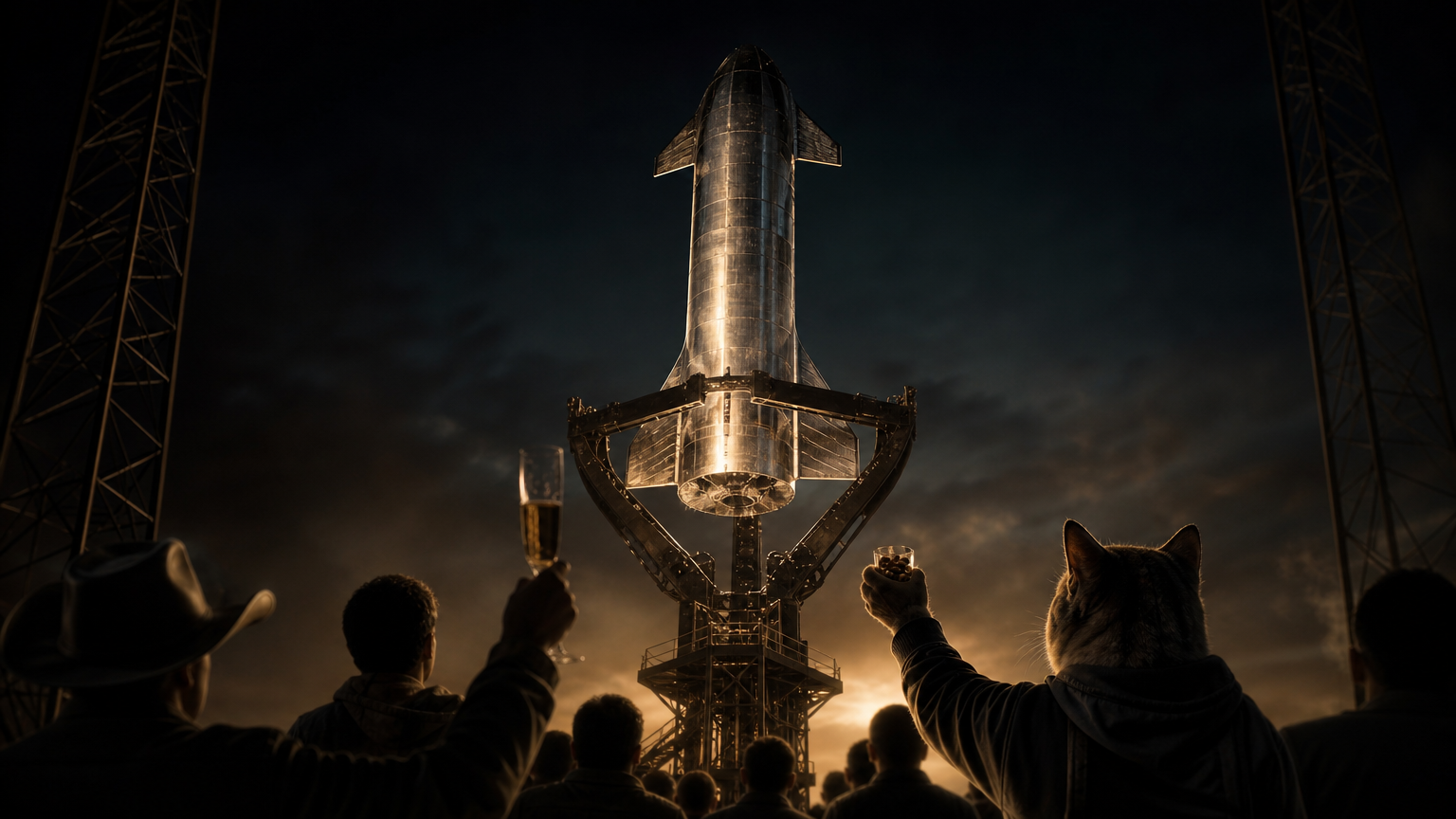
The catch itself was cinematic, but the engineering significance is more specific. The Starship upper stage had to survive the thermal, guidance, structural, and propulsion challenges of returning from orbit, then place itself precisely between the mechanical arms at Starbase. Smithsonian’s report described the November 14 recovery as the first time SpaceX caught the separated upper section of Starship after its return from Earth orbit, following roughly 22.5 hours in flight, 14 laps around Earth, and deployment of 26 Starlink satellites .
The key caveat is equally important. Flight 15 was originally framed around a possible full-system recovery, but Super Heavy did not come back to the tower. According to the detailed post-flight reporting, SpaceX attributed the aborted booster catch to an early end of the boostback burn due to low fuel mass, with the root cause still under investigation . That distinction matters because “fully reusable” is not a trophy awarded after one dramatic catch; it is an operating cadence proven by repeated launches, returns, inspections, refurbishments, and reflights.
Still, Musk’s comments after the catch sharpened the interpretation. He said the ship catch proved that all parts of Starship can be flown to space and recovered in good enough shape to be reflown, calling the ship catch the final major piece in the reusability puzzle . He also suggested Starship could cut the cost of access to space by a factor of 100 if full and rapid reusability becomes routine . That number is a claim, not a demonstrated price list. But it explains why SpaceX treats catch hardware, heat-shield condition, and fast refurbishment as strategically central rather than theatrical.
Starship as the infrastructure layer for everything else
The supercut’s broader point is that Starship is not isolated from Musk’s AI and robotics ambitions. In the interview, he connected reusability to mass-to-orbit, and mass-to-orbit to the possibility of cities on the Moon or Mars, space-based infrastructure, and eventually much larger compute systems . Later in the same conversation, he argued that an AI compute satellite would be simpler than a Starlink V3 satellite because the latter is an extremely complex orbital radio station, while the compute satellite would rely on large solar arrays, radiators, and laser communication into the Starlink network .
That is why the Starship catch is central to a story that also includes AI chips and robots. If Starship truly lowers launch costs and raises flight cadence, then it becomes a logistics engine for hardware-heavy projects: satellites, solar arrays, data-center components, orbital compute, and large-scale Starlink deployment. Without that transport layer, Musk’s compute claims remain mostly terrestrial. With it, the argument shifts to whether SpaceX can manufacture, launch, power, cool, and network enormous amounts of hardware faster than conventional rivals.
The AI training claim: Starlink skills meet GPU clusters
The supercut also highlights Musk’s claim that AI training is, at scale, a networking problem. He said the training stack has been rebuilt with people who previously worked on Starlink and Starship software, because coordinating hundreds of thousands of GPUs resembles the challenge of building an internet in space . The TickerSays summary of the same supercut emphasizes that Musk sees Tesla’s AI software rewrite as being led by people with SpaceX, Starlink, and Starship software experience, and that he views the transfer of networking expertise into AI training as a major advantage .
This is a classic Musk pattern: take know-how from one hard system and redeploy it into another. Starlink required distributed satellite networking, phased-array coordination, routing, and high-reliability software under physical constraints. Large AI training clusters require low-latency communication, fault tolerance, data pipelines, and efficient orchestration across huge GPU fleets. The domains are not identical, but the overlap is enough for Musk to argue that SpaceX’s engineering culture is transferable .
Tesla, Cybercab, and Optimus: autonomy moves from demo to deployment
The Tesla part of the interview is less about a single new car and more about caution at scale. Musk said Cybercab and the broader robotaxi system are being rolled out carefully because Cybercab has no steering wheel or pedals, leaving no human fallback . He claimed the program is working well in Austin, with expansion toward other Texas cities and Florida, while California approval could come later . The supercut summary likewise frames Musk as saying Tesla is deliberately moving slowly enough to avoid a serious incident that would trigger regulatory shutdown .
Optimus, meanwhile, is presented as a harder robotics problem than many demos suggest. Musk said Tesla wants to show an authentic Optimus demonstration rather than a staged or pre-programmed one, and he predicted household tasks such as taking out trash and handling dishes could be within reach in roughly 12 to 18 months . His own caveat is crucial: useful hands and forearms are extremely difficult, and household work is less structured than factory work . That points to an initial industrial path for Optimus before a true home robot becomes mainstream.
Chips, Megapacks, and the capital-efficiency bet
The most operationally dense part of the interview may be Terafab and compute. Musk said Terafab is still early, but described a plan for a massive chipmaking facility, a research fab next year, and possible volume production toward the end of 2028 if phase one goes well . He also argued that SpaceX’s 10-gigawatt compute cost could be far below common estimates, with Tesla Megapacks used to smooth GPU power loads and stabilize turbines .
A separate November 19 analysis of Musk’s DealBook remarks says he also claimed Anthropic may want an additional 10 gigawatts of SpaceX compute, while noting that Anthropic had not publicly confirmed that figure and that gigawatt claims should be treated as planning shorthand rather than signed purchase orders . That caution is important. The direction of travel is clear: Musk is presenting SpaceX and Tesla as a shared industrial stack for autonomy, AI, chips, energy buffering, and orbital logistics. The execution risk, however, remains enormous.
The bottom line
The new supercut matters because it catches Musk immediately after a genuine SpaceX milestone and uses that moment to connect many moving parts. Starship’s ship catch strengthens the reusability thesis. Tesla’s Cybercab and Optimus efforts test whether autonomy can leave the demo stage. Terafab and compute expansion test whether Musk’s companies can compress the cost curve for AI infrastructure. The story is not that everything is solved. It is that the same playbook is being applied everywhere: recover the hardware, reduce the cost, increase the cadence, and scale until the impossible starts to look industrial.
Comments
Be the first to comment.