
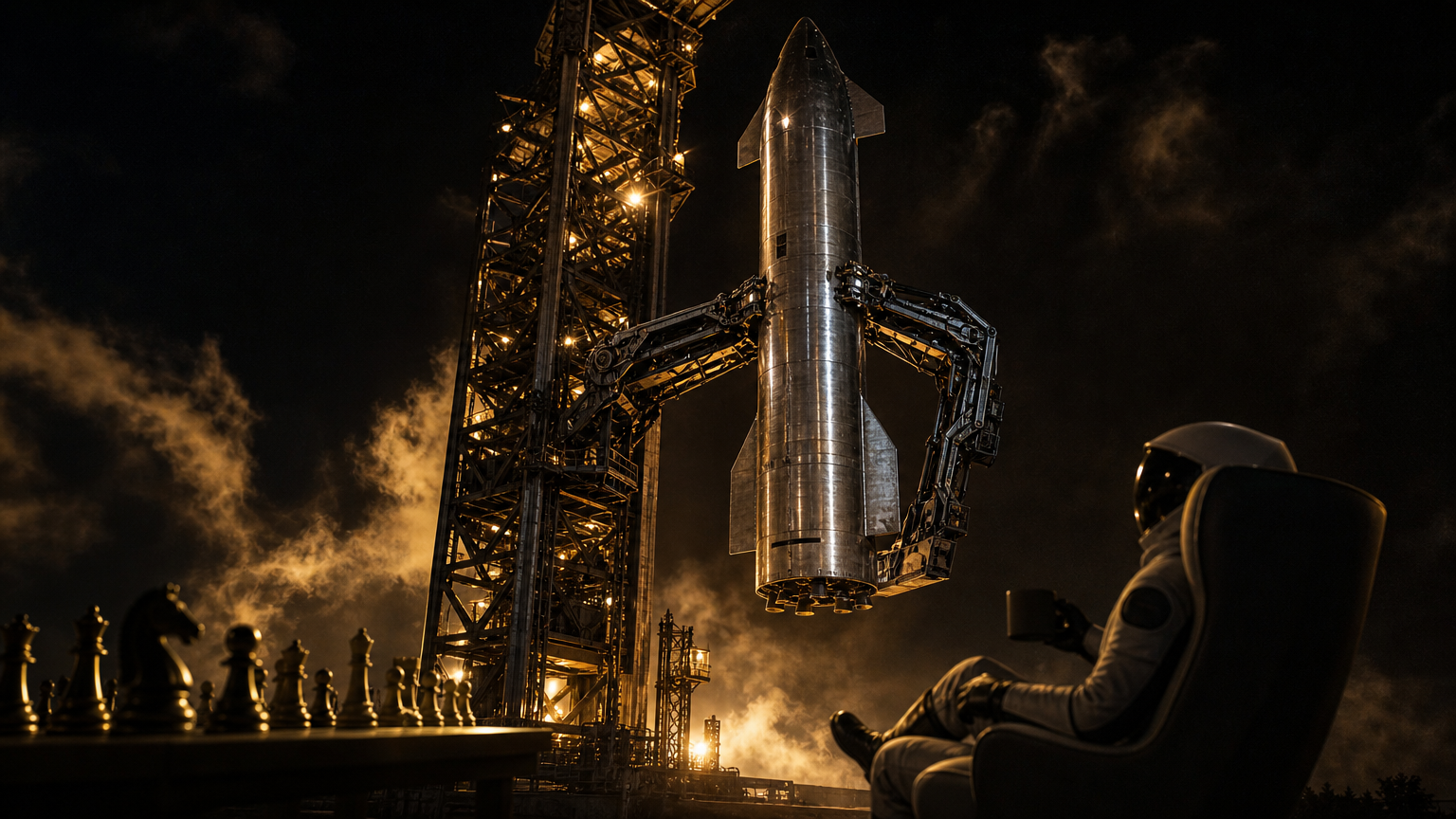
A catch that changes the recovery problem
SpaceX’s latest Starship flight produced the image the program has been working toward: the upper-stage vehicle, Ship 42, returning from space to Starbase, Texas, and being caught by the tower’s mechanical arms. The mission launched from Starbase on Friday, November 13, and the upper stage came back on Saturday, November 14, after a flight that lasted more than 20 hours . The catch was the first time SpaceX recovered the Starship upper stage this way, rather than ending the ship’s flight with an ocean landing or loss of the vehicle .
That distinction matters. Super Heavy booster catches had already shown that the tower-arm concept could work for the first stage. The upper stage is a different challenge: it must survive orbital flight, deorbit, atmospheric reentry, a final flip and a precision approach to the launch site before the “chopstick” arms can take the load. On Flight 15, SpaceX demonstrated that the ship could come back to the same launch complex and be captured instead of carrying landing legs or splashing down far from the pad .
The visual drama risks hiding the engineering point. This was not only a landing stunt; it was an experiment in how to make the most expensive part of a fully reusable launch system return to the ground in a form that can be inspected, serviced and, eventually, flown again. Tower capture could remove the need for heavy landing gear, keep the vehicle close to fueling and stacking infrastructure, and shorten the path from recovery to reflight. That is the economic logic behind the hardware.
What Flight 15 achieved
Flight 15 was not simply a catch attempt. The Starship upper stage, identified in reporting as Ship 42, reached orbit, deployed 26 Starlink V3 satellites and then returned for the tower catch in Texas . The fully stacked Starship system is about 407 feet tall, with Super Heavy forming the lower stage and the 171-foot Starship vehicle serving as the upper stage that flies in space .
Bank of America analysts described the catch as a major step toward a fully reusable orbital rocket, saying it filled a missing piece in Starship’s reusability development . The same analysis noted that the 22.5-hour mission tested multiple capabilities relevant to later Starship operations: commercial payload deployment, multiple orbits, deorbit burn, atmospheric reentry and recovery of the upper stage .
For Starlink, the payload number is not a footnote. Flight 15 carried 26 next-generation Starlink V3 satellites, which Proactive’s report said SpaceX compared to roughly 10 Falcon 9 V2 Mini launches in delivered capacity . If Starship can reliably carry larger batches and return hardware for reuse, the launch cost per satellite could fall over time. That is why the catch is strategically important even before it proves fast turnaround.
The miss: no double catch yet
The mission did not deliver the full scenario SpaceX wanted. The company also intended to recover the Super Heavy booster with the tower earlier in the flight, but that catch was called off after separation . The booster instead diverted to a water landing in the Gulf, while SpaceX said it was still investigating the root cause; reporting described the issue as appearing related to low fuel and an automated abort .
That caveat is important because the story is not “Starship is now fully reusable.” It is more precise to say SpaceX recovered the upper-stage ship by tower catch for the first time, while still failing to recover both major stages on the same flight. The Motley Fool summarized the investment-side significance bluntly: SpaceX got half the rocket home, but the lower half was not caught, and no caught ship has yet flown a second time .
The difference between a single spectacular catch and operational reuse is the difference between a prototype milestone and a transport system. A rocket can be reusable in design philosophy and still not yet reusable in practice at the cadence and cost SpaceX wants.
Why the tower matters
SpaceX’s tower-catch architecture is a bet that recovery infrastructure can do work that would otherwise be carried by the vehicle. Landing legs add mass, complexity and inspection points. Ocean recovery introduces saltwater, transport and refurbishment burdens. A catch at the launch site, by contrast, aims to put the vehicle directly back where it can be examined, serviced and restacked.
That is especially valuable for an upper stage. In most orbital launch systems, the upper stage is expended. It reaches orbit, performs its job and is discarded. Starship’s business case depends on changing that pattern. The upper stage must not only survive reentry but return accurately enough for the tower arms to catch it. Flight 15 showed that this part of the architecture is no longer only a drawing-board idea .
SpaceX reinforced the point two days later by posting onboard footage described as riding on Starship 42 during the final approach to catch . The company’s choice to release that view underlines how central the terminal approach is: the vehicle is not merely falling back; it is managing attitude, velocity and position against a fixed structure that has little tolerance for error .
Reuse is now the next proof point
The immediate question is not whether SpaceX can catch a Starship upper stage once. It is what condition Ship 42 is in, how much work is needed to prepare it for another flight, and whether the next missions can repeat the result. The Motley Fool reported that Elon Musk said the caught ship could probably fly again after a few weeks of refurbishment, while also noting that the booster still needs to be recovered on the same flight and that a caught ship has not yet reflown .
That is the hinge of the story. A few weeks of refurbishment would be impressive for a first recovered orbital ship, but it is not the same as airline-style operations. The long-term goal is not to catch a trophy; it is to make inspection, heat-shield work, engine servicing, propellant loading and restacking predictable enough that Starship can fly often. Until a caught ship flies again, the economic claim remains partly unproven.
Bank of America’s note pointed to the same sequence of next milestones: SpaceX still has to achieve a successful double catch and re-fly recovered hardware . Those two tests will say more about cost and cadence than the first catch alone.
A milestone, not the finish line
The fairest reading is that SpaceX has made a material advance in recovering both major stages at the launch site, but it has not yet closed the loop. Flight 15 showed that the upper stage can go to orbit, deploy payloads, come back through the atmosphere and be caught by the tower. It also showed that the full two-stage recovery system remains unfinished because Super Heavy did not return to the arms on the same mission .
That combination makes the catch both historic and incomplete. It reduces one of the largest uncertainties in Starship’s design, but it opens the next set of harder operational questions. Can Ship 42 or a successor fly again quickly? Can the booster and ship both be caught on one flight? Can the heat shield survive repeated entries with minimal work? Can SpaceX turn an engineering triumph into a repeatable launch service?
For now, the answer is that SpaceX has moved the Starship program from “can the ship be caught?” to “how fast can a caught ship fly again?” That is a real step forward. Even Tetris never dropped a piece this expensive.
Comments
Be the first to comment.