
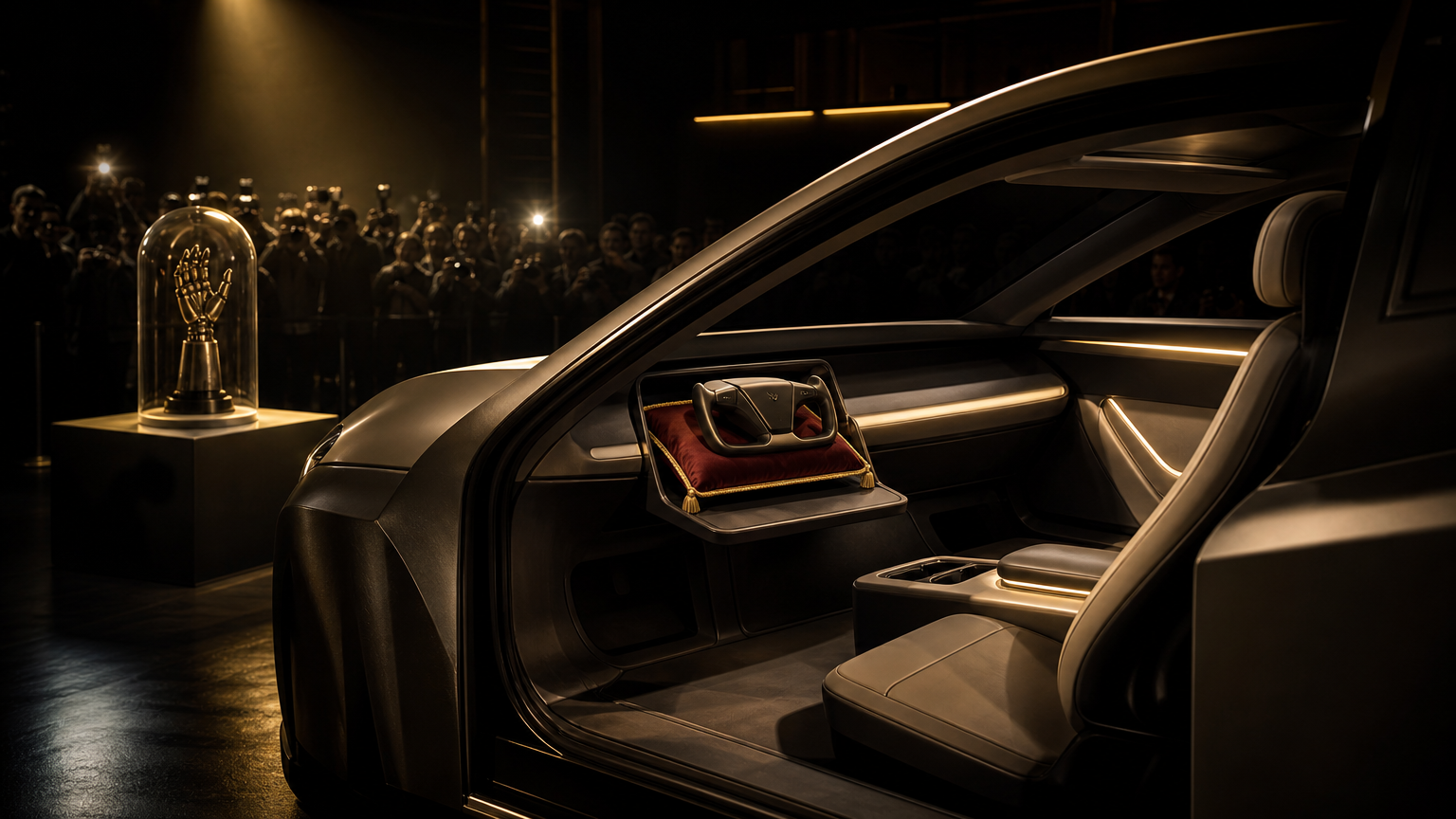
A Model Y with no fallback controls
Tesla’s next big robotaxi idea is not only the Cybercab. At The New York Times DealBook Summit on November 18, Elon Musk said Tesla plans “an autonomous version of Model Y” that would not have steering wheels or pedals and would be intended to transport groups of six or seven people . The comment matters because the Model Y is not a niche experiment in Tesla’s lineup; it is the company’s mass-market crossover platform, and adapting it for driverless use would put Tesla’s autonomy strategy closer to family transport than to a two-seat urban pod.
Musk framed the need around capacity. The Cybercab, as described in recent coverage of his remarks, seats two and is meant to handle most passenger miles, but Musk said larger groups still need an autonomous vehicle . Dow Jones also reported Musk’s argument that Tesla wants a fully autonomous ride-hailing vehicle capable of fitting a “whole family in the car,” with the planned Model Y variant serving that larger-party use case .
That distinction is important. A two-seat robotaxi can be optimized around commuting, airport runs or solo urban trips. A six- or seven-seat autonomous Model Y would ask a different question: can Tesla make driverless transport feel normal for families, groups and daily errands? If Tesla can use a familiar nameplate and manufacturing base, the idea becomes more than a futuristic demo. It becomes a proposal to remove the most familiar piece of the car cabin from one of the world’s most recognizable electric crossovers.
Plan, not product
The key word is still “plans.” Musk did not announce a launch date, production start, factory, price, sales model or regulatory pathway for the steering-wheel-free Model Y . Redfire’s report also emphasized that Musk gave no date, price or production details, and that Tesla had not published formal specifications for such a vehicle .
That leaves the project in a familiar Tesla zone: strategically significant, technically ambitious and not yet concrete. The absence of a steering wheel is not comparable to moving a screen or redesigning a dashboard. It removes the human fallback that today’s supervised systems still assume. A conventional Model Y can ask a driver to intervene. A Model Y with no pedals and no wheel cannot make that request in the same way. It must either operate inside a tightly controlled service model, satisfy regulators that it can meet safety standards without conventional controls, or be limited to environments where approvals are already in place.
Recent reporting underlined that uncertainty. Redfire noted that a wheel-less Model Y would face federal safety questions because U.S. vehicle rules still include standards built around manual controls and a human driver, and it said Musk did not specify whether Tesla would sell the vehicle to owners or run it only inside the Robotaxi fleet . In other words, the design is not only an engineering statement. It is a regulatory claim waiting to be proven.
Why Model Y changes the scale
Using the Model Y name changes the conversation. Cybercab is a dedicated robotaxi concept: it is expected to be judged as a new kind of vehicle. Model Y, by contrast, is already a mainstream family crossover. Musk’s plan suggests Tesla wants to stretch an existing, high-volume vehicle family into an autonomous people carrier rather than leave driverless transport to a separate pod.
That could help Tesla in three ways. First, the Model Y already has public recognition, so passengers may trust it faster than a strange new capsule. Second, Tesla has deep production experience with the platform, which could matter if the company wants to deploy robotaxis at scale. Third, a six- or seven-seat autonomous crossover would address a practical gap in ride-hailing: many trips involve luggage, children, friends or multiple adults, not just one passenger with a backpack.
But the same familiarity also raises the bar. People know what a Model Y is supposed to do. If Tesla removes the steering wheel, the company is effectively saying the vehicle’s software, sensors, compute and remote operations can replace not just a driver’s hands, but the whole backup logic of the cabin. That is a heavier promise than adding a new trim level.
The software update behind the hardware dream
The timing of the Model Y remarks coincided with Tesla’s wider software activity. Tesla Oracle reported that software update 2026.44.1 went into wide rollout after starting on November 17, bringing FSD v14.3 Lite to eligible Hardware 3 vehicles and FSD v14.3.13 to Hardware 4 vehicles . The same report said the update targets both older Hardware 3 cars and newer Hardware 4, showing that Tesla is still maintaining two autonomy-compute generations while trying to move the fleet forward .
That split is central to the steering-wheel story. A future vehicle without manual controls cannot be treated like a normal feature update. It depends on confidence that the onboard computer can perceive the road, plan safely and behave predictably across edge cases. Yet Tesla’s current customer fleet is not uniform. Hardware 3 owners are receiving a “Lite” branch, while Hardware 4 vehicles receive the fuller v14.3.13 build . This is the reality behind the slogan: autonomy is not one button pressed across one identical fleet, but a moving stack of chips, models, release branches and vehicle capabilities.
Not a Tesla App’s tracker listed 2026.44.1 with FSD 14.3.13, Charger Network View, Automatic Collision Evasion, Full Self-Driving (Supervised) and security improvements, with a release date of November 17, 2026 . The same tracker showed the update still in rollout rather than universally installed, which is typical for Tesla’s wave-based software distribution .
Charging becomes part of autonomy
The most visible feature in 2026.44.1 may not be a driving maneuver at all. Charger Network View groups charger pins on the map at normal zoom levels so drivers can see network coverage as they zoom out, and Tesla Oracle reported that additional third-party fast-charger locations were added . That matters because autonomy does not end when the car changes lanes. For a robotaxi or driverless family vehicle, routing, charging availability, charging price and stall selection are part of the operating system.
Not a Tesla App also reported hidden or preparatory changes in 2026.44.1, including work on charging price notifications, navigation preferences and Grok-related improvements . Some of those features may not yet be live, but their direction is clear: Tesla is tightening the relationship between driving software, route planning, energy management and user interaction.
That vertical integration is one of Tesla’s advantages. If the company wants cars to operate with less human intervention, it must make the car better at deciding where to go, where to charge, how to avoid bad routes and how to communicate what it is doing. A steering-wheel-free Model Y would need that whole stack to feel boringly reliable.
The real milestone is accountability
The headline is dramatic: Tesla removes the steering wheel. The real milestone will be whether Tesla can remove the driver’s responsibility as convincingly as it removes the hardware. Musk’s plan points to a larger autonomous Model Y that could serve families and groups, while software update 2026.44.1 shows Tesla still working through the fleet-level complexity of different computers, different FSD builds and a charging network that increasingly behaves like part of the car .
For now, the steering wheel has not disappeared from the Model Y you can order in the ordinary way. What has changed is the target. Tesla is no longer presenting no-wheel autonomy only as a separate Cybercab idea. Musk has now attached it to the company’s crossover icon. If regulators, safety data and manufacturing follow, the Model Y could become the bridge between today’s supervised electric car and tomorrow’s driverless family shuttle. If they do not, it remains another ambitious Tesla promise parked just beyond the next software update.
Comments
Be the first to comment.