
The headline check: yes, this is the Anthropic IPO question
The working headline is “Should You Really Buy Anthropic Stock at Its IPO?” The answer, after the first 24 hours of trading, is: only with caution, a small position, and a clear understanding that you are not buying “AI” in general. You are buying one expensive, fast-growing, compute-hungry AI model company whose public debut has already shown both the power of hype and the speed at which it can fade.
Anthropic announced on November 20, 2026 that its IPO had closed, including the full exercise of the underwriters’ option to buy additional shares, at a public offering price of $83 per Class A share . The company said the offering totaled 1.127 billion Class A shares, with about $93.5 billion in gross proceeds from the IPO itself and approximately $119.5 billion when including the concurrent private placement . Anthropic’s Class A stock began trading on Nasdaq on November 19 under the ticker ANT .
That makes the debate concrete. Investors are no longer speculating about whether Anthropic might list. They are deciding whether the post-IPO price still leaves room for an attractive return.
What buyers are really buying
At $83 a share, Anthropic’s IPO was already valued like a future infrastructure layer of the economy, not like a normal software company. The final SEC prospectus said Anthropic sold 956.35 million new Class A shares while selling stockholders sold 23.65 million shares; it also disclosed a concurrent $26 billion Class N private placement by strategic technology partners .
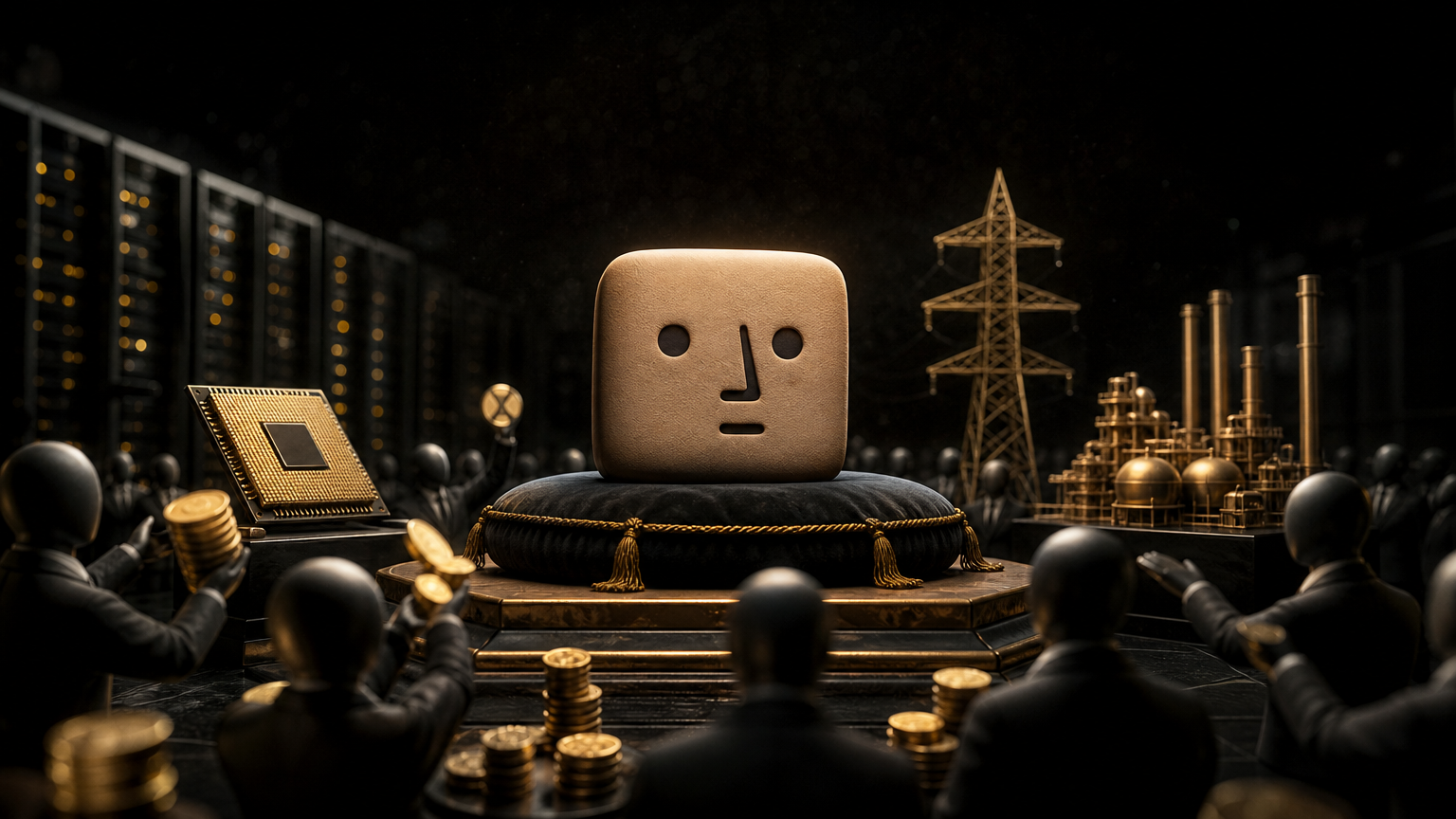
Those strategic buyers matter. Anthropic said AMD, Broadcom, Google, Micron, Microsoft, Nvidia and TSMC Partners bought Class N shares at the IPO price in the private placement . On one hand, that is a powerful signal: the companies that provide chips, cloud capacity and related infrastructure want to be tied to Anthropic’s growth. On the other hand, it reinforces the central concern. The AI value chain may reward suppliers of compute, semiconductors, networking, memory, electricity and cloud capacity before it rewards the model company using all of that capacity.
That was the core warning in the original investment debate: buying AI does not automatically mean buying the most visible AI lab. Many investors already own heavy AI exposure through the S&P 500, where a JPMorgan tally cited in the prior analysis found that 41 AI-linked companies accounted for nearly half the index’s value in early October . In plain English, your index fund may already be making a large AI bet for you.
The first trading day looked spectacular, then less so
The market debut delivered the kind of numbers bankers dream about. AP reported that Anthropic’s IPO raised $81 billion from the 980 million-share base offering at $83 a share, making it the biggest IPO on record and surpassing SpaceX’s June IPO proceeds of roughly $75 billion . The stock opened at $111.50, implying a valuation above $2 trillion at one point, before closing its first trading day at $97.17 .
That close was still more than 17% above the IPO price . But it also meant anyone buying at the open was quickly underwater by the closing bell. Axios reported that investment bankers earned about $550 million in underwriting fees and that the stock’s first-day trajectory — opening at $111.50 and closing at $97.17 — showed a strong debut but not a smooth one .
The next morning made the risk clearer. Axios reported on November 20 that Anthropic shares fell 11% in midmorning trading, dipping below $87 and moving much closer to the $83 IPO price . The same report noted that the selloff came as the Nasdaq was down about 2% and as sentiment around the AI trade had weakened . That is not a verdict on Anthropic’s technology. It is a reminder that the entry price matters.
The bullish case is not fantasy
The bullish case for Anthropic is serious. Claude is one of the leading frontier AI systems, the company has deep enterprise relationships, and its IPO has given it enormous financial flexibility. The company said it received about $91.6 billion of the IPO’s gross proceeds, before underwriting discounts, commissions and expenses, and closed the additional $26 billion private placement . That is a war chest large enough to fund compute, research, hiring, infrastructure and strategic expansion at a scale few companies can match.
Anthropic is also unusually positioned because it is not merely selling a consumer chatbot story. The stronger version of the investment thesis is that the company becomes an indispensable intelligence layer for enterprises, coding, research, scientific work and high-value automation. If customers build workflows around Claude, integrate it into core operations and trust it for hard problems, pricing power can survive even as simpler AI tasks become commoditized.
There is also a market-structure argument. MSCI announced that Anthropic A would be added to the Large Cap segment of the MSCI Global Standard Indexes effective December 1, 2026, after satisfying early-inclusion criteria based on its first-day closing market price . Index inclusion can create mechanical demand from funds that track those benchmarks, although it does not guarantee long-term outperformance.
The bearish case starts with valuation and control
The skeptical case is just as serious. First, valuation. A company can be strategically important and still be a bad stock if investors pay too much too soon. The first-day action already showed how quickly an attractive allocation at $83 can become a risky chase above $110.
Second, Anthropic’s governance is not plain vanilla. Its prospectus describes a novel structure: Anthropic is a Delaware public benefit corporation, has a Long-Term Benefit Trust connected to board oversight, and created a special Class F share held by a founder LLC that carries 50.1% of the total voting power on matters submitted to stockholders generally . That structure may align with Anthropic’s mission around responsible AI, but it also means ordinary Class A shareholders have limited influence.
Third, public investors are buying into a business whose cost base is tied to massive infrastructure needs. The prior analysis emphasized that Anthropic does not own most of the machines it depends on, while much of its spending is long-term and fixed; revenue, by contrast, can be usage-based and more cyclical . If customers optimize usage, switch models or negotiate prices down, the model maker can feel margin pressure while chip and cloud suppliers still collect revenue.
So should you buy?
For most investors, the answer is not “never.” It is “not as a reflex, not because of the ticker, and not with money you cannot afford to see swing hard.”
If you already own a broad U.S. equity index fund, you probably have substantial AI exposure through Microsoft, Alphabet, Amazon, Nvidia, Broadcom, utilities, data-center names and other AI-linked companies. The question is whether you need a concentrated, single-company AI model bet on top of that.
A reasonable framework is this: treat Anthropic as a speculative satellite position, not a portfolio core. If you believe the company will become a dominant enterprise AI platform, a small staged purchase may be defensible. But buying aggressively after a historic IPO pop assumes that Anthropic will not only grow explosively, but also capture enough economics to justify a valuation already measured in the trillions.
The cleanest conclusion is that Anthropic may become one of the defining companies of the AI era, yet the IPO is not automatically the best moment to buy it. The smarter move is to separate the company from the stock. The company can be exceptional while the stock is merely expensive. At this stage, discipline beats excitement.
Comments
Be the first to comment.