
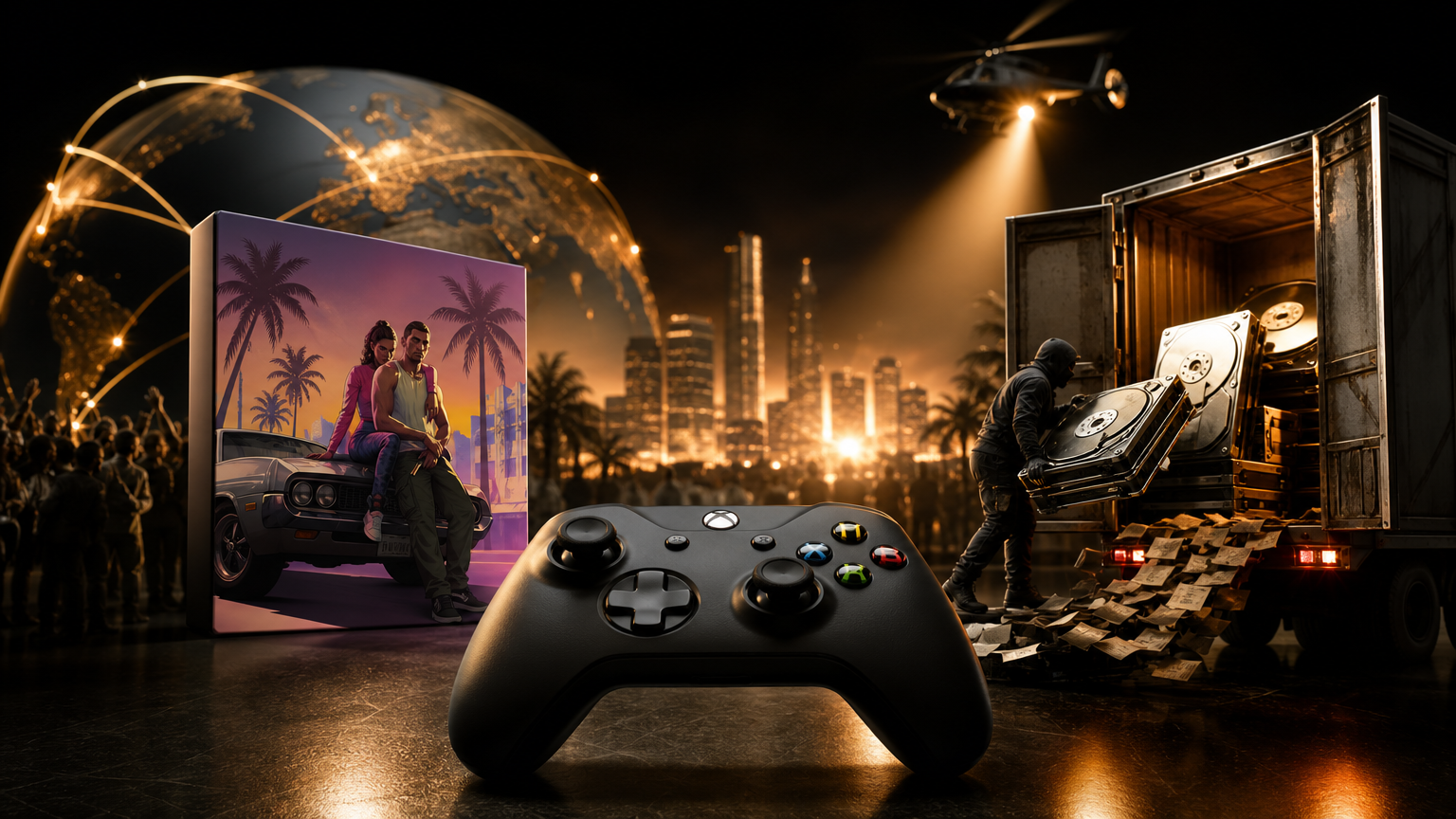
A launch measured like a media earthquake
Grand Theft Auto VI did not land like a normal product release. Rockstar Games announced on November 19 that the game was available for PlayStation 5 and Xbox Series X|S, framing the arrival as the culmination of its biggest creative ambition and promoting it with a sweep of glowing reviews from major outlets . The company also reminded investors and players of the franchise’s industrial weight: Grand Theft Auto V alone has sold in nearly 235 million units, while the wider Grand Theft Auto series has sold nearly 480 million units .
That context matters because GTA 6 is being judged against the entire entertainment business, not just the console chart. Moneycontrol reported on launch day that the game ended a 13-year wait, returned players to Vice City and the Florida-inspired state of Leonida, and was widely billed as one of the most anticipated releases in video game history . The same report cited Sensor Tower estimates of more than 19 million pre-orders and about $1.84 billion in revenue, while also noting Newzoo projections that global launch-week sales could land between $3.3 billion and $5.2 billion .
Those figures remain estimates, not official Rockstar or Take-Two totals. Still, they explain why GTA 6 is being discussed less as a game and more as a stress test for premium entertainment. In an attention market split among TikTok, streaming platforms, creator channels, sports, cinema, music and live service games, Rockstar has produced a rare object that many people planned their week around. The old question was whether video games could compete with film. GTA 6 makes the sharper question unavoidable: how many other entertainment forms can still compete with a game of this scale?
Xbox had a “GTA day,” but not only a GTA day
The scale was especially visible on Xbox. Pure Xbox’s launch-day roundup opened with “Happy GTA 6 Day” and noted that GTA 6 was playable on Xbox consoles after a 13-year wait . Yet the same roundup also listed four other Xbox releases arriving on November 19: The Binding of Isaac: Repentance+ Online, An Eggcellent Sorting Game, Kitsune Zero and Time Machine: Hidden Objects .
That detail is easy to miss, but it reveals the gravitational distortion created by Rockstar’s release. Other games still launched. Stores still refreshed. The industry did not stop. But every competing release had to exist in the shadow of one title that players, retailers, platform holders and media outlets treated as the day’s central fact. For smaller games, November 19 was not just a date on the calendar; it was weather.
The business lesson is uncomfortable. Premium blockbusters are riskier and more expensive than ever, yet GTA 6 shows that a sufficiently powerful brand can still command synchronized global attention. Its launch suggests that the single-purchase blockbuster has not been erased by subscriptions, free-to-play economies or short-form video. It has become rarer, more expensive and more dependent on a tiny number of franchises that can turn anticipation into infrastructure demand.
A leak at the worst possible moment
Rockstar’s triumph, however, came with an immediate security problem. Video Games Chronicle reported on November 19 that Cyberleek, a hacker group associated with earlier GTA 6 leaks, claimed to have released a development build of the game through torrent links on its site . According to VGC, the listing was labeled as an Xbox build from November 2026, while screenshots circulating online appeared to show files from a development build .
The claim came with a major caveat: VGC reported that the executable file was missing, meaning people with the files could not simply launch and play the build . Cyberleek also claimed it could release the missing executable later, tying an earlier release to a cryptocurrency token target, according to the same report . That combination of alleged stolen development material, fan curiosity and crypto incentives turns the leak into more than a piracy story. It is a reminder that the bigger the cultural event, the larger the attack surface around it.
The timing was brutal. A normal post-launch conversation would focus on reviews, sales, fan discoveries, technical performance and the first wave of shared stories from Leonida. Instead, Rockstar also had to absorb a narrative about production material escaping into the wild just as the finished game reached players. Even if the alleged build proves incomplete, unplayable or exaggerated, the episode exposes how vulnerable prestige games can be once years of production assets, platform builds and distributed development pipelines converge before release.
The labor paradox behind the blockbuster
The second complication is more structural. Nestor Uriarte, an animation programmer at Rockstar Games, wrote in The Guardian on November 18 that Rockstar employees were voting on union recognition after the release of Grand Theft Auto VI . He argued that the team had helped make “the world’s biggest video game” and should have working conditions to match that achievement .
Uriarte’s essay is important because it cuts against the simple victory narrative. He wrote that there had been no indication layoffs were coming, but that workers still found it hard not to worry after seeing studios across the sector cut jobs . He also connected those fears to broader issues: overtime before launch, past allegations of crunch culture, the need for paid hours, the rise of AI and the desire for workers to have a formal voice in shaping studio conditions .
That is the central paradox of GTA 6. A project can be acclaimed, commercially dominant and culturally unavoidable, yet still leave some of its makers uncertain about what comes after launch. The blockbuster model creates enormous peaks of labor demand: writers, programmers, animators, artists, designers, audio teams, localization specialists, QA testers, producers and support staff push for years toward one immovable date. Once that date passes, the industry often asks whether the same workforce is still needed at the same size.
GTA 6 therefore tests more than consumer appetite. It tests whether a modern mega-studio can convert a historic launch into durable employment, healthier production norms and shared upside for the people who built the machine. If success at this level cannot ease workers’ anxiety, then the issue is not performance. It is the design of the business model.
The new entertainment benchmark
On launch day, GTA 6 looked like the rare premium release still capable of bending the broader culture. It drew estimated billion-dollar demand before full official sales reporting, crowded out competing attention, energized console ecosystems and triggered conversations far beyond gaming media . It also arrived with the vulnerabilities that now accompany cultural dominance: leaks, platform pressure, labor questions and the financial expectations of a publicly traded parent company.
That is why “GTA 6 redraws entertainment scale” is more than a headline. The game is a benchmark for what a blockbuster can still do in 2026. It shows that audiences will still gather around a single paid release when the brand, craft and anticipation are large enough. It also shows that scale does not solve everything. The same launch that proves the strength of premium games also exposes the fragility of the systems used to build them.
Rockstar has delivered the event. Now the industry has to decide what the event proves: that bigger is still better, or that bigger has become a load test no one else can safely run.
Comments
Be the first to comment.