
The Apple playbook, without Apple
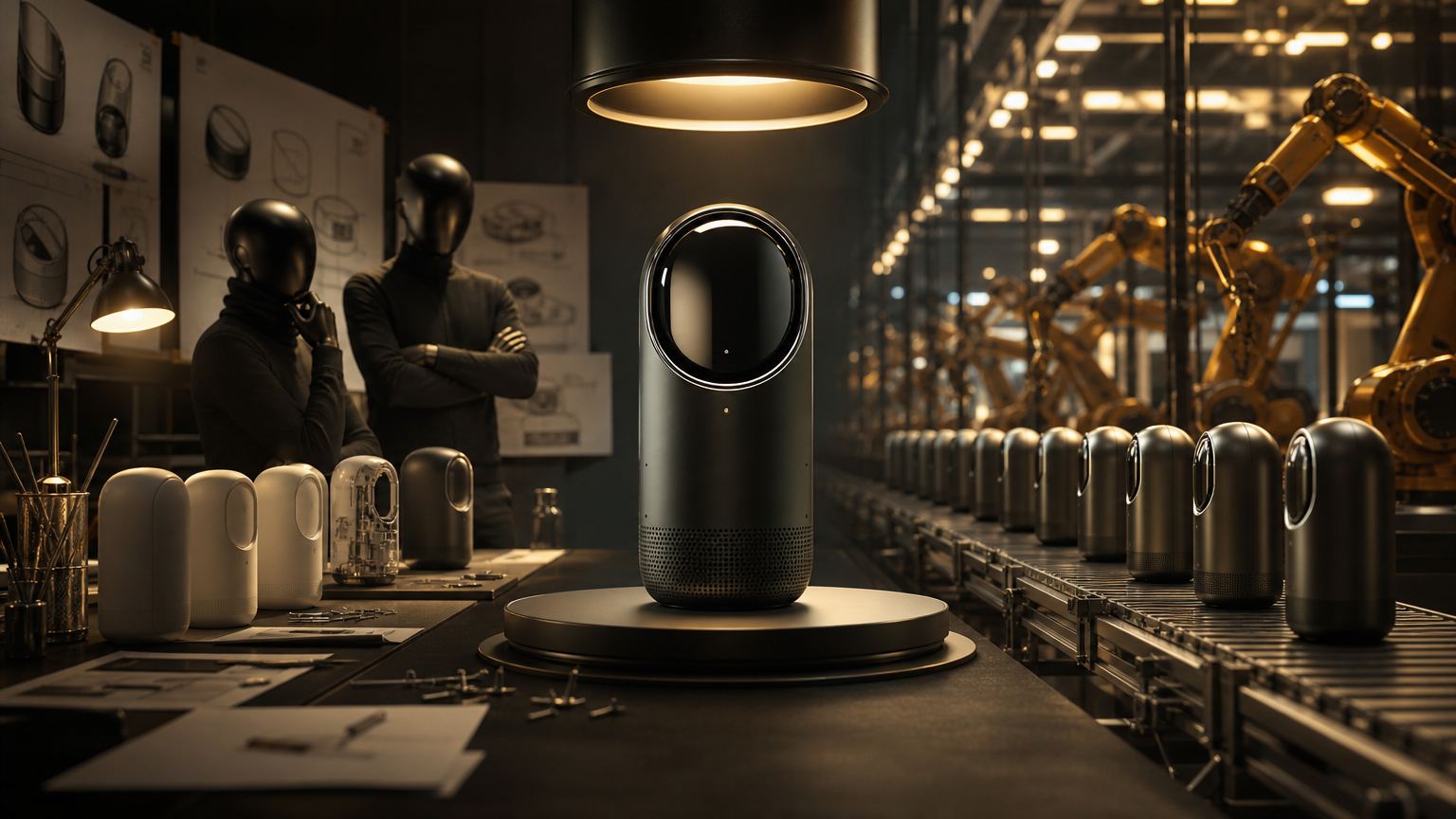
OpenAI’s first proprietary consumer hardware project now looks less like a side experiment and more like a deliberate attempt to import Apple’s device-making culture. A fresh 36Kr/Lei Tech report says the design and R&D effort is being led by a team of Apple veterans, while production is being routed through companies already embedded in Apple’s manufacturing universe . The same report frames the arrangement as a system in which Jony Ive and LoveFrom shape the design direction, former Apple hardware figures handle product implementation, OpenAI’s own software and model teams define the interaction layer, and Chinese manufacturers translate the idea into mass-producible hardware .
That division of labor matters. OpenAI does not merely need a shell around ChatGPT. It needs a device that can make a large language model feel ambient, useful, safe and reliable without the familiar crutch of a smartphone screen. The current reporting describes the first product not as a phone, but as a screen-free AI device expected to reach consumers in 2027, with Luxshare Precision described as a core manufacturer . Separately, Daily Economic News reported that OpenAI’s first edge-side AI hardware product could begin shipping around the end of 2026, with multiple Chinese suppliers involved and Luxshare Precision said to be handling whole-device manufacturing and key components .
The two timelines are not perfectly identical, and neither OpenAI nor the named suppliers have publicly launched the product. But together they suggest that the project has moved beyond concept art and into the less glamorous phase where tooling, component allocation, manufacturing responsibility and launch windows start to matter.
The team behind the device
The hardware team’s Apple lineage is central to the story. According to the 36Kr/Lei Tech account, OpenAI’s hardware effort grew out of the 2025 acquisition of io Products, the startup co-founded by Jony Ive and former Apple colleagues including Tang Tan, Evans Hankey and Scott Cannon . The report says OpenAI completed the team integration in July 2025, with the io group becoming part of OpenAI and continuing to work on hardware R&D and product execution, while Ive and LoveFrom remained deeply involved in design and creative direction .
The individual backgrounds show why OpenAI sought this group. Tang Tan spent roughly 25 years at Apple and worked on iPhone and Apple Watch product design; the report says he now serves as OpenAI’s chief hardware officer and is one of the key technical leaders of the project . Evans Hankey, who led Apple industrial design after Ive’s departure, is described as continuing to oversee industrial design responsibilities after the io team’s integration . Scott Cannon is described as more focused on manufacturing and supply chain work for OpenAI’s device project .
This is an unusually direct transfer of consumer electronics know-how into an AI lab. Software companies can iterate after release; a physical device forces earlier decisions. Industrial design, acoustic architecture, thermal constraints, camera placement, sensor privacy, battery life, assembly yield and repair policy all become product questions. OpenAI’s bet appears to be that model quality alone is not enough; the interface, body and supply chain must be designed together.
What the first product appears to be
Current reporting distinguishes two tracks: a first AI device and a possible future phone. The first hardware product is described as a screen-free device, sometimes compared in earlier reports to a “donut” or puck-like object, with microphones, speakers, a camera and environmental sensors, primarily using voice interaction and context awareness . IT Home, citing Daily Economic News and prior reporting, said the form factor has not been officially announced and that rumored pricing around 300 to 400 dollars remains unconfirmed .
That uncertainty is important. A screenless AI device has a seductive promise: no app grid, no notifications, no typing, no visual clutter. But it also creates a trust problem. If the device can hear, see and interpret its surroundings, users need clear ways to know what it is sensing, when it is recording, what it is sending to the cloud and how it can be stopped. The 36Kr/Lei Tech report makes the same strategic point: without a screen, users cannot check what information the device is gathering or what action it is taking as easily as they can on a phone .
This is where OpenAI’s software and model teams become as important as the hardware veterans. The physical device may be Apple-like in discipline, but the product will rise or fall on whether the AI layer can make ambient computing feel controllable rather than eerie.
The phone rumor is a second front
The week’s other supply-chain development concerns a possible OpenAI phone. Securities Times reported on November 19 that FIH Mobile, a Foxconn subsidiary listed in Hong Kong, had obtained orders for OpenAI’s phone project and would participate in whole-device assembly; the same report said the product design, order scale and mass-production arrangements were still unknown . Zaobao, summarizing Chinese supply-chain reports, added that OpenAI’s first phone could appear as early as the end of 2027 or in 2028, and that Apple suppliers including Luxshare Precision, Lingyi iTech and AAC Technologies could participate in component supply .
English-language coverage echoed the same caution. Digital Trends noted that the FIH Mobile report relies on unnamed supply-chain sources and that OpenAI has not commented on smartphone plans . Gizmochina likewise reported that neither OpenAI nor Foxconn had confirmed the order, and that no design, price or launch date had been shown publicly .
The phone story should therefore be read as a signal, not a product launch. It suggests that OpenAI is exploring more than one route into user hardware: a dedicated AI companion first, and perhaps a handset later. It also suggests that OpenAI is willing to work inside the same supplier web that powers the iPhone, even if the eventual ambition is to challenge the phone’s role as the dominant personal computing interface.
Why Apple’s supply chain matters
The most striking part of the story is not that OpenAI wants a gadget. Many AI companies want gadgets. The striking part is the degree to which OpenAI appears to be borrowing both people and process from Apple’s ecosystem. 36Kr/Lei Tech describes OpenAI’s first hardware system as “strong Apple style,” with former Apple talent setting the design and R&D direction and long-time Apple suppliers handling manufacturing .
That gives OpenAI advantages. Mature suppliers know how to scale, how to control tolerances, how to manage component risk and how to build consumer devices in volume. A company trying to ship its first proprietary hardware product would rather learn from those systems than reinvent them.
It also creates new risks. Inventory cannot be patched over the air. A bad hinge, weak battery, flawed microphone array or privacy backlash can turn into recalls, write-downs or reputational damage. Distribution, returns, warranty service and retail education are not native strengths for a software lab. If OpenAI sells a screen-free AI device, it will need to explain not only what the product does, but why it deserves a permanent place in a home, bag or pocket.
The real strategic question
OpenAI’s hardware plan is best understood as a battle for the interface. On phones today, ChatGPT is often another app, widget or voice option inside operating systems controlled by Apple and Google. A proprietary device would give OpenAI more control over microphones, sensors, wake behavior, personalization, privacy prompts and the moment-to-moment relationship between model and user.
The current supply-chain reports do not prove that OpenAI has solved the category problem. They do show that the company is acting as if AI needs its own hardware language. By pairing Apple-trained designers and operators with Apple-adjacent manufacturers, OpenAI is trying to compress decades of consumer electronics learning into its first serious device cycle. The challenge is that atoms are far less forgiving than model updates. If the product works, OpenAI gains a new front door to its models. If it misfires, the company will discover that hardware has no hotfix button.
Comments
Be the first to comment.