
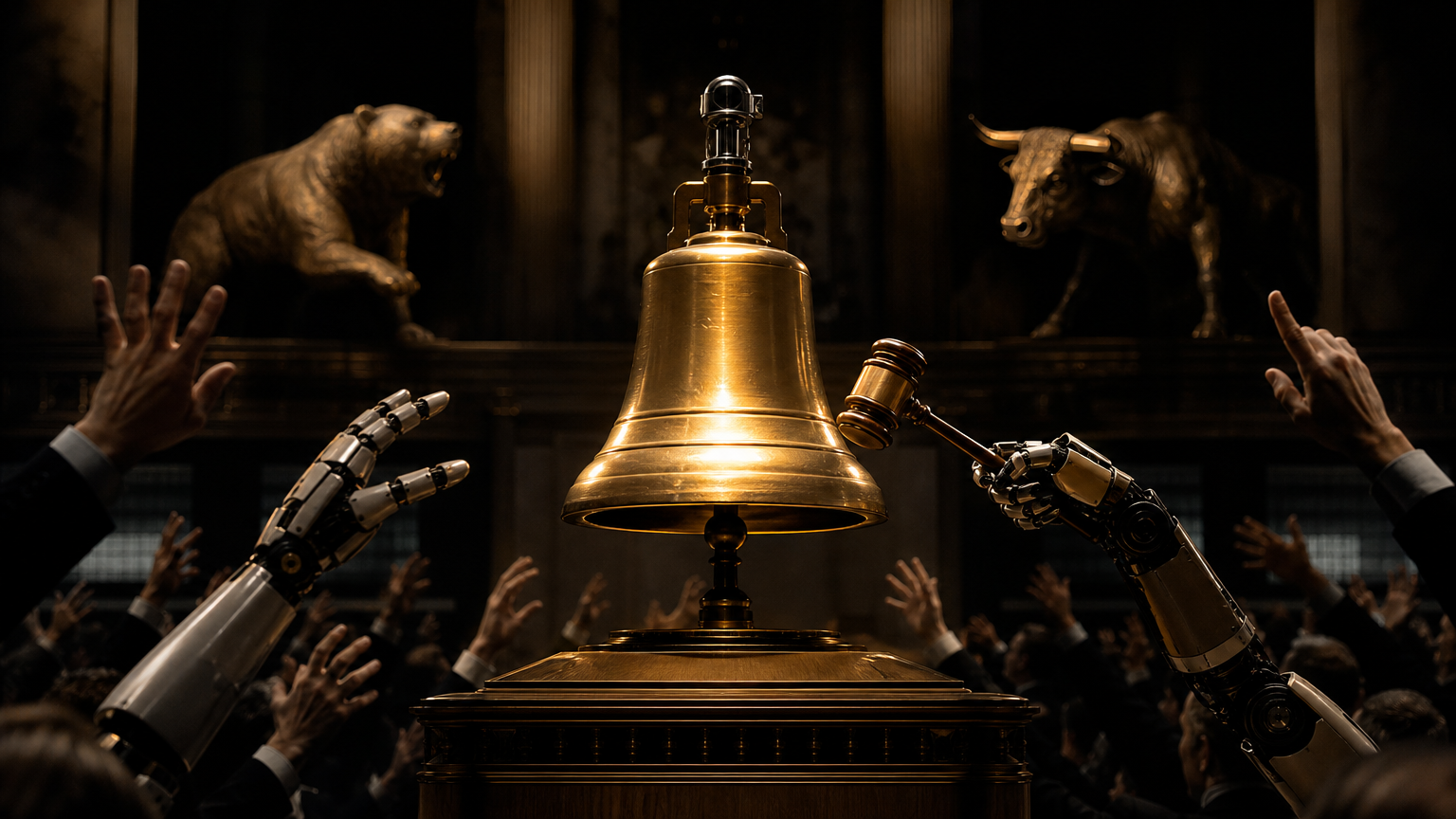
A safety company becomes a market weapon
Anthropic’s Wall Street debut has shifted the AI industry from private power struggle to public-market referendum. The company priced its initial public offering at $83 per share, above the earlier $70-to-$78 range, and expanded the deal to 980 million Class A shares, with 956,351,354 shares sold by Anthropic and 23,648,646 sold by existing stockholders . The shares were set to trade on the Nasdaq Global Select Market on November 19, 2026, under the ticker ANT, with the offering expected to close on November 20 .
That pricing transformed a story about an AI lab into a story about control. Anthropic did not merely list; it raised about $81 billion, making the offering the largest IPO on record according to AP’s count, ahead of SpaceX’s roughly $75 billion June listing . At the IPO price, Anthropic’s initial valuation was about $1.5 trillion, and its first trade at $111.50 briefly pushed the implied market value above $2 trillion . The company closed its first session still sharply above the offer price, but the intraday retreat showed how fragile AI enthusiasm has become .
Beating OpenAI to the public markets
The strategic point is simple: Anthropic reached public investors before OpenAI. AP framed that timing as a possible advantage if investors later decide they already have enough exposure to the AI sector and are less willing to buy into the next major AI listing . That matters because OpenAI remains Anthropic’s defining rival, both commercially and philosophically.
Anthropic’s own prospectus names OpenAI and Google as primary competitors in frontier models for developers and enterprises . It says those competitors fight for customers, talent, compute and strategic partnerships . In other words, the “war for control of AI” is not a slogan. It is written into the risk factors: the companies are competing for the scarce ingredients of frontier AI.
The timing is also uncomfortable for Anthropic’s carefully cultivated identity. Dario Amodei and several co-founders left OpenAI to build a lab more visibly centered on safety. Yet the public-company version of Anthropic now has the same pressure every listed giant faces: justify its valuation, defend growth, and keep investors convinced that massive AI spending can generate durable returns.
Nvidia is not just a supplier
Nvidia sits at the center of this contest because compute is the new industrial base of AI. Anthropic’s final prospectus says Google, Nvidia, AMD, Broadcom, Micron, Microsoft and TSMC Partners agreed to buy an aggregate $26 billion of Class N common stock in a concurrent private placement at the IPO price . It also specifies that Google and Nvidia each agreed to purchase about 120.5 million Class N shares for roughly $10 billion apiece .
That makes Nvidia more than a chip vendor. It is a financial backer, infrastructure gatekeeper and market bellwether. Nvidia reported third-quarter fiscal 2027 revenue of $115.8 billion, up 103% from a year earlier, with data center revenue of $107.6 billion, up 110% year over year . Those numbers show why the AI economy remains tied to the chipmaker’s execution, even as model companies like Anthropic seek the public-market spotlight.
But Nvidia’s dominance also creates systemic risk. Reuters reported that Anthropic’s debut was viewed as a key test of investor confidence after a bruising period for AI stocks, with concerns focused on data-center expansion, borrowing costs and the departure of Nvidia CEO Jensen Huang . Chipmakers including Nvidia, AMD, Broadcom, Marvell and Micron were lower in Friday premarket trading after Anthropic’s first-day pop faded .
The IPO did not rescue the AI trade
If investors expected Anthropic to restart the AI rally, the first day gave them a mixed answer. Reuters reported that U.S. stocks slumped on November 19 after Anthropic’s supersized IPO failed to revive faded AI enthusiasm . Anthropic opened at $111.50 and rose as high as $115, but pared the gain to about 17.1% by the close . All three major U.S. stock indexes fell at least 2%, and the S&P 500 logged a sixth straight losing session .
That contrast is important. Anthropic succeeded as an IPO, but failed as a market sedative. It proved investors were willing to buy the first pure-play frontier AI lab at enormous scale, yet it did not eliminate doubts about valuation, capital intensity or the circular financing of the AI buildout. The company’s offering created a new public benchmark, but it also gave investors a live price against which to revalue OpenAI, Nvidia, cloud providers and data-center suppliers.
Safety, governance and power
The IPO also intensifies the debate around Dario Amodei. He has long argued that powerful AI systems require tighter controls and serious regulation, but critics see a contradiction: warnings about catastrophic risk can also strengthen the market position of the few companies rich enough to meet the proposed rules. Anthropic’s public listing brings that accusation into sharper focus. If safety becomes the language of regulation, and regulation raises the cost of entry, the best-funded labs may become even harder to challenge.
Governance is central to the controversy. AP reported that Anthropic’s IPO structure gives Dario Amodei, Daniela Amodei and five other co-founders a special class of stock with 50.1% of the voting power of all outstanding shares . The final prospectus likewise says the Class F common stock is entitled to voting power equal to 50.1% of the total voting power, allowing the Founder LLC to determine the outcome of matters submitted to stockholders generally .
That structure may reassure those who want founders to preserve a long-term safety mission. It may worry investors who prefer ordinary shareholder accountability. Either way, it confirms that Anthropic’s IPO is not a conventional transfer of control to the public market. Public investors can buy economic exposure; founders retain decisive voting power.
OpenAI raises the capability pressure
OpenAI is not standing still while Anthropic absorbs Wall Street’s attention. Axios reported that OpenAI disclosed this week that Astra 6.2 is its first publicly released model to reach the “High” threshold for AI self-improvement . Axios also noted that Anthropic’s own data showed Claude moving from leading fewer than 1% of the company’s AI research tasks in February to more than a quarter by August, with humans still supervising .
That is the deeper context for the IPO. The market is not only pricing today’s subscription revenue or enterprise contracts. It is trying to price recursive acceleration: models helping build better models, labs compressing research cycles, and compute providers selling the hardware behind that acceleration. The OpenAI-Anthropic rivalry therefore pushes in two directions at once: toward stronger safety claims and toward faster product cycles.
The contradiction is now public
Anthropic has entered public markets as the first major AI lab to do so, but it has not escaped the contradictions that made it famous. It asks investors to believe in explosive growth while asking policymakers and the public to take AI risk seriously. It sells a safety-first identity while racing OpenAI, Google and other frontier labs for customers, talent and compute. It warns about concentration of power while creating a founder-controlled voting structure.
AP reported that Anthropic’s IPO has also concentrated extraordinary wealth among insiders, with Dario Amodei’s net worth estimated at $22.7 billion and Daniela Amodei’s at $22.8 billion by Thursday afternoon . That wealth is not incidental. It is part of the new AI order: the people who frame the risks, build the models, buy the chips and write the governance rules are increasingly the same people.
The IPO does not settle the war for control of AI. It opens a new front. OpenAI still represents the product and platform challenge. Nvidia still controls much of the compute bottleneck. Anthropic now has public capital, public scrutiny and founder control. The result is a market that can finally price one of the frontier labs in real time, but still cannot answer the bigger question: whether the companies racing to control AI can also be trusted to control themselves.
Comments
Be the first to comment.