
The button disappears, the assistant changes jobs
Google’s latest redesign of its desktop homepage looks small until you remember what the homepage represents. The familiar “Google Search” button is being replaced by Gemini-related controls, while a collapsible sidebar gives signed-in users a way to return to recent AI Mode searches and conversations . Ars Technica reported on November 20 that the redesign was moving from test to rollout, with shortcuts under the search bar for image generation, file analysis and brainstorming with Gemini . 9to5Google, citing Google Search VP Robby Stein’s post on X, described the change as a global desktop rollout that pulls Gemini chat history and tasks into the Search homepage .
That is more than a cosmetic edit. Google’s homepage has long been one of the most disciplined interfaces on the internet: a logo, a field, and a promise that typing a query would open the web. The new layout keeps ordinary search available, but it gives prime visual space to AI workflows before the user even reaches a results page . Android Authority noted that pressing Enter or choosing an autocomplete suggestion should still lead to regular Search results unless the user intentionally chooses AI Mode . In other words, Google is not deleting Search; it is changing the first cue users see when they arrive.
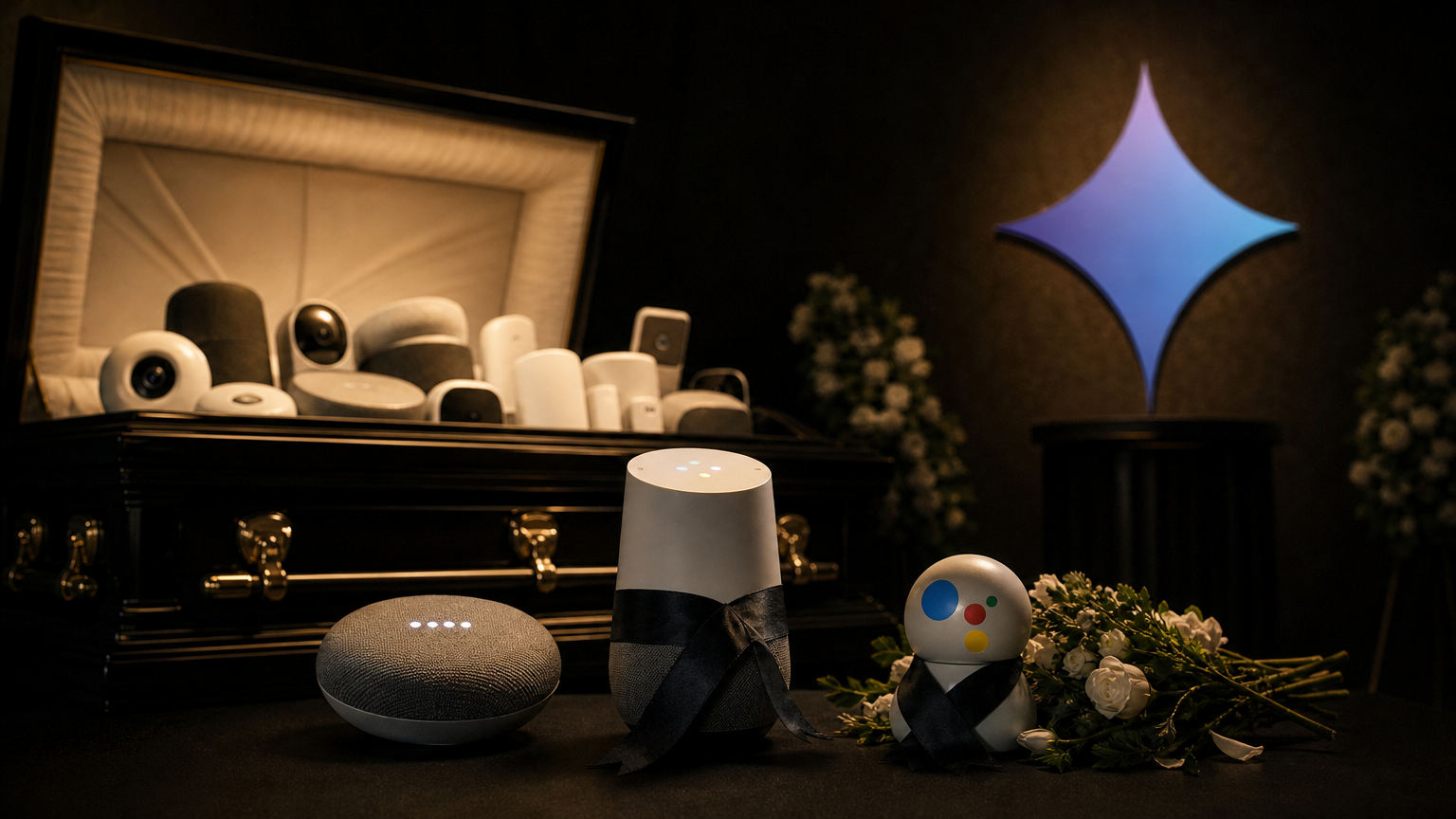
The timing matters because this homepage update landed alongside another, more consequential sunset. Google announced on November 20 that it will retire the Nest app on January 25, 2027, move Nest device management into Google Home, and replace Google Assistant on speakers and smart displays with Gemini for Home on August 2, 2027 . The Verge summarized the move as a shutdown of the Nest app in favor of Google Home and a retirement of Assistant on Google smart-home devices . Together, the two developments show the same pattern in two different places: Search is being redesigned around AI interaction, and the smart home is being reorganized around Gemini.
What changes on the Search homepage
The homepage redesign gives Google a new AI front door. According to Ars Technica, the old dedicated search button is gone, while “I’m Feeling Lucky” remains and the new AI buttons sit below the search bar . The new left-side panel is meant to help users resume recent AI Mode threads, a behavior closer to chat history than to classic web search . Stein’s explanation, quoted by 9to5Google, was that people increasingly bring questions to Search that are not “one and done,” and that testing showed the sidebar helped them continue exploring .
That phrase is the strategic tell. A classic search query is a transaction: type, click, leave. A Gemini-style interaction is a session: ask, refine, upload, generate, compare, return. By making the homepage remember and surface prior AI work, Google is nudging Search toward continuity. The immediate user benefit is convenience, especially for research, planning and creative tasks. The trade-off is that Google’s own AI layer becomes a more persistent intermediary between the user and the open web.
The company appears to be proceeding carefully. Android Authority reported that the core search path remains intact when users type a query and hit Enter, meaning the redesign does not automatically force every request into AI Mode . But visual hierarchy is policy by other means. Putting image generation, file analysis and Gemini brainstorming where a plain Search button used to sit tells users what Google wants them to try next . Even if the traditional results page remains one keystroke away, the homepage now frames conversational AI as a first-class route to information.
What changes at home
The smart-home side is less subtle because it comes with end dates. Google’s community announcement says the Nest app will be retired on January 25, 2027, across Android, iOS and the web, and Nest devices will move into the Google Home app and home.google.com . The same announcement says Google Assistant on speakers and smart displays will be retired on August 2, 2027, when Gemini for Home becomes the replacement voice assistant . Google says devices supported today will continue to work with the updated experiences .
For customers, the immediate checklist is practical. Google says Nest thermostats, cameras, doorbells, Nest Protect, and Nest x Yale Lock controls are moving into Google Home, with existing schedules and settings transferring automatically . It also says users should download custom video clips from home.nest.com before January 25, 2027, because manually saved clips will not transfer with video history . First-generation Nest Aware subscriptions are slated to move to Google Home Premium, with Google promising continued coverage and more details by email closer to the transfer date .
Assistant’s retirement is the more symbolic change. Google frames Gemini for Home as a more natural voice layer that can handle pauses, mid-sentence changes and follow-up context better than command-style Assistant interactions . Android Authority reported the August 2, 2027 cutoff as the point when Gemini fully replaces Assistant on Google home hardware . Droid Life described the result bluntly: Nest app users will need Google Home, and Assistant users on remaining speakers and displays will be moved to Gemini for Home .
A single migration story
These changes should not be read as two unrelated product updates. In Search, Google is reworking the internet’s front door around Gemini. In the home, it is consolidating older Nest and Assistant surfaces into Google Home and Gemini for Home. The connective tissue is not just branding; it is control of the workflow.
For Google, consolidation has obvious advantages. One app is easier to secure, update and monetize than two overlapping smart-home control layers. One AI interface can be developed across Search, mobile, speakers, displays and web surfaces more efficiently than maintaining a legacy voice assistant and a separate chatbot identity. Google’s official explanation emphasizes security, newer infrastructure, privacy controls and faster rollout of protections for Nest users . Those are credible reasons, especially for devices that manage cameras, locks, thermostats and alarms.
For users, the picture is more complicated. A smart speaker can be updated overnight, but the appliance ecosystem around it ages slowly. Cameras are mounted, thermostats are wired, locks are installed, routines are memorized by households. When a platform owner retires the interface that people built habits around, the hardware may remain “supported,” yet the lived experience can still change. The most sensitive issues are not only whether a device turns on, but whether routines survive, whether family members understand the new app, whether older saved media is preserved, and whether the new assistant behaves predictably.
The search-page redesign raises a parallel trust question. Google says users can still run normal searches, and reports so far support that . But the design change pushes users toward generated and conversational answers, which affects publishers, advertisers and people who still prefer link-by-link exploration. The loss of a button is not the loss of Search; it is a signal that Google increasingly sees Search as a place where AI does the steering.
The AI-first patch cycle begins
The most important thing about this week’s news is not that Google changed a button or retired an app. It is that both changes move long-standing user habits into Gemini-shaped containers. Search habits built over decades are being reframed around AI Mode. Smart-home habits built through Nest and Assistant are being pushed into Google Home and Gemini for Home.
That makes the transition both ambitious and risky. If Gemini for Home is faster, more natural and reliable, many users may accept the forced migration as overdue cleanup. If Google Home misses beloved Nest features, or if Gemini misreads household commands, the retirement of Assistant will feel less like modernization and more like platform churn. In Search, if the Gemini sidebar helps users resume complex work, it may become invisible infrastructure. If it feels like AI clutter on a historically clean page, it will remind users how much control Google has over the web’s front door.
Either way, the direction is now unmistakable. Google is not simply adding Gemini to existing products. It is using Gemini as the replacement architecture for how people search, ask, control and return. Assistant is being retired, the Nest app is being folded away, and even the homepage button that once embodied classic Google is giving way to an AI workflow. The AI-first patch cycle has reached the front page and the living room at the same time.
Comments
Be the first to comment.